Did you know there’s a fun idea about how numbers were designed?
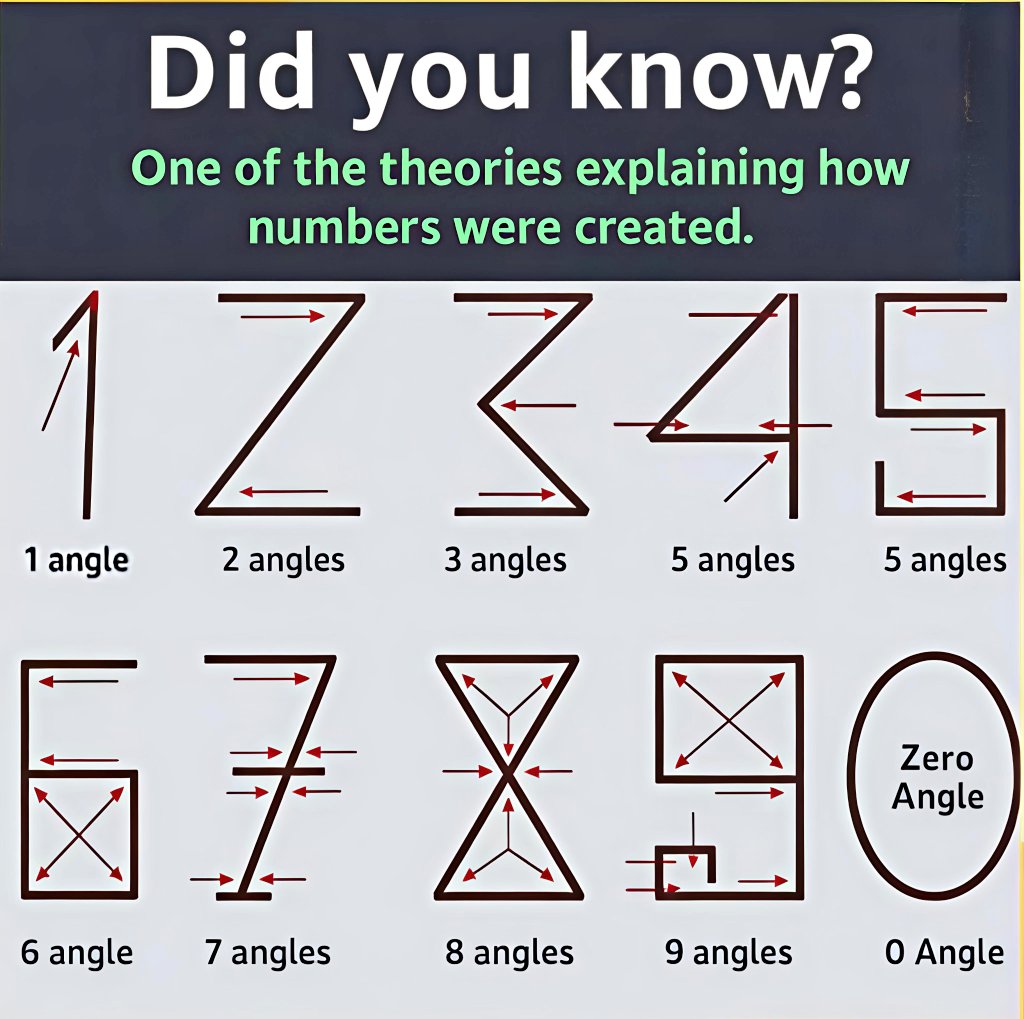
Some people say that ancient Arabic numerals were shaped based on the number of angles they have.
For example:
1 has one angle
2 has two angles
3 has three angles
…and so on.
And 0 has no angles at all — which matches its value!
It’s interesting because when you look closely, these shapes feel surprisingly connected to the numbers we use today.
Whether this idea is historically true or just a clever pattern, it’s a beautiful way to look at numbers — like they were designed with hidden logic inside them.
Math trick
Ask someone to name a two-digit number. Let’s say the person calls out 13. You then write down 13 and keep writing consecutive numbers until you have 10 numbers in total:
13, 14, 15, 16, 17, 18, 19, 20, 21, 22
What’s the sum of these numbers? All you need to do is find the 5th number from the left, which is 17. Then simply put a 5 to that number to get 175—and that’s the sum!
Let’s try another example. Suppose for 69. You write:
69, 70, 71, 72, 73, 74, 75, 76, 77, 78
The 5th number from the left is 73. Put a 5 to get 735—and that’s the sum!
This trick works for any positive whole number. You can even try it with three-digit numbers, like 420:
420, 421, 422, 423, 424, 425, 426, 427, 428, 429
The 5th number from the left is 424, and appending a 5 gives 4245, which is the sum.
Things to research when bored:
-String theory
-Dark matter
-Analects of Confucius
-The Fermi Paradox
-Quantum Entanglement
-Time dilation and relativity
-Transhumanism
-Lost Civilisations and Myths
-Political Bias in Cartography
-Bioluminescence
-Street art movements
-Legends of Werewolves in Europe
-The Voynich Manuscript
-Green children of Woolpit