Methodological debates move the field forward. Recent debates on lesion network mapping (LNM) motivated us to develop robust LNM (rLNM), combining spatial null models and selective specificity to distinguish symptom effects from shared background. https://t.co/Jy5UwXcgQ8
@DAgourakis In our tests, rLNM remained sensitive to symptom-related connectivity in hub regions. The null accounts for the convergence expected at hubs, and connectivity above that baseline can still be detected. We’ve seen promising results, and We’ll share the results in an upcoming paper
@DAgourakis We only tested an anatomy-preserving null that repositions lesions. The drop in hub-driven false positives comes from the anatomy-preserving null, before any symptom contrast. Selective specificity tests what differs between related symptoms.
Cui et al. fixed Lesion Network Mapping by making it robust (rLNM) https://t.co/3BrYtWRPgX ... just months after van den Heuvel et al. had pointed out that the conventional version often generates similar looking maps for different symptoms. rLNM maps are gorgeous. LNM is back
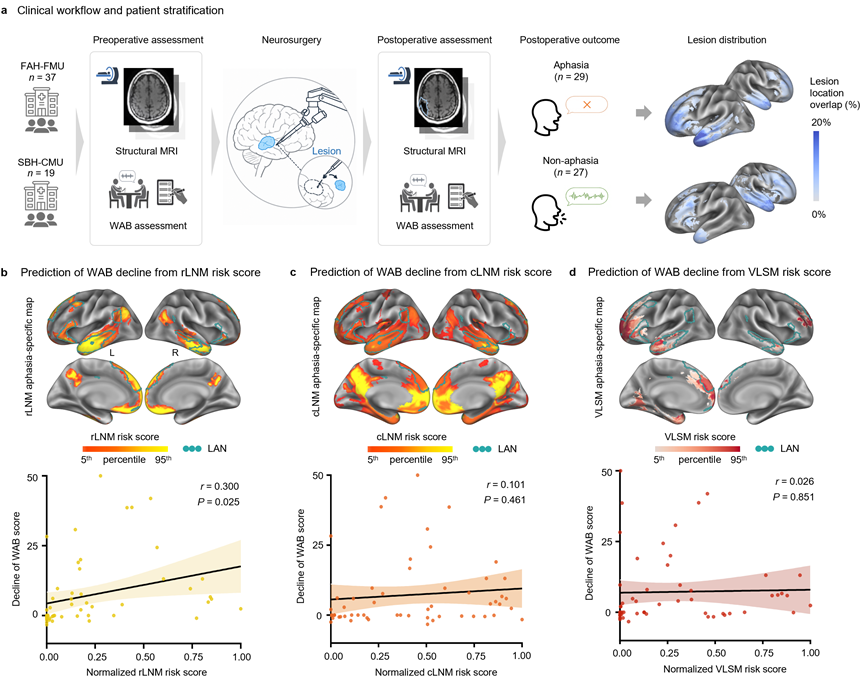
6/8 Interventional validation: in 56 epilepsy surgery patients, the extent of surgical resection within the rLNM-derived language network predicts postoperative language decline at the single-patient level.
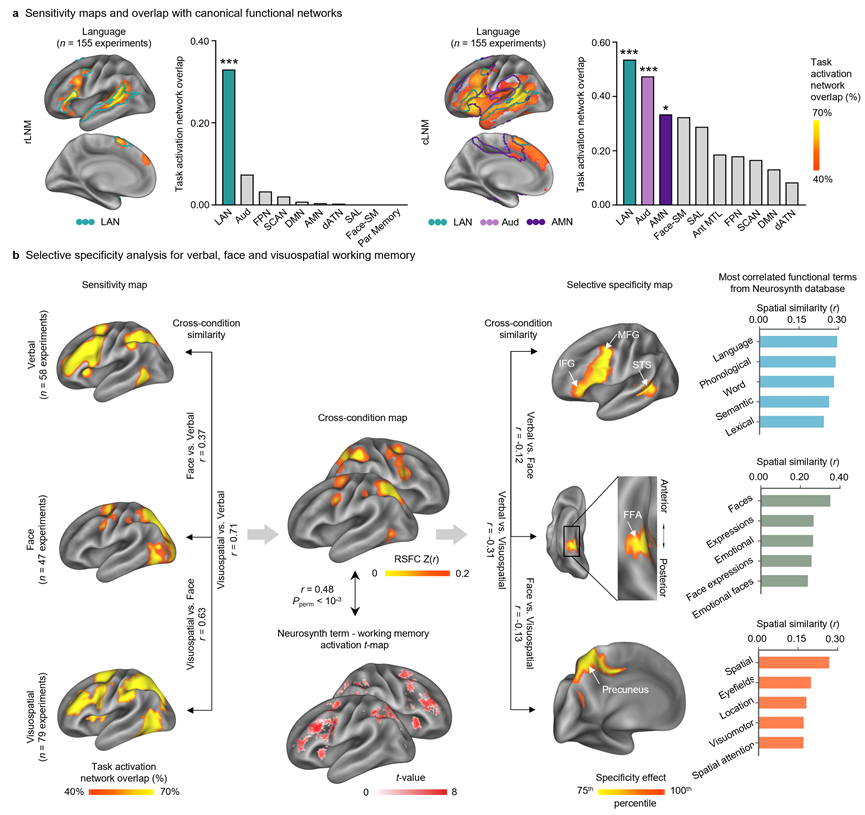
5/8 Validation with task activations. rLNM isolates the language network where conventional LNM gives a broader map. It also separates shared working-memory connectivity from verbal-, face- and visuospatial-selective patterns.
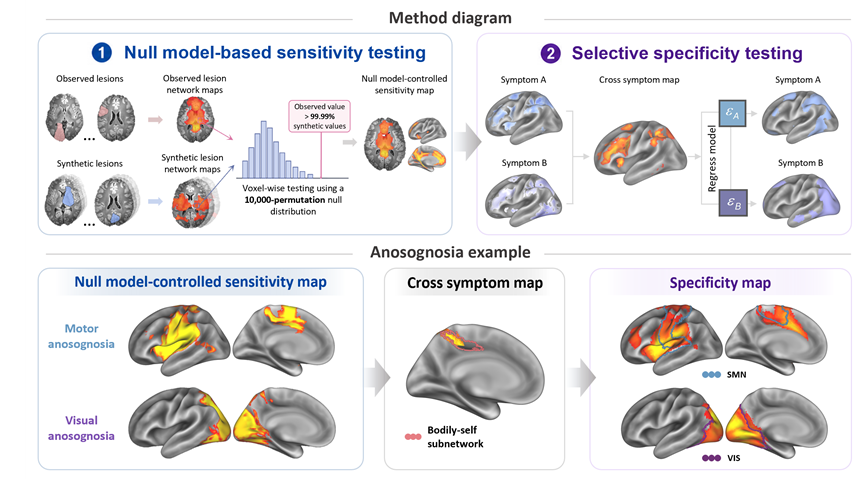
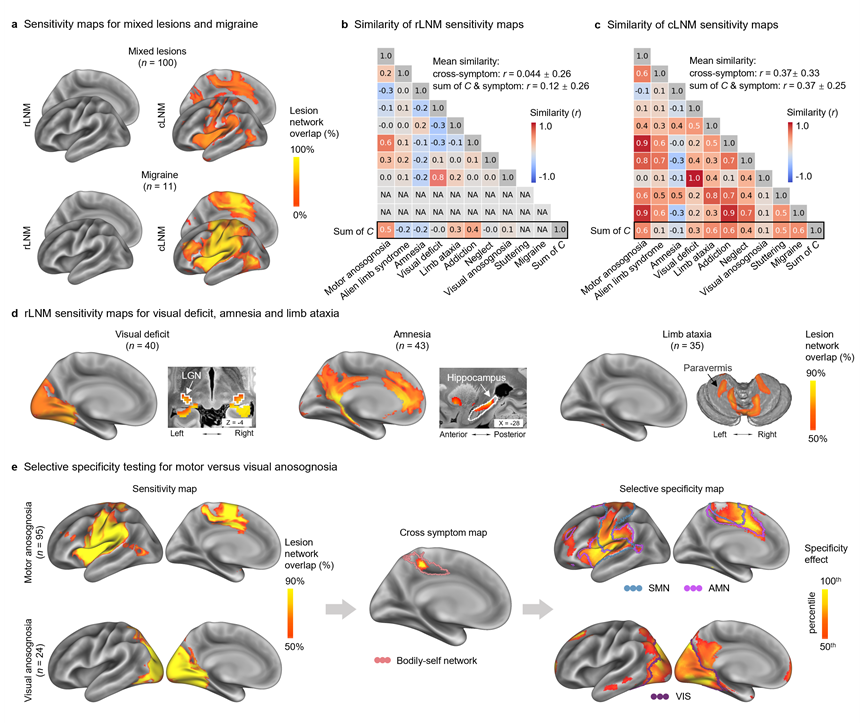
4/8 Across 10 symptom datasets, rLNM reveals distinct, biologically meaningful networks and separates shared from selective effects in motor/visual anosognosia. No voxels survive in migraine, stuttering or mixed lesions: rLNM does not force a network onto every dataset.
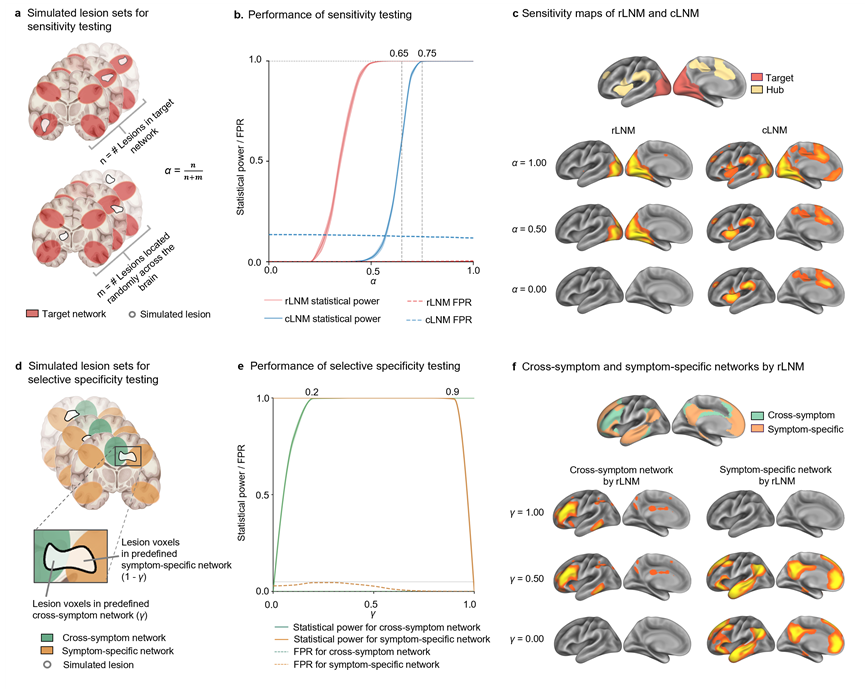
3/8 Does it work when ground truth is known? In simulations, rLNM reduces hub-driven false positives and improves sensitivity. It also recovers predefined shared and symptom-specific networks as their contributions to simulated lesions vary.
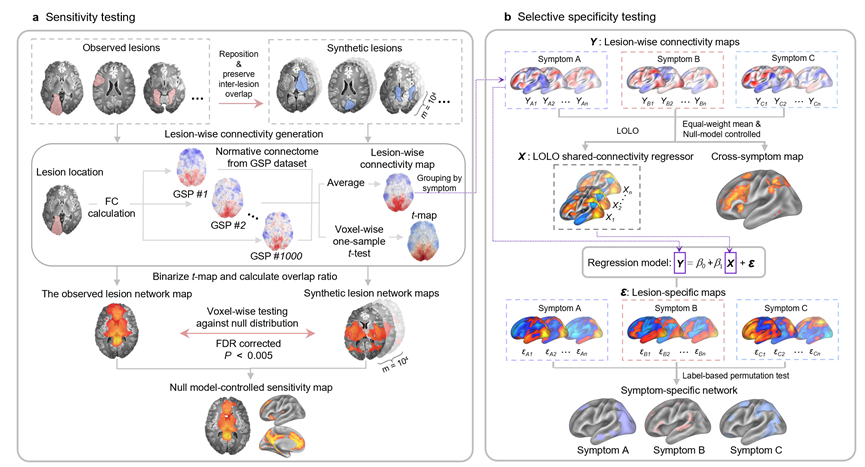
2/8 How does rLNM work? An anatomy-preserving spatial null model tests network convergence against chance. For selective specificity, think task-vs-task fMRI: comparing related symptoms helps separate shared connectivity from symptom-selective effects.
Can lesion network mapping predict survival in children with brain tumors? Collaboration with UCL and @Brain_Circuits in @Nature suggests the answer is yes. Cutting the tumor off from this network may confer survival benefit.
https://t.co/CiVAfkLiIv
LNM has become a backbone of modern cognitive neuroscience. Recent debates have stress-tested its method foundations. Our robust LNM (rLNM) reinforces its statistical backbone through null-model testing and selective specificity
ROBUST Lesion Network Mapping
Very beautiful work showcasing the power of permutation to address potential LNM concerns
Testing LNM existence is a critical 1st step, and the findings indicate that migraine lacks an LNM signature
Nice work @hesheng3 and team!
Lesion network mapping (LNM) has been powerful in linking symptoms and brain functional circuits, but ongoing debates highlight that it is still hard to isolate symptom-specific effects. We came up with a new method, robust LNM (rLNM) — a unified framework combining null models and selective specificity to reveal reliable, symptom-specific networks from background structure. https://t.co/6WHpBRNuQn
@bttyeo@foxmdphd@ndosenbach@club_scan
Association cortex connected to the striatum (esp. PFC) is more chained (catenated) than parietal regions belonging to the DMN (e.g. angular gyrus) and context-association network (CAN), with FC to the hippocampus. Why? what's the processing difference?
https://t.co/V7PQ5DtPK1