Instead of watching 1 hour of Netflix tonight, watch this ex-Google Chief Scientist Jeff Dean’s lecture. It’s the clearest explanation I’ve seen of the full AI engineering stack - from building LLMs from scratch all the way to one human coordinating 100 agents.
The best part is that it’s useful whether you’ve never touched a model or you’ve been shipping agent systems every day for the past year.
Bookmark it & watch the whole lecture this weekend, because it might end up being the most valuable thing you learn all week.
Announcing the Voice Arena STT Leaderboard, our human-verified benchmark testing how accurately speech-to-text models transcribe real, spontaneous conversation across 7 languages
The leaderboard covers 🇺🇸 US English, 🇮🇳 Hindi, 🇧🇩 Bangla, 🇧🇷 Brazilian Portuguese, 🇻🇳 Vietnamese, 🇷🇴 Romanian and 🇸🇦 Arabic. Every model is evaluated on the same held-out corpus per language: real, unscripted phone calls between native speakers, recorded in-country on their own phones, with the noise, fillers and interruptions of natural conversation.
Unlike public STT benchmarks, results are measured on fully proprietary audio - no model has seen a second of it in training. @Reson8Offical's resonant-1 leads the US English board at 4.34% WER, ahead of models from @Microsoft , @Google , @OpenAI and @Meta . @SarvamAI leads in Hindi and Bangla, while Microsoft takes #1 in Romanian and Brazilian Portuguese.
Key elements of the Voice Arena STT Leaderboard:
➤ Real speech, real conditions: audio is drawn from unscripted phone calls between native speakers, recorded in-country on the speakers' own devices, preserving the background noise, fillers and interruptions of production traffic.
➤ 100% proprietary, held-out audio: the corpus is collected and owned by Voice Arena. No model has seen a second of it in training, so results cannot be inflated by dataset contamination.
➤ Human-verified ground truth: transcripts are produced by native transcribers through a six-stage pipeline, and only segments verified 3-of-3 survive into the final test set.
➤ Corpus-level WER with symmetric, language-aware normalization: the same normalization is applied to both references and hypotheses, so models are penalized for recognition errors, never for spelling choices.
Key results for the Voice Arena STT Leaderboard:
➤ The most accurate US English model is not from a big lab: Reson8's resonant-1 leads at 4.34% WER, ahead of Microsoft, Google, OpenAI and Meta.
➤ Model choice alone is worth ~44%: on the US English board, #1 sits at 4.34% WER and #20 at 7.74%. Same audio, same test set. Picking the right model cuts nearly half of your transcription errors before you touch anything else in the pipeline.
➤ There is no global winner: the #1 model changes with the language, with Reson8 leading US English, Sarvam leading Hindi and Bangla, and Microsoft leading Romanian and Brazilian Portuguese. Teams building for more than one market will not be covered by a single vendor at the top of every board.
We think super long context is a problem solved by multi-agents. Recently we applied SwarmOS to research a problem we are interested in: What is China AI-stack’s pressure path. We shared the full generated report in this blog as well.
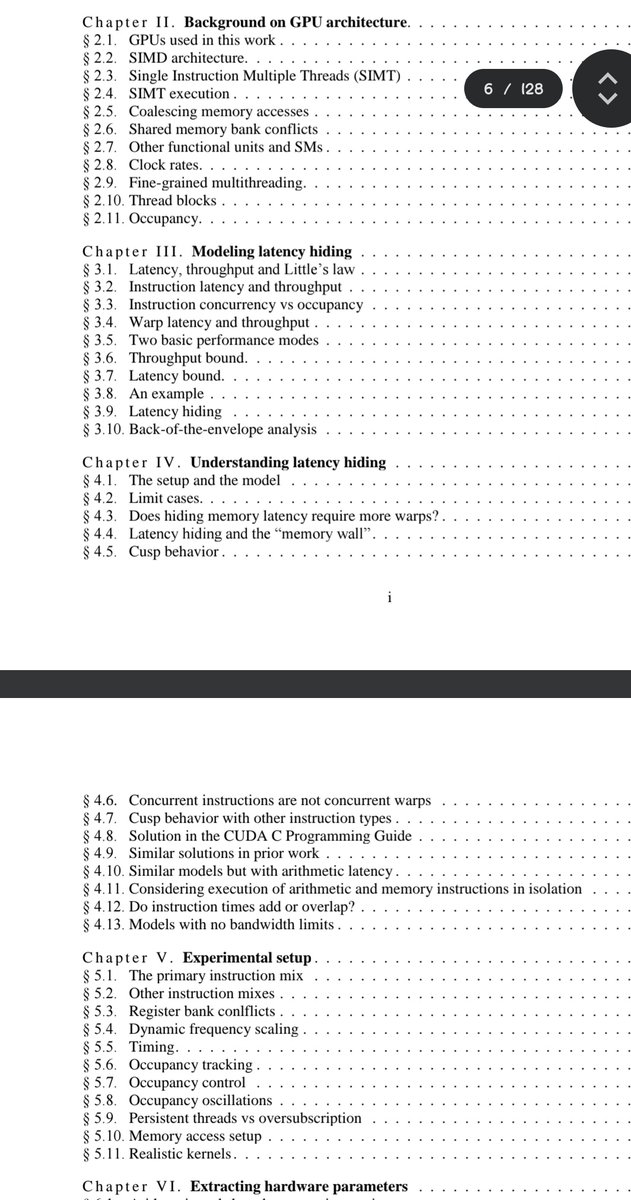
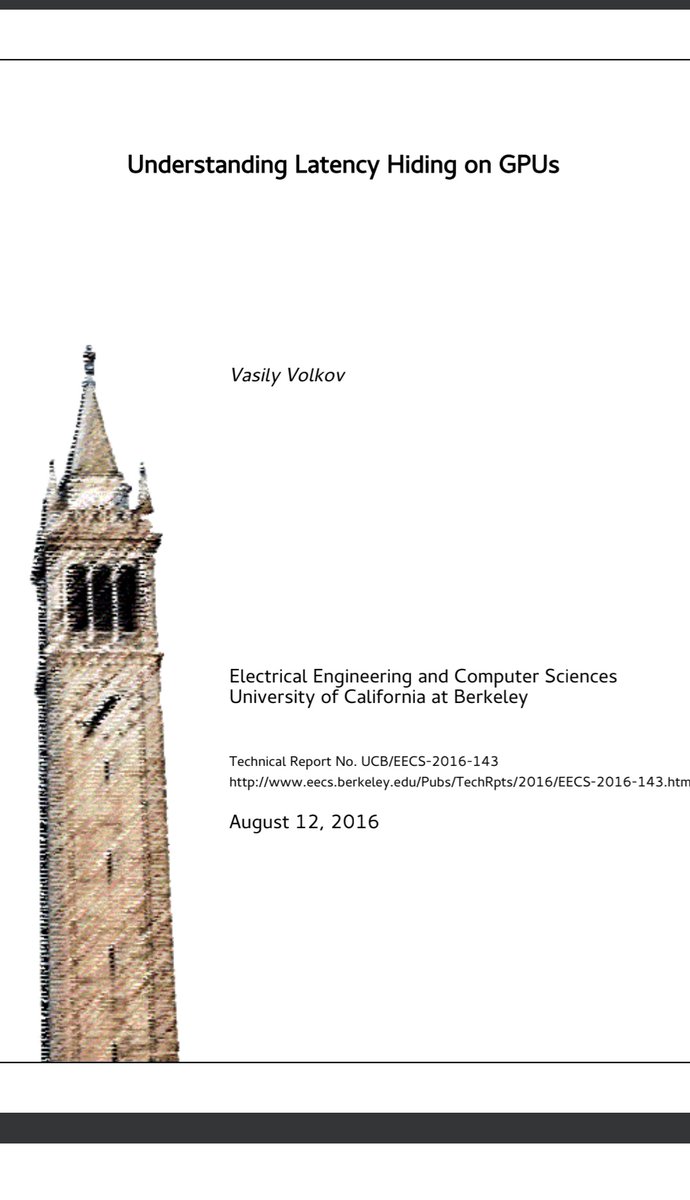
Doom scrolling led me to an unexpected gem: Understanding Latency Hiding on GPU by Vasily Volkov (UC Berkeley). It explains many GPU architecture and performance concepts that even Programming Massively Parallel Processors doesn't cover in depth.
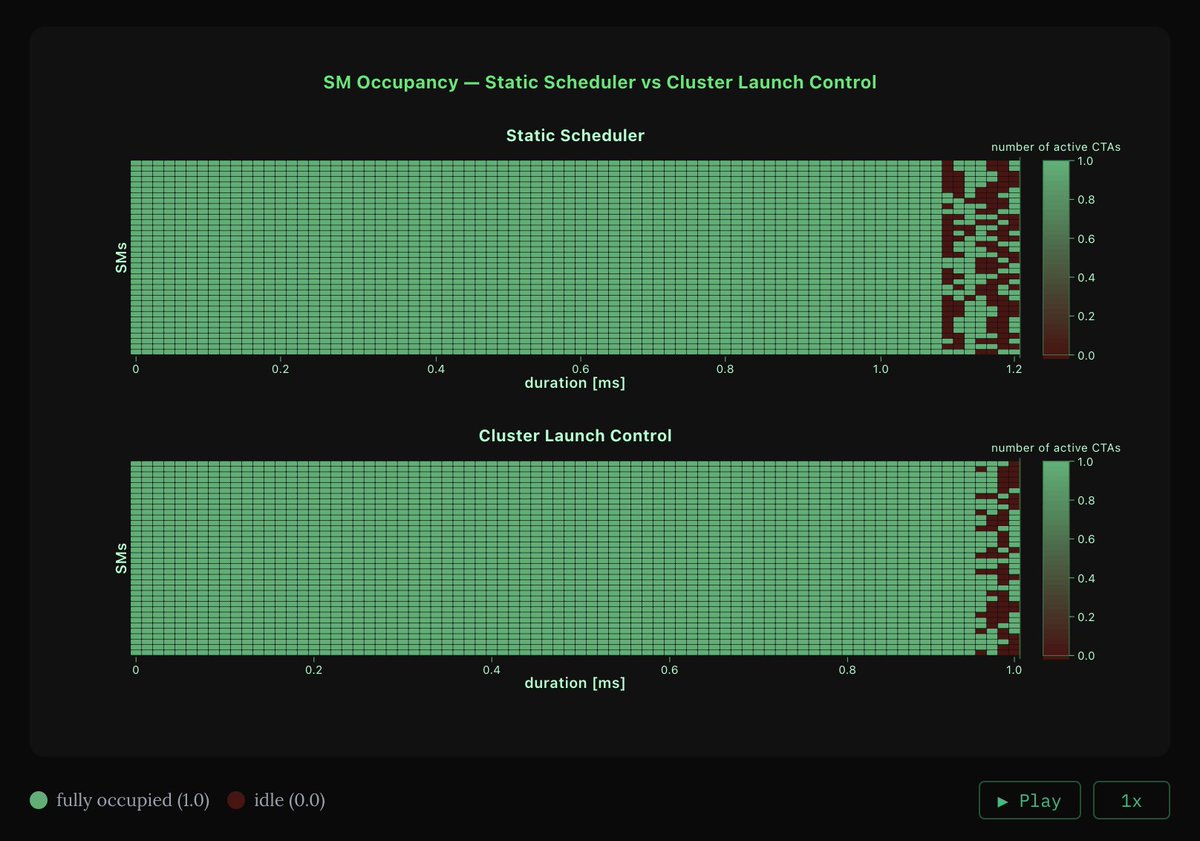
I wrote a matmul kernel on B200 in pure CUDA/PTX that beats cuBLAS by 6% at M=N=K=8192.
Inspired by @gaunernst's blog on Blackwell instructions with benchmarking done on @modal.
Blog: https://t.co/nifzaMdPJS
Repo: https://t.co/EKjrnCrp0z
New work on Scaling Test-Time Compute for Agentic Coding:
Paper: https://t.co/1bQXq7bwDk
This work introduces a test-time scaling framework for agentic coding that converts rollouts into structured summaries capturing key hypotheses, progress, and failure modes while discarding low-signal details.
This enables two forms of inference-time scaling: (1) Recursive Tournament Voting (RTV) for parallel selection via iterative small-group comparisons, and (2) Parallel-Distill-Refine (PDR) for sequential improvement by conditioning new rollouts on distilled summaries.
Our approach consistently boosts performance on frontier benchmarks. On SWE-Bench Verified, Claude-4.5-Opus improves from 70.9% → 77.6%, and on Terminal-Bench v2.0 from 46.9% → 59.1%. These gains highlight that effective test-time scaling for long-horizon agents hinges on representation, selection, and reuse, not just sampling more trajectories.
Check out a more detailed thread by @anirudhg9119.
CPU vs GPU vs TPU vs NPU vs LPU, explained visually:
5 hardware architectures power AI today.
Each one makes a fundamentally different tradeoff between flexibility, parallelism, and memory access.
> CPU
It is built for general-purpose computing. A few powerful cores handle complex logic, branching, and system-level tasks.
It has deep cache hierarchies and off-chip main memory (DRAM). It's great for operating systems, databases, and decision-heavy code, but not that great for repetitive math like matrix multiplications.
> GPU
Instead of a few powerful cores, GPUs spread work across thousands of smaller cores that all execute the same instruction on different data.
This is why GPUs dominate AI training. The parallelism maps directly to the kind of math neural networks need.
> TPU
They go one step further with specialization.
The core compute unit is a grid of multiply-accumulate (MAC) units where data flows through in a wave pattern.
Weights enter from one side, activations from the other, and partial results propagate without going back to memory each time.
The entire execution is compiler-controlled, not hardware-scheduled. Google designed TPUs specifically for neural network workloads.
> NPU
This is an edge-optimized variant.
The architecture is built around a Neural Compute Engine packed with MAC arrays and on-chip SRAM, but instead of high-bandwidth memory (HBM), NPUs use low-power system memory.
The design goal is to run inference at single-digit watt power budgets, like smartphones, wearables, and IoT devices.
Apple Neural Engine and Intel's NPU follow this pattern.
> LPU (Language Processing Unit)
This is the newest entrant, by Groq.
The architecture removes off-chip memory from the critical path entirely. All weight storage lives in on-chip SRAM.
Execution is fully deterministic and compiler-scheduled, which means zero cache misses and zero runtime scheduling overhead.
The tradeoff is that it provides limited memory per chip, which means you need hundreds of chips linked together to serve a single large model. But the latency advantage is real.
AI compute has evolved from general-purpose flexibility (CPU) to extreme specialization (LPU). Each step trades some level of generality for efficiency.
The visual below maps the internal architecture of all five side by side.
👉 Over to you: Which of these 5 have you actually worked with or deployed on?
Many of us are heavily using Codex every day for weeks/months to build real features across frameworks, systems, compilers, dev-tools, and more. It has been crazy to see millions of tokens rapidly turn into features. The last few releases have made systems work finally viable.
Cool to see that Tesla Full Self Driving has adopted the @LLVMFoundation MLIR stack, and is seeing 20% faster reaction time as a result. It is quite likely that a modern compiler and runtime implementation the break-through that robotaxi and FSD have been waiting for!
Cool to see Chronicle from @OpenAI 👀This is closely related to what we explored in GUM. Great to see these ideas making it into products!!! https://t.co/r9eTsyCU3e
What if computer-use agents could do real work?
We built Gym-Anything: a framework that turns any software into a computer-use agent environment.
We used it to create CUA-World: 200+ real software, 10,000+ tasks and environments, across all major occupation groups, from medical imaging to financial trading.
🧵
Facebook 首批工程师、Dropbox CTO,用 AI 编程一个周末之后说:我们再也不会手写代码了。
接下来 5 天,他写的代码比过去 5 年加起来还多。
他在 South Park Commons 见过几百个工程师和创始人,发现工作年限和 AI 适应能力几乎没关系。FAANG + 名校背景,几乎什么都预测不了。面试里故意给一个手动完不成的任务,用 AI 的人和没用的,代码量差距是 10 倍。
最有用的筛选信号:有没有个人网站,有没有 side project,有没有那种看到新工具必须今天就用上的性格。他管这叫 restlessness(坐不住)。他现在投人就押这个。