Our PNAS paper is now online!
We show that paternal metabolic effects on offspring can originate in the testis - not from sperm mitochondrial DNA or later epididymal exposure.
A key message: fathers’ health before conception matters.
https://t.co/g8rJKyHDoj
https://t.co/MbvrrYwGTJ Excited to share our new paper in eLife! We integrated human bulk and single-nucleus transcriptomics to define the fallopian tube epithelial hierarchy and identify progenitor populations that may represent precursors of high-grade serous ovarian cancer.
Excited to share our new commentary! @NedPlace and I discuss how evolutionary medicine can guide the design of next-generation non-hormonal contraceptives, approaches that prevent pregnancy while also protecting long-term reproductive and overall health.
https://t.co/FPpxQMTdGb
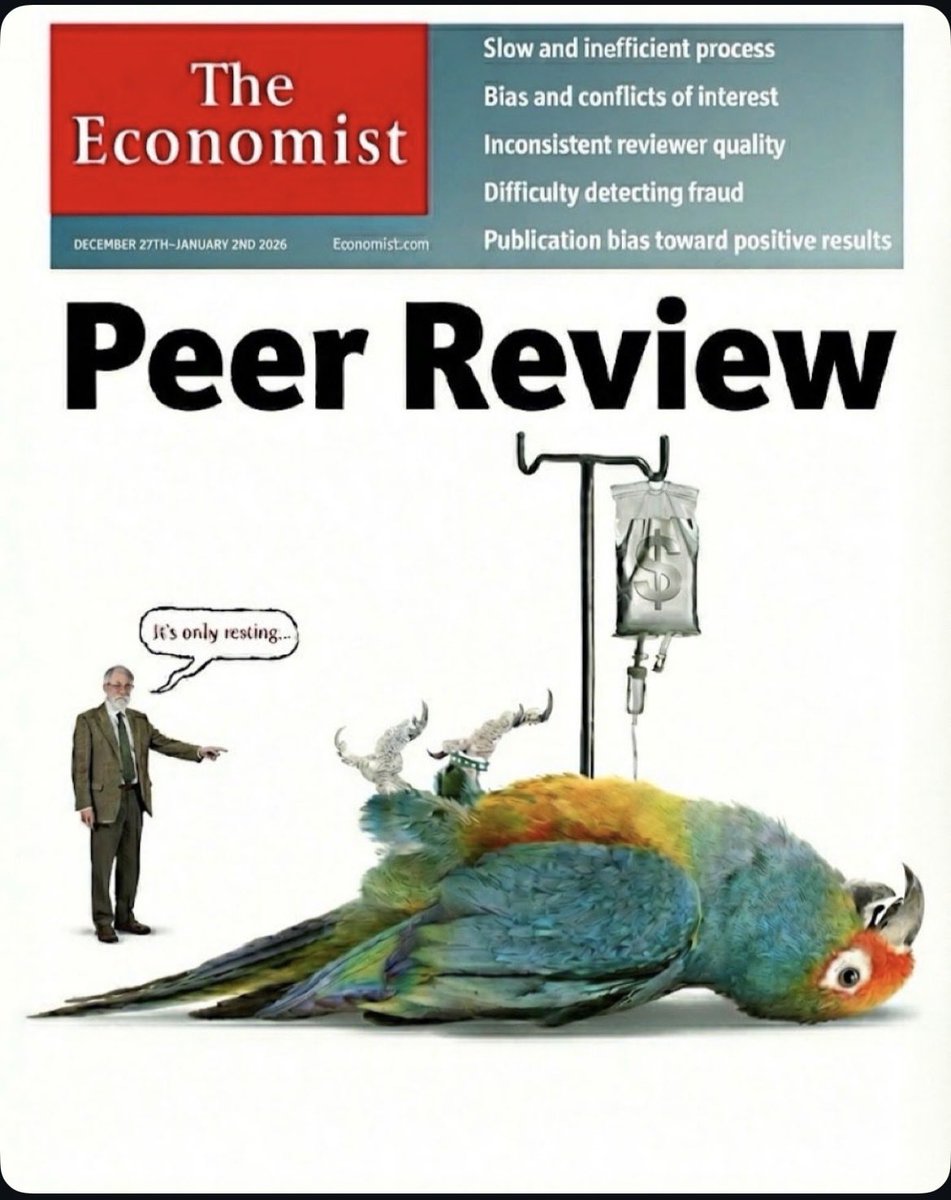
For decades, peer review has been treated as the gold standard of scientific validation.
Yet many scientists know the reality: the system is far from perfect. Peer review is broken and sometimes even corrupted.
The process can be slow, inconsistent, and vulnerable to bias. Reviewers are sometimes asked to judge work outside their true expertise. In other cases, they may be evaluating ideas that challenge the very paradigm in which they were trained. And occasionally, reviewers are simply competitors.
Ironically, the most prestigious journals can also be the most conservative. Truly new ideas are often met with skepticism, while safer work that fits the current narrative moves more easily through the system.
Increasingly, papers are judged less by the originality of the idea and more by the volume of data, the sophistication of statistics, and the beauty of the figures. Science risks becoming data-rich but idea-poor.
But there is an important reality to remember: journals do not ultimately decide the impact of scientific work. Impact is decided later, by the community. By the scientists who read it, test it, debate it, and cite it.
In the end, citations and ideas determine the legacy of a paper, not the impact factor of the journal that first published it.
Science has always advanced by questioning assumptions. Perhaps it is time we also question the system that filters scientific ideas.
Great conversation with Morgan Ashley @NonstopLocal 360 about our reproductive health research — fertility, infertility, male contraception, & healthy next generations.
🎥 Watch here: https://t.co/Yh98XVcW05
#ReproductiveHealth#WSUResearch#MaleContraception
Reimagining #Scientific#Publishing: Your Voice Matters! We want to hear from researchers like you! Share your thoughts on current scientific publishing and what changes you believe are needed. Link to the survey: https://t.co/LxmDbkF92M
Nature Paintings of the Palouse-
Spring turns the Palouse into a living canvas. Snapped these from my flight into Pullman-brushstrokes of green, gold, and earth all around.
#Palouse#SpringVibes#NatureArt#PullmanWA
Our Spring Reception was filled with laughter, applause, and the kind of community spirit that sets us apart. We honored excellence, celebrated milestones, and looked ahead to a future that’s full of promise. #SMBatWSU#FutureIsBright#SMBReception2025#ScienceCommunity#GoCougs
Spring in the Pacific Northwest—cherry blossoms, wildflowers, and mirror-like rivers. A quiet reminder of resilience, renewal, and the beauty that endures. #PNW#SpringVibes#NatureHeals
Honored to receive the 2025 ASA Distinguished Andrologist Award! Deep thanks to my mentors, nominators, collaborators, and trainees. To young scientists: Stay open to the unexpected. The best is yet to come. #ASA2025#Andrology#Science
🚨 Exciting news! The eLife Special Issue on Reproductive Health is out! 🎉
🔗 Explore the full issue: https://t.co/wsRAkS8vVK
📄 Read my editorial: https://t.co/CfVGrIfaN6
Huge thanks to all contributors! #ReproductiveHealth#OpenScience#eLife
Excited and honored to join Washington State University as Director of the School of Molecular Biosciences and the Center for Reproductive Biology! https://t.co/dMBSvw47oZ
Ending 2024 on a high note with the Frank J. DeSantis Senior Investigator Award from The Lundquist Institute at Harbor-UCLA! This honor belongs to my amazing team- past and present trainees, lab staff, and collaborators. Excited for what’s to come in 2025!
Re #autism. There is overwhelming evidence for a true, staggering increase in autism. Likewise there is overwhelming evidence that vaccination is not responsible. The failure to identify autism’s true causes is a spectacular scientific failure. https://t.co/xyH6lkkuiP