Today @UrvinFinance and @WeTheInvestors_ have kicked off a new advocacy effort with @welbornecon. We've petitioned the SEC for rulemaking to Redline Reg SHO. We want the SEC to adopt a universal pre-borrow requirement, end the Madoff exemption, and impose fines for FTDs.
In July 1985, over a billion people watched Live Aid.
Months earlier, Michael Jackson and Lionel Richie had written "We Are the World." All of it was a response to a famine in Ethiopia.
Almost nobody remembers who actually caused the famine. 🧵
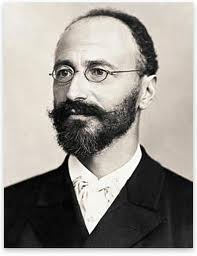
Marx died in 1883 with two volumes of Capital unwritten and one fatal contradiction unanswered. Eugen von Böhm-Bawerk noticed.
In 1884 he published the first volume of Capital and Interest, a history of every interest theory ever floated, and he treated the exploitation theory the way a pathologist treats a corpse: methodically, and without sentiment. Marx claimed that labor alone creates value, that the capitalist pockets "surplus value" by paying workers less than their product is worth. Sounds tidy. Then Böhm-Bawerk asked the question that collapses the whole structure. Why does a worker accept $90 today instead of waiting a year for the $100 his labor will eventually fetch in the finished good?
Present goods are worth more than future goods. That is interest. Not theft, not a parasite skimming off the top, but the price of time itself. The capitalist who advances wages today for output that sells next year performs a service, and he earns the spread for bearing the wait and the risk. Böhm-Bawerk laid this out in 1889 in The Positive Theory of Capital, and the exploitation story had no reply.
But the real execution came in 1896. Engels had finally dragged Volume III of Capital into print in 1894, and there Marx quietly admitted that commodities do not actually sell at their labor values: they sell at "prices of production" governed by an average rate of profit. Böhm-Bawerk pounced in Karl Marx and the Close of His System. Volume I said value comes from labor. Volume III said prices systematically deviate from labor. Marx had spent twenty years building a cathedral on a foundation he himself dynamited in the back pages. You cannot assert that labor determines value on Monday and that competition overrides it on Thursday and call the result science.
A century of central planners ignored this and proceeded to starve Ukraine, wall off Berlin, and empty the shelves of Caracas. The theory was dead in 1896, but the bodies just kept arriving anyway, because nobody reads the footnotes before they reach for the gun.
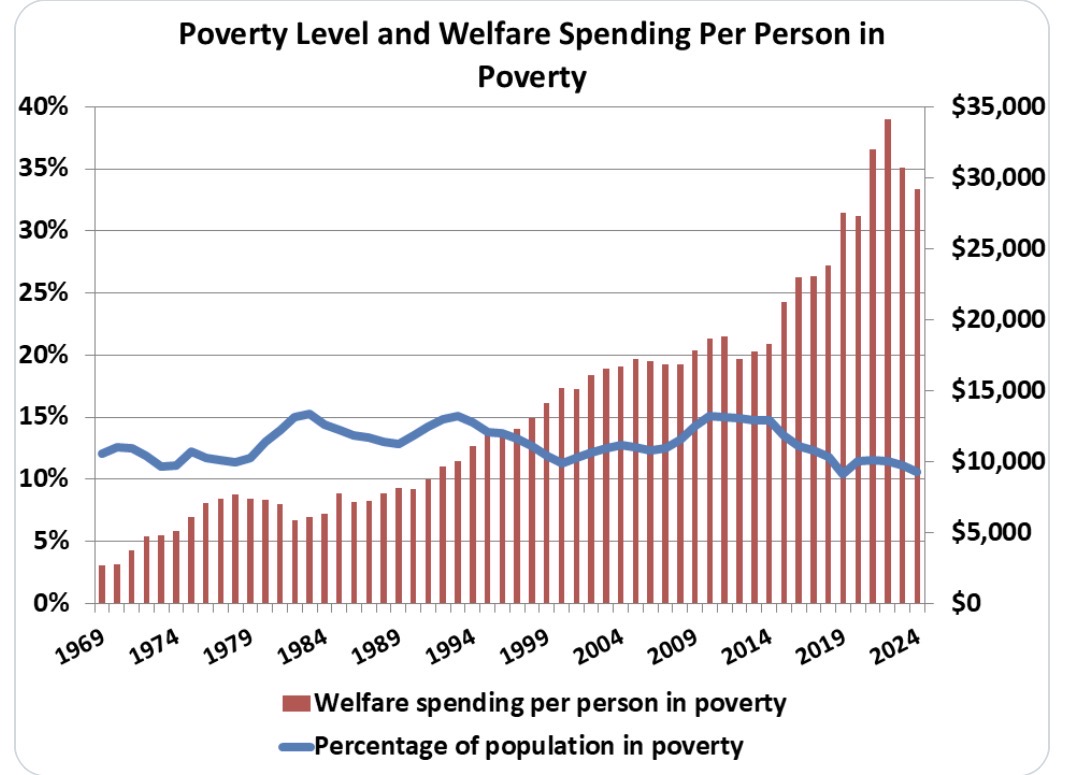
The welfare state itself is a fraud. Legalized looting. Few people (including economists) realize that the “poverty rate” is a relative, not absolute measure, calculated arbitrarily as 50% of median income, so when the latter rises, so does the poverty threshold. That’s why no amount of government spending on poverty alleviation can sustainably reduce the poverty rate (aside from the fact that subsidizing a thing causes more of the thing). Most poverty pimps know this math and prefer the relativist measure precisely cuz it’s used to justify perpetual increases in government welfare looting/spending (from which the pimps extract their share). Conservatives aid and abet the fraud.
New project -
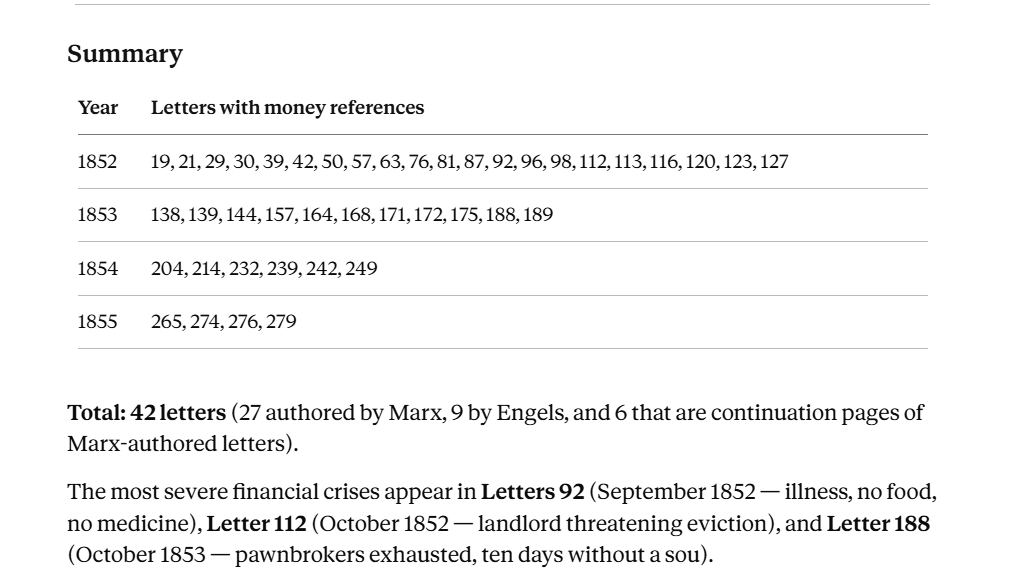
I'm experimenting with using AI to sort through all of Karl Marx's letters to find every time he asked Engels to send him money.
This is just 4 years of results.
Turns out Marx asked Engels for money A LOT.
This new op-ed from economists like Piketty, Stiglitz, and Hickel call for essentially de-growth. A few notable incorrect statements here 🧵
https://t.co/95kgzVhzo4
Here's something many people don't know about me -
Before I publicly dissected the long list of problems in the 1619 Project, I contacted the New York Times through their official channels to request a series of corrections to unambiguous factual errors in its content. The editor - Jake Silverstein - brushed me off and refused any correction - a pattern he also exhibited toward other critics from across the spectrum.
Before I publicly broke the story about Kevin Kruse's plagiarism in Reason, I contacted Princeton's academic integrity officer and alerted him to the problems I had found, giving them a chance to respond and address it internally. They ignored my email and later claimed to have lost my email after I went public.
Before I published my findings on Quinn Slobodian's habitual manipulation of source materials to alter its plain meaning through misquotation, I submitted an article to Contemporary European History (the journal where the worst examples appeared), highlighting the problems with the passages and asking for a correction through their official process. They desk-rejected it, brushed me off, and falsely claimed that Slobodian's piece had been thoroughly vetted in peer review. In fact, one of their own referees had flagged the same problems over a year earlier and recommended rejection of the article.
Before I published an expose on Nancy MacLean & Sandy Darity's similar manipulation of W.H. Hutt quotations in their article for History of Economics Review, I (along with 2 coauthors) submitted a response comment to this journal asking for a correction through its official processes. The editor gave us a complete runaround where he imposed an arbitrary length limit requiring us to cut the content, sent the trimmed version to a referee, then rejected the piece because the referee said we didn't sufficiently address the very same things we were forced by the editor to cut. When I then asked the editor to issue a simple corrigendum to the most egregious misquotation (one that transformed Hutt's explicit attack on the racism of white Afrikaners into a defense of Apartheid), he refused and tried to pass it off as a difference of "interpretation."
Before I published an expose of a leading covid masking model in the Wall Street Journal, I sent a comment to the medical journal that published it alerting them to a math error that changed their entire set of results. The journal acknowledged the error was real but refused to publish my piece on the grounds that the "next release" of the model would be updated to reflect it - even as politicians up to and including Joe Biden were trumpeting the erroneous results all over the news.
"Teaching is not about information. It’s about having an honest intellectual relationship with your students. It requires no method, no tools, and no training. Just the ability to be real. And if you can’t be real, then you have no right to inflict yourself upon innocent children."
- Paul Lockhart, A Mathematician's Lament
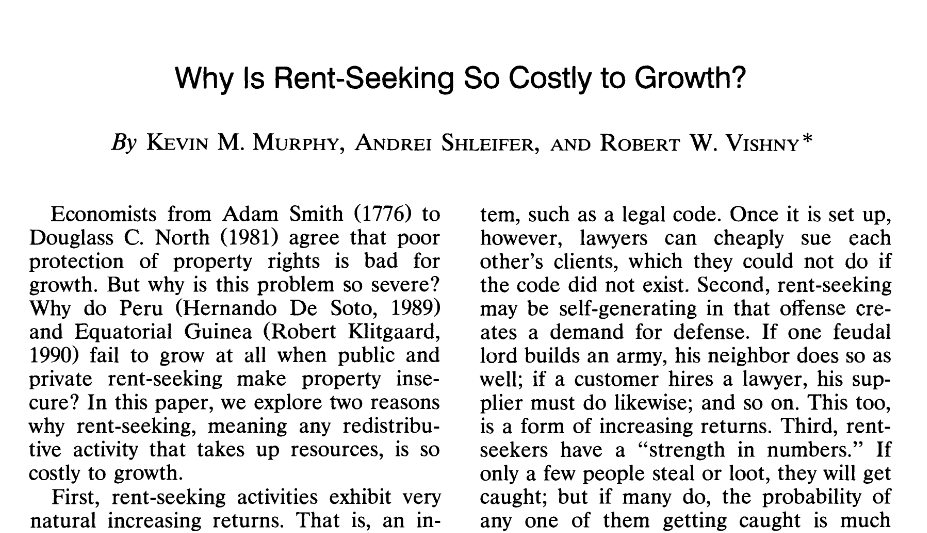
This is one of my favorite papers to teach rent-seeking and the relationship to economic growth. Its well argued and essentially also introduces multiple equilibria logic to students in simple mathematics.
Admin bloat is, in large part, a jobs program for PhDs in fields that have become oversaturated due to decades of advanced degree overproduction despite low student demand for these majors. It is a classic case of budget-maximizing bureaucracy that adds little to education.
🚗🔋 Many think Beijing masterfully planned China's EV takeover. Fengming Lu (@ANUBellSchool ) and I spent 3 years and 60+ interviews finding out what actually happened in our latest article @TheChinaJournal. A thread 🧵
A study shows that the quality of the school has no influence on the intelligence of children from immigrant backgrounds.
Their cognitive abilities "remain at the level of their country of origin not only in the first generation, but also in the second and even later."
For 250 years, Japan maintained an extraordinary peace by forcing the entire warrior class to live in the capital Edo, a city that was essentially a giant consumption machine that produced nothing.
Half its population were samurai pensioners doing busywork, while the daimyo (the ruling elite) were burning money on mandatory mansions and endless processions between their estates. The whole city ran on agricultural surplus extracted from the rest of Japan.
Some surprising facts:
1) The city functioned as a hostage system. The daimyo (regional lords) were required to leave their families permanently in Edo as de facto hostages. Most noblewomen never once visited the lands their husbands governed. Instead, they spent their entire lives in the capital as insurance against rebellion.
2) Half the city were warriors with nothing to fight. At any given time, nearly half of Edo's population were samurai, which were living as state pensioners in a country at total peace. Most did little beyond civil administration and calligraphy lessons, since most work was considered beneath them.
3) It was probably the world's largest city, centuries before Tokyo's modern fame. Edo likely exceeded a million people by 1700. London didn't hit that mark until 1800, New York did not until 1880.
4) It had very high population density, almost entirely in single-storey buildings. Some commoner districts hit twice Manhattan's current density.
5) The poor were taxed at up to 70% of their harvest. The agricultural surplus flowed up through public taxation rather than rent, making the state the direct intermediary between peasants and the elite.