In a 2009 study by Bowen & Marlatt, 123 smokers were exposed to cigarette cravings.
One group was taught a mindfulness technique called “urge surfing.”
Instead of trying to fight the craving or immediately giving in to it, they were taught to simply notice the urge, allow it to exist, and watch it pass without acting on it.
What was interesting is that the technique didn’t make the cravings disappear.
They still wanted to smoke.
But over the following week, the mindfulness group smoked significantly fewer cigarettes.
The goal was never to eliminate the craving.
It was to break the automatic connection between feeling an urge and acting on it.
Think of an urge like a wave.
It rises.
It gets more intense.
It peaks.
And eventually, it comes back down.
Learning about urge surfing completely changed the way I think about discipline in trading.
For years, I thought becoming disciplined meant eventually reaching a point where I simply wouldn’t have those impulses anymore.
No FOMO.
No frustration after a loss.
No greed.
No desire to revenge trade.
No urge to make the money back.
But that isn’t discipline.
I don’t need the thought to disappear before I can make a good decision.
I can feel an incredibly strong urge to revenge trade and still not place the trade.
I can feel frustrated after taking a loss without needing to make the money back.
I can feel FOMO watching a move happen without me without needing to chase it.
Instead of immediately reacting, I can notice what’s happening, give the feeling some time, and let the wave rise and fall without turning it into an action.
The goal isn’t to become a trader who never experiences FOMO, frustration, greed, or the desire to make a loss back.
The goal is to become a trader who can experience all of those feelings without automatically obeying them.
Sometimes the biggest trading skill isn’t controlling what enters your mind.
It’s understanding that you don’t have to act on everything your mind tells you to do.
I have a few mechanical filters for deciding whether or not I will trade at the reversal, or wait for the continuation.
This is 1 of them | CiC Filter
Thesis: Cracks in Correlation (SMT & PSP Variants I have taught you) validate swing formations and phases of distribution in a MMXM.
Phase 1 = SMR (reversal)
Phase 2/3 =redistributions (continuation)
Fair Value Gaps away from reversals define new invalidations I.e. where continuations form.
n = # of CiC necessary to validate a swing point.
HTF True Reversal | n = 2
HTF Continuation [in gap] | n - 1 = 1
LTF Continuation [in gap] | n - 2 = 0
When we lack a 2-stage-CiC at the reversal
We wait for to trade the HTF Continuation & validate the swing formation with at least 1 crack in correlation.
We do not need an entry time frame crack in correlation (m1-m5) based on this logic.
Gap selection:
Now do you remember how I taught you to filter gap selection timeframes. Recall we use implied dealing ranges from the point of reversal to the DOL.
Let’s use the example of a H4 universal model; Generally speaking I taught you the following
1. Below 50% IDR (early in reversal) m15 gaps are permissible
2. Above 50% IDR (higher in range, more time has passed) m30/h1 gaps are preferred
A trader without rules is a gambling addict.
Do you want to be different?
Set rules and stick to them.
Every time you break them, don’t think of it as letting yourself down… you’re letting your family down, and you’re proving them right when they say trading doesn’t work.
Play smart.
Price isn't random.
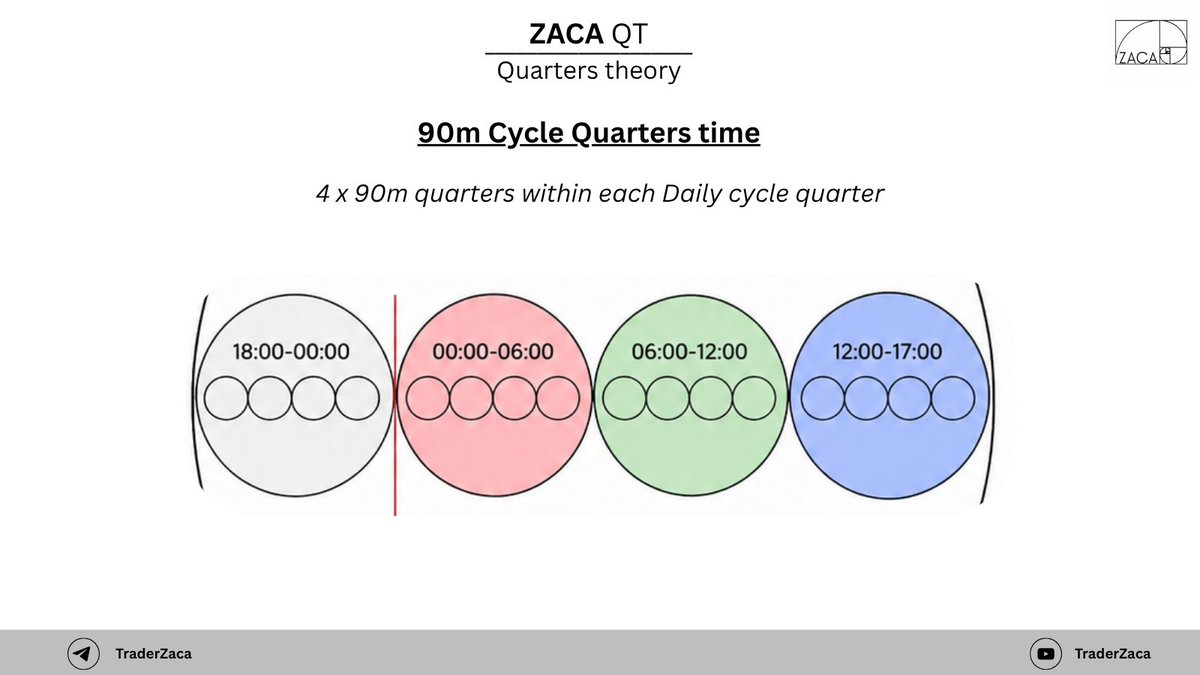
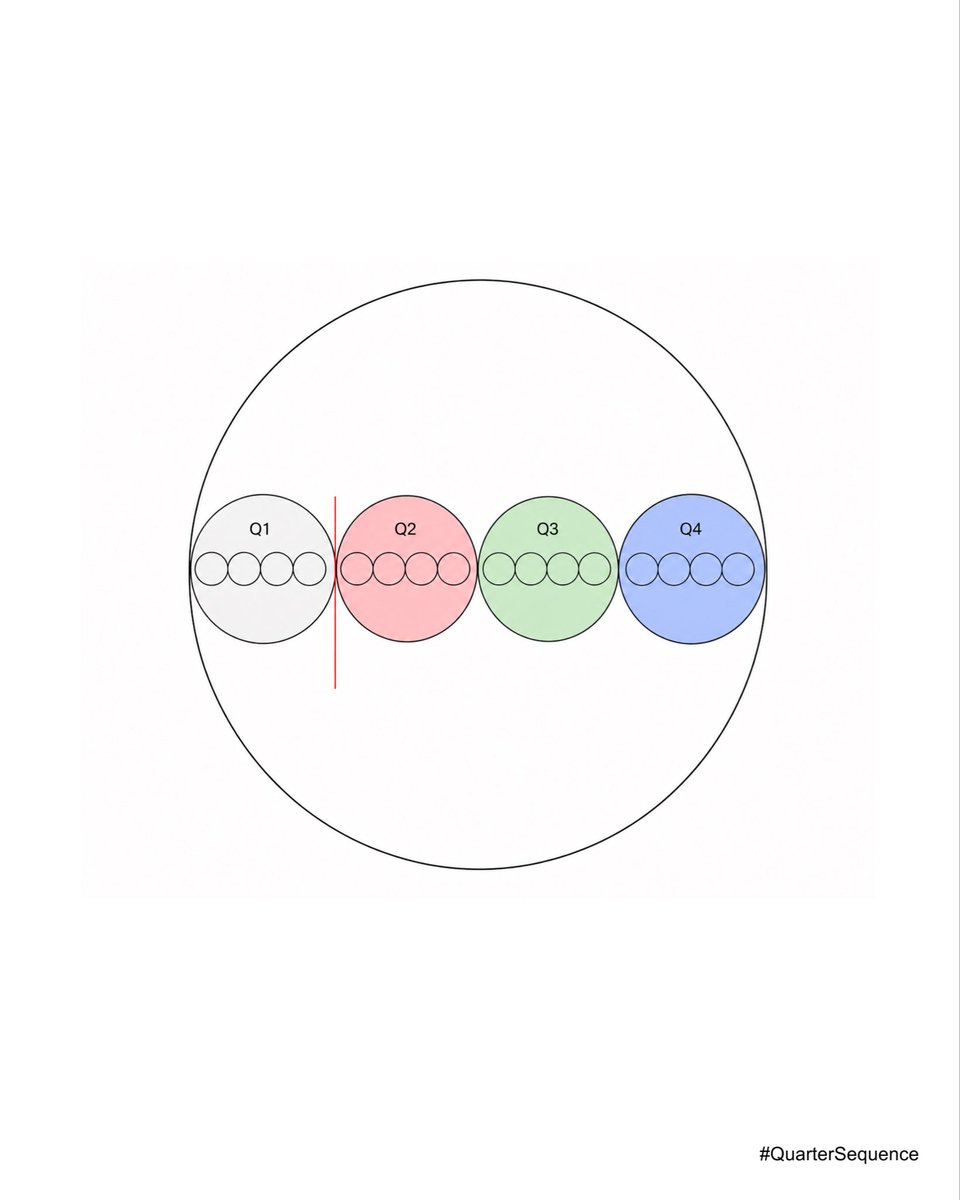
It runs in 90-minute cycles.
Each quarter has a job.
Without knowing this —
the market looks like chaos.
With it — everything makes sense.
I personally trade the green one. 🟢
$NQ — Quarterly Theory 📐
#QuarterlyTheory#ICT#NQ#SmartMoney
Ever wondered how ICT got the times of his killzones?
18.00 - 00.00 (Asian Session) 6hrs*
00.00 - 06.00 (London Session) 6hrs*
06.00 - 12.00 (NY Session) 6hrs*
12.00 - 18.00 (PM Session) 6hrs*
24hrs added together.
Now... if you divide 6hrs by 4 you'll get 90mins.
Q1: 18.00 - 19.30 | Q2: 19.30 - 21.00 | Q3: 21.00 - 22.30 | Q4: 22.30 - 00.00 (90min Cycles of the Asian Session)
Q1: 00.00 - 01.30 | Q2: 01.30 - 03.00 | Q3: 03.00 - 04.30 | Q4: 04.30 - 06.00 (90min Cycles of the London Session)
Q1: 06.00 - 07.30 | Q2: 07.30 - 09.00 | Q3: 09.00 - 10.30 | Q4: 10.30 - 12.00 (90min Cycles of the NY Session)
Q1: 12.00 - 13.30 | Q2: 13.30 - 15.00 | Q3: 15.00 - 16.30 | Q4: 16.30 - 18.00 (90min Cycles of the PM Session)
Do you see the sequence? Q2 - Q3 are where the killzones are for every 90min cycle.
Why? Q2 is mainly used for manipulation, Q3 is mainly used for distribution.
Nobody talks about Friday in QT.
Bullish week → Friday pulls back.
Bearish week → Friday pushes up.
In most cases, Friday SHAPES
the weekly candle wick.
Closes Q4.
Opens Monday's Q1
This is TGIF Theory.
Missing piece of QT
You heard it here first 👑
#TGIF#QuarterlyTheory
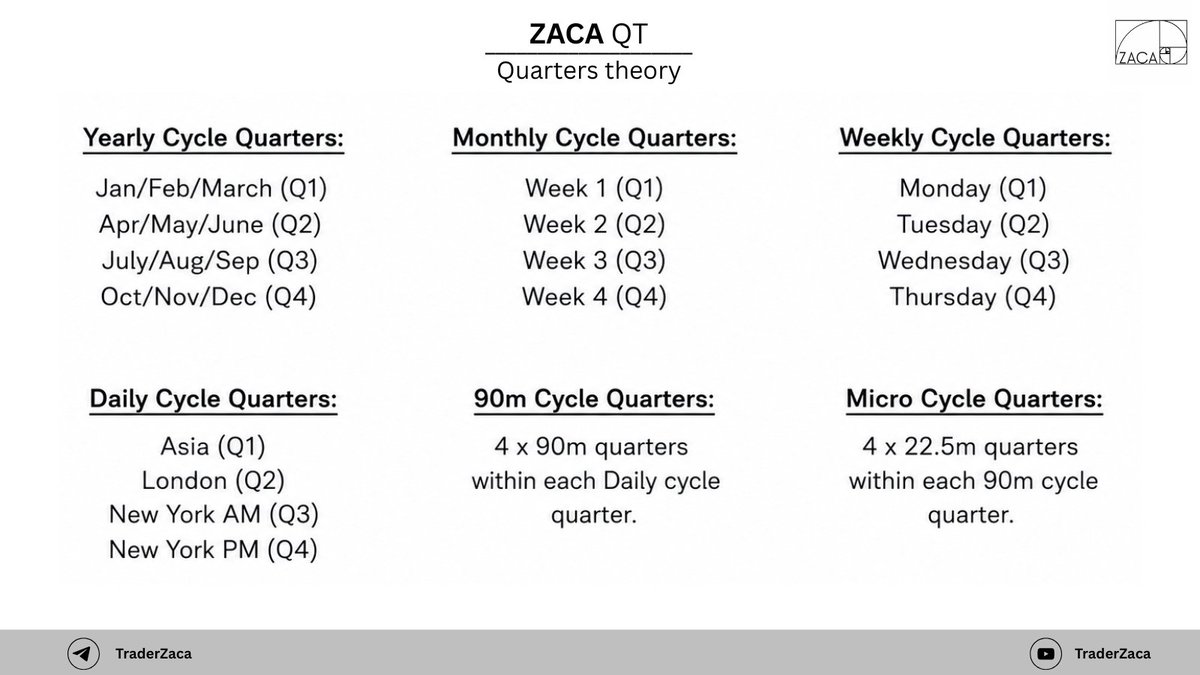
Quarterly Theory works on every timeframe.
Yearly. Monthly. Weekly.
Daily. 90min. Micro.
Same sequence. Different clocks.
This is why the market is fractal.
$NQ — Quarterly Theory 📐
#QuarterlyTheory#ICT#NQ#Fractal#SmartMoney
Asia → 8:00 PM – 12:00 AM
London → 2:00 AM – 5:00 AM
New York → 9:30 AM – 11:00 AM
New York True Open (7:30 AM)
Daily True Open (12:00 AM)
Above the true opens = sells,
Below the true opens = buys.
@blackcoretrades@LethalityTrader O mal dos comerciantes qusrem sempre uma prova, sem ao menos tentar, o que isso vai agregar ? O @LethalityTrader tem dado dicas preciosas. Vá e vê se funciona, sem mais.
Time is Cause.
Price is Effect.
The Algorithm books Price in regards to pre-cycle market conditions which occur during specific windows of Time.
Every function precedes and follows another specific function.


![XYJtrades's tweet photo. I have a few mechanical filters for deciding whether or not I will trade at the reversal, or wait for the continuation.
This is 1 of them | CiC Filter
Thesis: Cracks in Correlation (SMT & PSP Variants I have taught you) validate swing formations and phases of distribution in a MMXM.
Phase 1 = SMR (reversal)
Phase 2/3 =redistributions (continuation)
Fair Value Gaps away from reversals define new invalidations I.e. where continuations form.
n = # of CiC necessary to validate a swing point.
HTF True Reversal | n = 2
HTF Continuation [in gap] | n - 1 = 1
LTF Continuation [in gap] | n - 2 = 0
When we lack a 2-stage-CiC at the reversal
We wait for to trade the HTF Continuation & validate the swing formation with at least 1 crack in correlation.
We do not need an entry time frame crack in correlation (m1-m5) based on this logic.
Gap selection:
Now do you remember how I taught you to filter gap selection timeframes. Recall we use implied dealing ranges from the point of reversal to the DOL.
Let’s use the example of a H4 universal model; Generally speaking I taught you the following
1. Below 50% IDR (early in reversal) m15 gaps are permissible
2. Above 50% IDR (higher in range, more time has passed) m30/h1 gaps are preferred](https://pbs.twimg.com/media/HOF8DyybQAAsSPB.jpg)





![XYJtrades's tweet photo. I have a few mechanical filters for deciding whether or not I will trade at the reversal, or wait for the continuation.
This is 1 of them | CiC Filter
Thesis: Cracks in Correlation (SMT & PSP Variants I have taught you) validate swing formations and phases of distribution in a MMXM.
Phase 1 = SMR (reversal)
Phase 2/3 =redistributions (continuation)
Fair Value Gaps away from reversals define new invalidations I.e. where continuations form.
n = # of CiC necessary to validate a swing point.
HTF True Reversal | n = 2
HTF Continuation [in gap] | n - 1 = 1
LTF Continuation [in gap] | n - 2 = 0
When we lack a 2-stage-CiC at the reversal
We wait for to trade the HTF Continuation & validate the swing formation with at least 1 crack in correlation.
We do not need an entry time frame crack in correlation (m1-m5) based on this logic.
Gap selection:
Now do you remember how I taught you to filter gap selection timeframes. Recall we use implied dealing ranges from the point of reversal to the DOL.
Let’s use the example of a H4 universal model; Generally speaking I taught you the following
1. Below 50% IDR (early in reversal) m15 gaps are permissible
2. Above 50% IDR (higher in range, more time has passed) m30/h1 gaps are preferred](https://pbs.twimg.com/media/HOF8DyzaEAAcGBS.jpg)