There is a growing trend in the US and cities all over are starting to cancel their contracts with FLOCK cameras.
Here is a summary of the progress and proof that we have the power if we get our local communities to say no.
Eugene, Oregon — Ended its contract with Flock Safety and discontinued use of the cameras after community pushback.
• Springfield, Oregon — Also ended its agreement and plans to remove cameras entirely.
• Bend, Oregon — Turned off Flock cameras and decided not to renew the contract after public concerns about privacy.
• Charlottesville, Virginia — Ended its Flock camera pilot program after it expired, citing privacy worries.
• Santa Cruz, California — Terminated its contract with Flock Safety, becoming the first city in CA to do so.
• Flagstaff, Arizona — Unanimously canceled its contract with Flock Safety amid privacy concerns.
• Cambridge, Massachusetts — Ended its contract and removed Flock cameras after a “breach of trust” related to unauthorized installations.
• Greenfield, Massachusetts — Announced plans to remove its Flock cameras later this year due to financial constraints.
• Olympia, Washington — Suspended its Flock camera pilot program and covered existing cameras based on privacy concerns.
• Stanwood, Washington — Paused use of its Flock cameras amid public records concerns.
• Sedona, Arizona — The Sedona City Council unanimously voted to cancel its automated license plate reader (Flock Safety) contract and remove the cameras after significant public concern about privacy and data‑sharing.
The more we say no, the more likely we are to send a message to the government.
We do not consent to constant monitoring when we are in public.
watching this video I have to ask technology is great but how far do you want to go with?? so much is not shared with humanity for what is used for..if people would know just what is happening in healthcare and how human biofield i used they would be sockt https://t.co/gXUnYvoLzw
Residents of Sedona and Flagstaff have successfully pushed for the removal of Flock surveillance cameras from public streets in an effort to preserve privacy and civil liberties. This marks another example of a community actively rejecting the expansion of the surveillance state and asserting local control over public spaces. We have the power, we just have to claim it.
...wild..wild west..so and what data are we talking about here???..are we talking about human biofild?? ..right..we dont talk about that... https://t.co/qASLFeGQHY
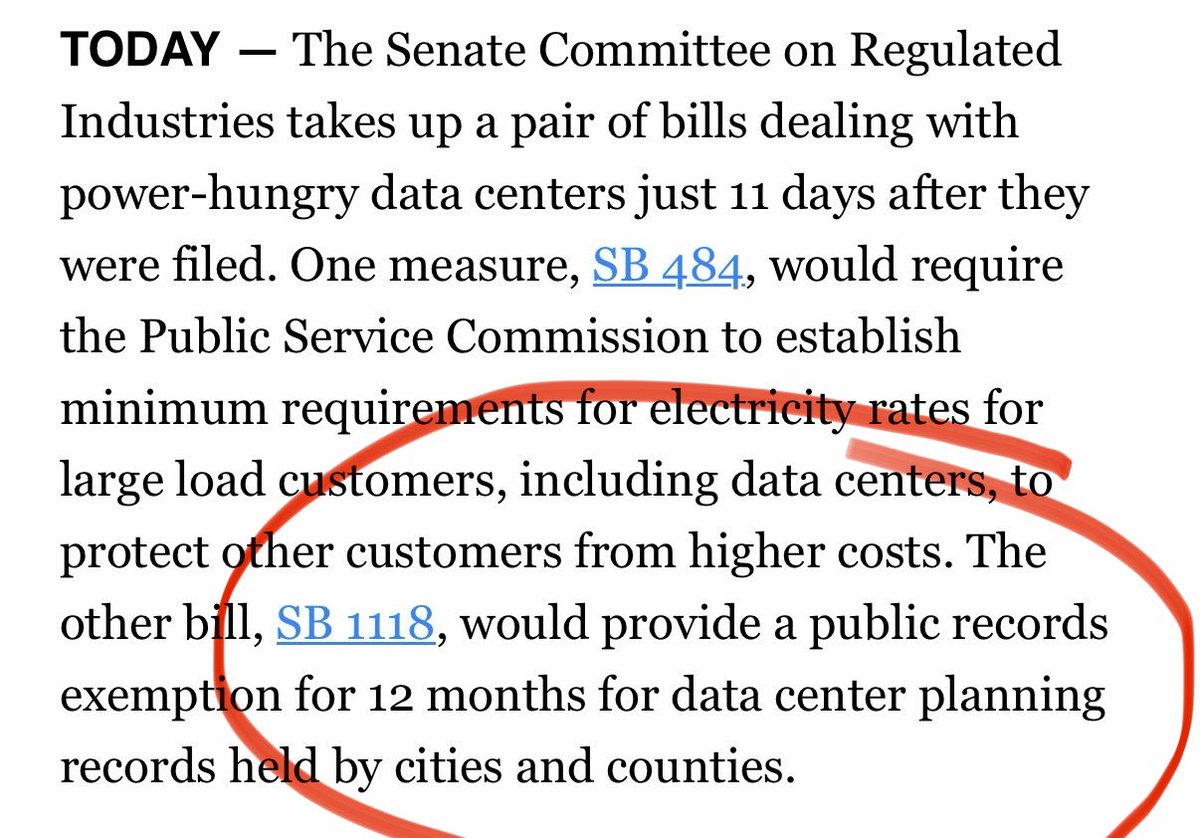
WOW—I’ve seen some truly corrupt bills get filed in Tallahassee—& I fought against them constantly
But this has to be one of the worst I’ve seen
A so-called “republican” is filing a bill to hide the public records of any data center being proposed in Florida
STOP SB-1118 now!
Frightening Mafia.
“Which of your companies own or control a Health Insurance Division…?”
“Keep your hand up if you also employ Healthcare Providers, Clinics and Pharmacies…”
“They’re increasingly controlling every aspect of our Healthcare System…”
Administrative exception to the fourth amendment requirement for warrants?
As a constitutional attorney, it is my responsibility and duty to clarify an answer for this question.
Here is an article in which I’ve identified and listed out all the exceptions to the fourth amendment that are authorized by our Constitution.
https://t.co/T0yJNbj1ny
.. excellent article ..had to read couple of times the part of primary role of gov. is not national security it is as the Constitution clearly mandates Liberty Security...https://t.co/VpkXM1bqwN
Palantir CEO admits to shareholders that Palantir is here to 'disrupt', and ‘when it’s necessary to scare enemies and on occasion kill them’! Are all the shareholders happy with that ? Sounds like terrorism ?
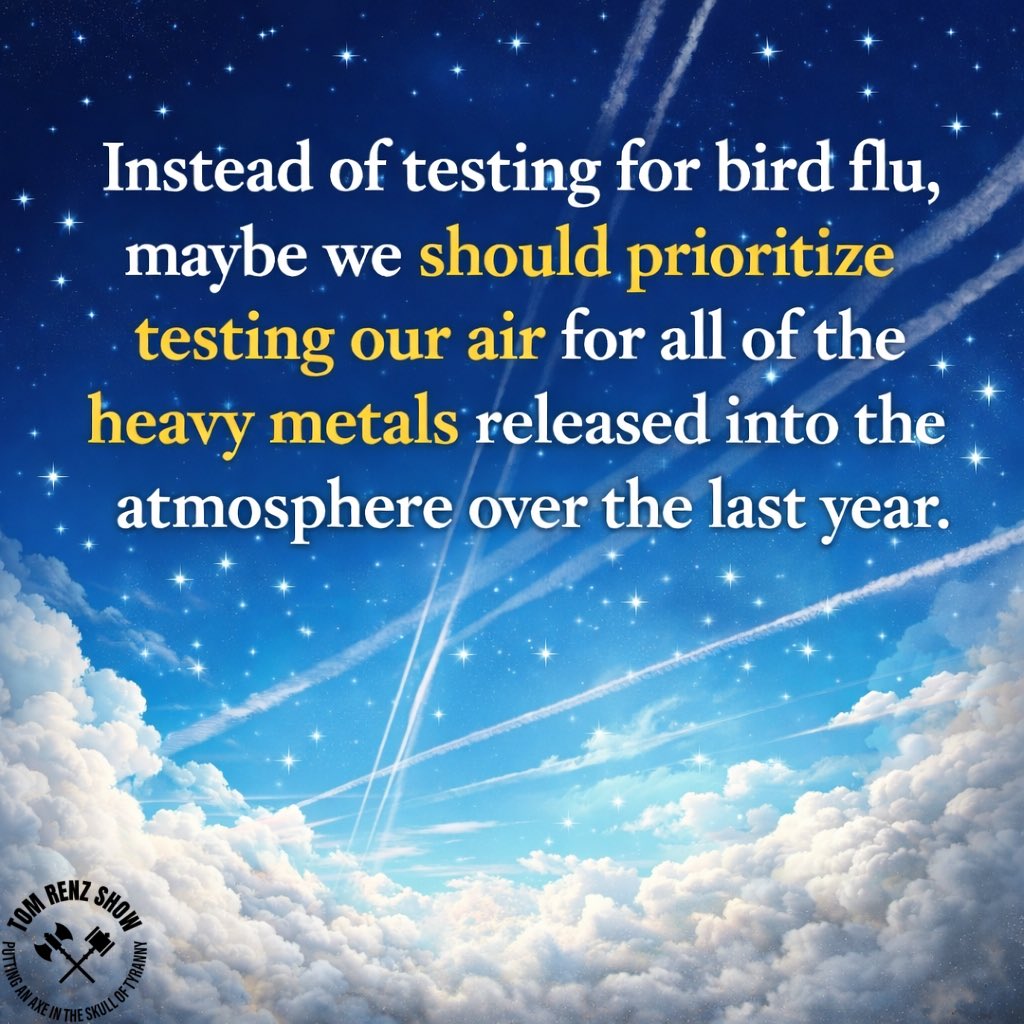
Our skies are crisscrossed with trails, yet no one in authority is asking the obvious question: what exactly is in the air we're breathing?
If they can test chickens, they can test the air.
Chemtrails aren't a “theory” when they're right over our heads.
It’s the Clouds, Not CO₂
And an overlooked new paper quietly proves it
A new observational study just delivered an inconvenient result for the climate-model narrative... and almost no one is talking about it.
The paper, published in Atmospheric Measurement Techniques (2025), analyzed more than 30 years of real-world measurements of downward longwave radiation at the ocean surface using data from 65 globally distributed buoys. This isn’t a model exercise. It isn’t a reanalysis. It’s the climate system as it actually behaves.
And what did they find?
The dominant control on surface longwave radiation, the energy that actually warms the surface, is cloud properties, not CO₂.
Let’s slow that down, because this matters.
Downward longwave radiation is the key mechanism by which the atmosphere transfers heat to the surface. If CO₂ were truly the primary driver of surface warming, you would expect changes in CO₂ to show up clearly.
They don’t.
Instead, the study shows that the best-performing models of surface longwave radiation rely almost entirely on:
-near-surface air temperature
-humidity
-cloud fraction
-cloud liquid water
-cloud ice water
In fact, the authors demonstrate that explicitly accounting for cloud thermodynamics dramatically improves agreement with observations, while formulations that rely on simplified or indirect representations perform significantly worse.
CO₂ doesn’t even appear explicitly in the best formulations... not because it violates physics, but because at the surface, clouds dominate the signal.
This alone should raise eyebrows.
Even more telling, the paper shows that major reanalysis products, the very datasets used to calibrate and validate climate models, perform worse than simple, observation-anchored empirical models. That means models are being tuned against datasets that already struggle to correctly partition energy between clouds and greenhouse gases.
In other words, if models appear to get the “right answer,” it may be because forcing from CO₂ is being adjusted upward to compensate for unresolved cloud processes.
That’s not a conspiracy. That’s how parameterization works when key physics can’t be resolved.
This study does not claim that CO₂ has no radiative effect. It doesn’t need to. What it shows, quietly but clearly, is that surface energy balance is governed primarily by clouds, which are:
-highly variable
-poorly constrained
-non-linear
-and deeply entangled with natural variability
That’s a problem for any narrative claiming we can precisely control global temperature by fine-tuning atmospheric CO₂.
It also helps explain a long-standing observation: why surface warming trends, especially over oceans, often fail to track model expectations. The models aren’t wrong because physics is wrong... they’re wrong because clouds are doing the heavy lifting, and we still don’t understand them well enough to parameterize them without tuning.
This paper doesn’t shout. It doesn’t challenge policy. It doesn’t wave ideological flags.
It just measures reality.
And reality keeps pointing to the same conclusion:
CO₂ may matter, but clouds run the system where it counts, at the surface.
If you want the deeper breakdown... including what this means for climate sensitivity, model tuning, and why “solutions” focused solely on CO₂ are likely to fail, that’s exactly what I cover at Irrational Fear.
Because the more data we collect, the clearer it becomes:
The climate story isn’t simpler than we were told.
It’s far more complex... and far less controllable.
https://t.co/CZJCckOqJR