What if you could debug and improve robot policies using just an iPhone? 📱🤯
Super excited to share RoboPocket! We realize robot-free post-training with AR Visual Foresight and Instant Online Fine-tuning. Dive into the thread below to see it in action! 🚀👇
Robot Policy Iteration is bottlenecked by the "PhD-in-the-loop" requirement for data collection. We introduce 📱RoboPocket, a portable system that turns your smartphone into an intelligent co-pilot for robot post-training. No physical robot? No problem. Improve policies instantly in the wild! 🤖
🔗Project Page: https://t.co/6AaStX1gDo
Introduce FTP-1, the first Generalist Foundation Tactile Policy. Enjoy FTP-1 on any tactile sensors and embodiments in your labs🤗!
Pretrained on 3000 hours tactile data and 21 sensors🤖, FTP-1 learns general tactile knowledge, that can even transfer to unseen sensors 🚀!
FTP-1 is distributed and evaluated by 5 global institutions, including Sharpa, UC Berkeley, Tsinghua, ETH Zurich, Shanghai Jiaotong University. We fully open-source all data and checkpoints for community usage🤗. Check the blog for more details😃!
https://t.co/CkloGgYRPm
Introduce FTP-1, the first Generalist Foundation Tactile Policy. Enjoy FTP-1 on any tactile sensors and embodiments in your labs🤗!
Pretrained on 3000 hours tactile data and 21 sensors🤖, FTP-1 learns general tactile knowledge, that can even transfer to unseen sensors 🚀!
FTP-1 is distributed and evaluated by 5 global institutions, including Sharpa, UC Berkeley, Tsinghua, ETH Zurich, Shanghai Jiaotong University. We fully open-source all data and checkpoints for community usage🤗. Check the blog for more details😃!
https://t.co/CkloGgYRPm
🤖 VTAM is our new video-tactile world action model for contact-rich robotic manipulation.
Work led by @Jensen_Yuan@HenryYia Zhenyu Zhang @wendi_chen_
✅Learns visuo-tactile predictive dynamics in latent space
✅Predicts actions, states, and virtual force signals jointly
☑️Lightweight tactile transfer finetuning of a pretrained video transformer
☑️Tactile regularization to stabilize multimodal fusion and prevent visual dominance
See our robot in action👇
🤗 https://t.co/QPn7wp8Ki9
🌐 https://t.co/7U9l7XA7DJ
#EmbodiedAI #Robotics #WorldModels #RobotLearning
Today, we announce our team’s progress in pursuing a different type of foundation model for robotics: the Direct Video Action Model (DVA), which does our best to take robotics and turn it into a generative modeling problem we can scale.
Technical blog: https://t.co/GMsxnC5wbJ
Robot Policy Iteration is bottlenecked by the "PhD-in-the-loop" requirement for data collection. We introduce 📱RoboPocket, a portable system that turns your smartphone into an intelligent co-pilot for robot post-training. No physical robot? No problem. Improve policies instantly in the wild! 🤖
🔗Project Page: https://t.co/6AaStX1gDo
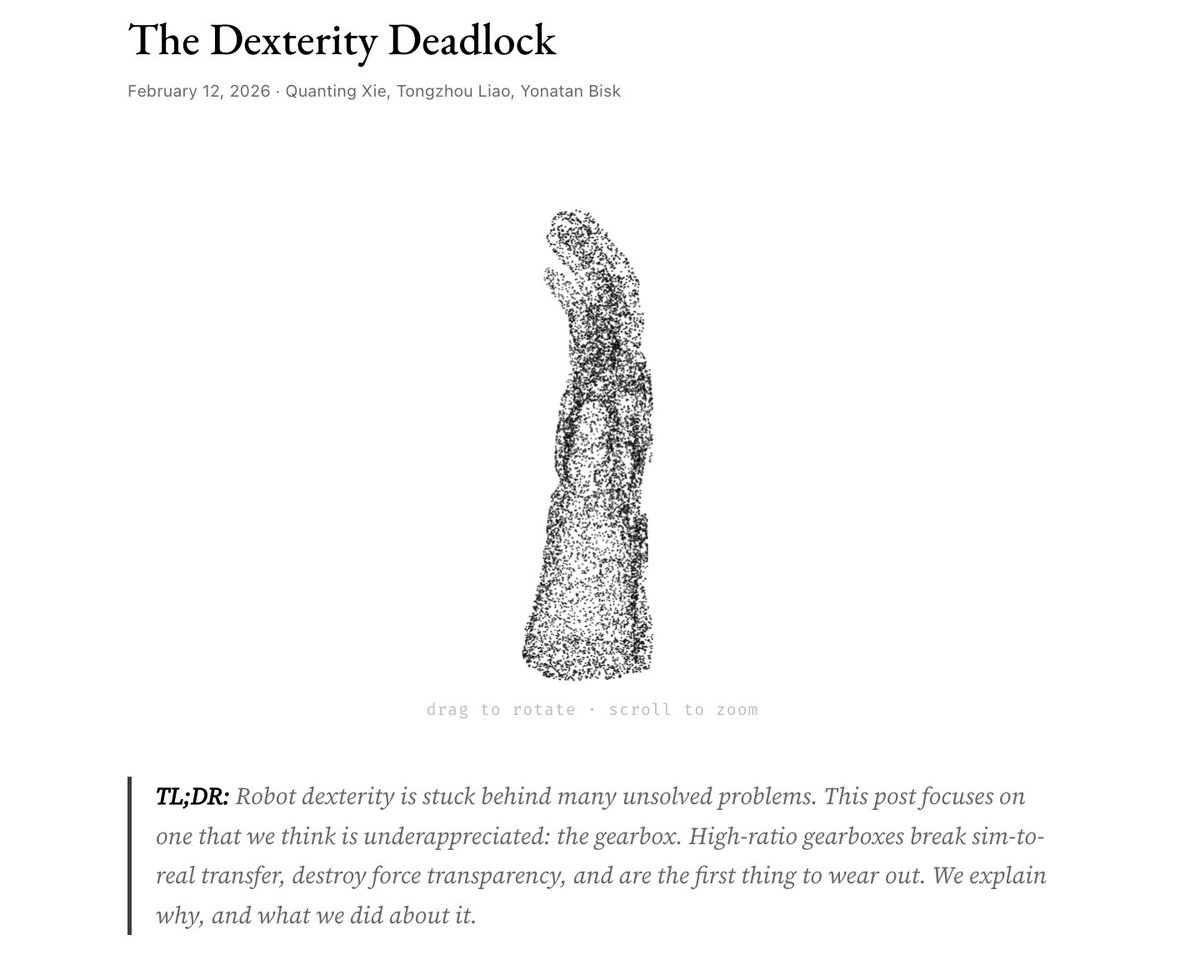
Why does manipulation lag so far behind locomotion? New post on one piece we don't talk about enough: The gearbox. The Gap You've probably seen those dancing humanoid robots from Chinese New Year. Locomotion isn't entirely solved; but clearly it's on a trajectory. But we haven't seen anything close for manipulation. 𝗪𝗵𝘆? When sim-to-real transfer fails, the instinct is to blame the algorithm. Train bigger networks. Crank up domain randomization. Those approaches have made real progress; we don't deny that. But we started wondering: are we treating the symptom or the disease? The Hardware Bottleneck: Fingers are too small for powerful motors. So most hands use massive gearboxes (200:1, 288:1) to get enough torque. But those gearboxes break everything manipulation needs:
• Stiction and backlash are complex to simulate. Policies trained on smooth physics hallucinate when they hit that reality.
• Reflected inertia scales as N². At large gear ratio, the finger hits with sledgehammer momentum.
• Friction blocks force information. The hand becomes blind.
And they're the first thing to break. What we are trying to build at Origami, we cut the gear ratio from 288:1 to 15:1 using axial flux motors and thermal optimization. The transmission becomes more transparent: backdrivable, low friction, forces propagate to motor current. Early signs are encouraging. Still running quantitative benchmarks. Why Interactive? I love how Science Center uses interactive devices to explain complex ideas. I want to borrow this concept and help people understand the hard problems in robotics better visually. The post has demos where you can toggle friction, slide gear ratios, watch the sim-to-real gap widen in real-time. What's inside:
• Interactive demos (friction curves, N² scaling, contact patterns)
• Comparison table: 14 robot hands by sim-to-real gap and force transparency
• The math behind why low-ratio matters
Read it here: https://t.co/imHPaCqNfS We're not claiming we've solved dexterity. The deadlock has many pieces. But we think this one's foundational. Curious what you think.
Today, we present a step-change in robotic AI @sundayrobotics.
Introducing ACT-1: A frontier robot foundation model trained on zero robot data.
- Ultra long-horizon tasks
- Zero-shot generalization
- Advanced dexterity
🧵->
Introducing GEN-0, our latest 10B+ foundation model for robots
⏱️ built on Harmonic Reasoning, new architecture that can think & act seamlessly
📈 strong scaling laws: more pretraining & model size = better
🌍 unprecedented corpus of 270,000+ hrs of dexterous data
Read more 👇
Can robots learn from their own experiences like humans? How can they go beyond demonstrations to discover novel behaviors?
☕️Introducing SOE — Sample-Efficient Robot Policy Self-Improvement via On-Manifold Exploration!
By constraining exploration to the manifold of valid actions, SOE yields diverse yet temporally coherent behaviors — enabling structured, efficient exploration. With simple rejection sampling + imitation learning, the collected rollouts fuel powerful policy self-improvement.
https://t.co/6Ld6jzhSGy
Our Reactive Diffusion Policy (RDP) is selected as a Best Student Paper Finalist 🏆 at #RSS2025!
Come chat with us at our poster tomorrow at the NCD Workshop @ RTH 105.
Excited to attend #RSS2025! 🎉 I’ll be presenting our poster on Reactive Diffusion Policy (RDP) at the main conf and WS:
📌 HRCM WS: Jun 21, 9:50 - 10:25 @ Epstein Plaza
📌 Main Conf: Jun 22 @ Bovard Auditorium
📌 NCD WS: Jun 25, 10:30–11:00 & 4:00–4:30 @ RTH 105
Come say hi!
Excited to attend #RSS2025! 🎉 I’ll be presenting our poster on Reactive Diffusion Policy (RDP) at the main conf and WS:
📌 HRCM WS: Jun 21, 9:50 - 10:25 @ Epstein Plaza
📌 Main Conf: Jun 22 @ Bovard Auditorium
📌 NCD WS: Jun 25, 10:30–11:00 & 4:00–4:30 @ RTH 105
Come say hi!
Today we're excited to share a glimpse of what we're building at Generalist. As a first step towards our mission of making general-purpose robots a reality, we're pushing the frontiers of what end-to-end AI models can achieve in the real world.
Here's a preview of our early results in autonomous general-purpose dexterous capabilities – fast, reactive, smooth, precise, bi-manual coordinated sensorimotor control.
Introducing Dynamism v1 (DYNA-1) by @DynaRobotics – the first robot foundation model built for round-the-clock, high-throughput dexterous autonomy.
Here is a time-lapse video of our model autonomously folding 850+ napkins in a span of 24 hours with
• 99.4% success rate — zero human intervention
• 60% human throughput speed
• 4.3/5 quality ratings (set by the client)
A thread on our motivation, insights and results:
We got a robot to clean up homes that were never seen in its training data! Our new model, π-0.5, aims to tackle open-world generalization.
We took our robot into homes that were not in the training data and asked it to clean kitchens and bedrooms. More below⤵️
Explore and try our RSS2025 paper "Reactive Diffusion Policy", which introduces a fast-slow network framework for visual-tactile policy learning.
Code is fully open-sourced!
https://t.co/UfXmDopGQ6
https://t.co/OiyWPapAQj
Reactive Diffusion Policy (RDP) has been accepted to RSS 2025! Code of RDP and TactAR are fully open-source now!
https://t.co/9qbXlOX9bV
https://t.co/PhoWX2H7CO
#RSS2025