Introducing Ψ₀ (https://t.co/qqH1PiIJS8) — an open foundation model for universal humanoid loco-manipulation.
🏆 Outperforms GR00T N1.6 by 40%+ overall success rate
📉 Uses only ~10% of the pre-training data
📦 Fully open-source: model, data, code, and deployment pipeline
1/10
Jensen today announced Alpamayo 1.5 at #NVIDIAGTC!
#Alpamayo 1.5 is a major update to Alpamayo 1—@nvidia’s open 10B-parameter chain-of-thought reasoning VLA model, first introduced at #CES. Built on the #Cosmos-Reason2 VLM backbone and post-trained with RL, it adds support for navigation guidance, flexible multi-camera setups, configurable camera parameters, and user question answering. The result is an interactive, steerable reasoning engine for the AV community. We’re also releasing post-training scripts to help researchers and developers adapt the model.
Additionally, we’ve significantly expanded the Alpamayo open platform across data and simulation, including releasing highly requested reasoning labels for the PhysicalAI Autonomous Vehicles dataset (https://t.co/fD9eUcndya), as well as our chain-of-causation auto-labeling pipeline.
🔎 Learn more about Alpamayo 1.5 and the latest extensions to the Alpamayo open platform:
https://t.co/P0nuqkwBab (please note that most of the links will become active in the next few days.)
Happy building—and stay tuned for more in the coming months!
@NVIDIADRIVE@NVIDIAAI
What does it take to build autonomous vehicles that can reason about the world they drive in?
Tomorrow at #NVIDIAGTC, Patrick Liu and I will take a deep dive into the #Alpamayo#reasoning model family—a family of reasoning-based vision–language–action (#VLA) models that form a core component of the Alpamayo open platform (https://t.co/EmY9IRNXHZ).
We’ll cover three main topics:
- How reasoning-based VLA models like Alpamayo 1 are designed and built
- What it takes to bring Alpamayo 1 to production, including some of our latest results
- Several exciting announcements about the expansion of the Alpamayo open platform
If you're working on autonomous driving, robotics, or foundation models for physical AI, this session will offer a look at where the field is heading.
Session details:
📅 Monday, Mar 16 | 3:00 PM PDT
📍 #NVIDIAGTC 2026
🔗 https://t.co/ZJk5GGIbFV
Looking forward to seeing many of you there.
@NVIDIADRIVE@NVIDIAAI
Alpamayo 1 is now @huggingface’s top-downloaded robotics model with 100K downloads and counting. 🎉
It helps researchers and autonomous-driving practitioners develop and evaluate vision-language-action models for complex autonomous-driving scenarios, especially rare long-tail events.
🔗 Get started with Alpamayo 1 today: https://t.co/QUrhHkZMbF
🎥 Watch the deep-dive: https://t.co/sxceaDLIjc
💨 How fast can an autonomous vehicle think?
With Alpamayo 1, NVIDIA's 10B-parameter chain-of-thought reasoning model, the distilled version can reason in real time.
Hear Marco Pavone (@drmapavone), Yan Wang, Yurong You, and Wenhao Ding from our AV Research team break down Alpamayo 1 and what's next for reasoning in autonomous driving.
🔁 Watch the replay: https://t.co/q3YcMjoFsn
Join me and my collaborators for a *live* discussion on @nvidia Alpamayo 1 (https://t.co/9nI9L08LJJ), a reasoning-based vision–language–action (VLA) model for autonomous driving.
🎥 Livestream: Inside NVIDIA Alpamayo 1: Making Autonomous Vehicles Reason
🗓 February 11
⏰ 9:00am PST
📍 Watch here: https://t.co/WJkK2AaTkF
As NVIDIA CEO Jensen Huang put it:
“The ChatGPT moment for physical AI is here — when machines begin to understand, reason, and act in the real world. Robotaxis are among the first to benefit. Alpamayo brings reasoning to autonomous vehicles, allowing them to think through rare scenarios, drive safely in complex environments, and explain their driving decisions — it’s the foundation for safe, scalable autonomy.”
During the livestream, we’ll cover:
- How #reasoning-based #VLA models like #Alpamayo 1 are designed and built
- Applications ranging from end-to-end #autonomy to reasoning-driven auto-labeling
- Key opportunities and challenges in developing reasoning models for #Physical #AI
I’ll be joined by core Alpamayo 1 developers @yan_wang_9@YurongYou@wenhaoding95, and we’ll take questions live from the community.
📖 Ahead of time, you might enjoy this overview of the Alpamayo ecosystem:
https://t.co/EmY9IRNXHZ
And if you’re attending @NVIDIAGTC (March 16–19) and would like to meet some of the Alpamayo team in person, you can use my employee code for 25% off your conference pass:
https://t.co/Qd3JkaMBIK
Hope to see you at the livestream!
@NVIDIAAI@NVIDIADRIVE
It’s incredibly exciting to see how quickly the community is engaging with the @nvidia Alpamayo ecosystem for developing reasoning-based autonomous vehicles (https://t.co/EmY9IRNpSr)!
In this instance, TIER IV is showcasing Alpamayo 1’s reasoning capabilities in Tokyo, integrated with Autoware and ROS. Fantastic work, @ShinpeiKato and the @tier_iv_global team! 👏
Quick highlights about Alpamayo:
Alpamayo 1:
- Among HuggingFace’s top 10 overall trending models
- Among the top 3 most downloaded models on HuggingFace when filtered by 'robotics'
Alpamayo PhysicalAI–Autonomous-Vehicles dataset:
- Trending in HuggingFace’s top 10 overall datasets
Happy developing! 🚀
#AutonomousVehicles #Robotics #AI #Reasoning #HuggingFace #Autoware #ROS #AutonomousDriving #PhysicalAI #Alpamayo #RobotLearning @NVIDIAAI@NVIDIADRIVE
More on #reasoning in Vision-Language-Action (#VLA) models --- Traditional VLA models decide what action to take by decomposing complex situations into their most salient factors. But reasoning models can do much more. When viewed as implicit world models operating in a semantic space, they can be used counterfactually—exploring multiple “what if” scenarios before acting.
In our recent paper, Counterfactual VLA (CF-VLA, https://t.co/IMk9CWQ2Zx), we show that counterfactual reasoning consistently improves trajectory accuracy, safety, and reasoning quality.
Key contributions:
- Self-reflective counterfactual reasoning: CF-VLA reflects on predicted meta-actions, anticipates consequences, and revises plans before execution—enabling causal self-correction.
- Automated data pipeline: A novel data pipeline generates counterfactual data, forming a self-improving loop for reasoning and action.
- Adaptive thinking in autonomous driving: CF-VLA focuses reasoning on the most challenging scenarios, improving performance while keeping test-time computation efficient.
Paper: https://t.co/IMk9CWQ2Zx
#AI #Robotics #VisionLanguageAction #AutonomousSystems #MachineLearning #CounterfactualReasoning @NVIDIAAI@NVIDIADRIVE
🚀 Exciting news from #CES2026!
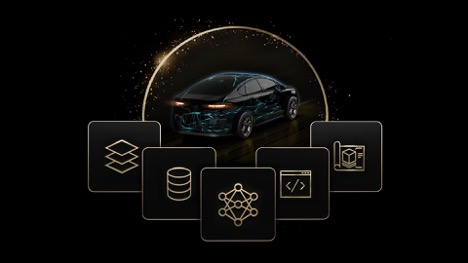
In his keynote today, Jensen announced @nvidia Alpamayo — a *fully open* ecosystem of models, simulation tools, and datasets designed to accelerate reasoning-based autonomous vehicle (AV) architectures and advance the path to Level 4 autonomous driving.
Alpamayo brings together several technologies we’ve developed to enable reasoning-based vision–language–action (VLA) models for AVs. Our goal is to provide researchers and developers with a flexible, fast, and scalable platform for evaluating and training reasoning-based AV architectures in realistic closed-loop settings.
Explore Alpamayo:
-- Press Release: https://t.co/H0ZxzXXsG6
-- Hugging Face Blog: https://t.co/EmY9IRNpSr
-- Tech Blog: https://t.co/htAOupt7Nz
-- Alpamayo 1 reasoning model: https://t.co/8PSdQNCSHg
-- Physical AI AV Dataset: https://t.co/fD9eUcmFIC
-- AlpaSim simulator: https://t.co/9WqutgoGfF
I’m incredibly proud of the @nvidia AV Research team (https://t.co/YI3eJrkbZQ) and our many @nvidia collaborators whose contributions made this possible.
More releases and features are coming soon — we can’t wait to see what the community builds with Alpamayo!
💡 Want to help grow the Alpamayo ecosystem? We’re hiring:
[Sr.] Research Scientist: https://t.co/D4Z0xLE8JX
[Sr.] Research Engineer: https://t.co/5yCpiDJ572
#AutonomousVehicles #AutonomousDriving #AI #Simulation #ReasoningAI #OpenEcosystem #Alpamayo @NVIDIAAI@NVIDIADRIVE
🚗 Imitation learning is everywhere—but is it enough?
So far, imitation learning—most commonly via behavior cloning (BC)—remains the go-to approach for training real-world autonomous vehicle (AV) driving policies. Yet BC operates in an open-loop (OL) fashion, overlooking the critical interdependence among inputs, outputs, and future states that comes with closed-loop (CL) operation. The result? The notorious—but often overlooked—OL–CL gap ⚠️
To address this challenge and encourage broader adoption of CL techniques, we’ve just published a survey (https://t.co/zLPiF17QmW) presenting a comprehensive taxonomy of closed-loop training methods for end-to-end driving. Our framework organizes approaches along three key axes:
- Action generation
- Environment response generation
- Training objectives
💡 Bottom line: enabling technologies—like neural rendering, generative world models, and scalable RL—have now matured, making closed-loop AV training ready for wide-scale adoption.
We’d love to hear your thoughts—drop a comment and join the discussion! 💬
And as a reminder, we are hiring for full-time research scientist and research engineer positions:
🔹 [Sr.] Research Scientist: https://t.co/D4Z0xLEGzv
🔹 [Sr.] Research Engineer: https://t.co/5yCpiDJCWA
@NVIDIADRIVE@NVIDIAAI@nvidia
Proud to contribute to Alpamayo-R1, NVIDIA’s new open reasoning VLA model. Together with the Physical AI datasets and AlpaSim, this release completes an open AV research stack. Excited to see what the community builds next.
We’ve just released @nvidia#DRIVE Alpamayo-R1 (AR1) — the world’s first industry-scale open #reasoning#VLA model for autonomous-vehicle (AV) research. AR1 integrates Chain-of-Causation reasoning with trajectory planning to improve decision-making in complex driving scenarios.
Built on @nvidia #Cosmos #Reason, AR1 is designed as a customizable foundation for a broad range of AV applications — from instantiating an end-to-end backbone for autonomous driving to powering advanced, reasoning-based auto-labeling tools.
Resources:
Model: https://t.co/9nI9L08LJJ
Inference Code: https://t.co/QpPzLEsFnm
Paper: https://t.co/8PSdQNDqwO
Blog Post: https://t.co/S92N6ff58L
A subset of the data used to train and evaluate AR1 is available in the @nvidia Physical AI Open Datasets: https://t.co/fD9eUcndya
AR1 can be evaluated using AlpaSim (https://t.co/9Wqutgpe5d), @nvidia's newly released open-source AV simulation framework built specifically for research and development. (Separate post on AlpaSim coming soon.)
This release completes @nvidia’s trifecta — model, data, and simulator — to accelerate research and development in the autonomous-vehicle domain. Happy developing, and stay tuned for more!
Huge thanks to the phenomenal team that made this possible @NVIDIAAI@nvidia.
Excited to unveil @nvidia's latest work on #Reasoning Vision–Language–Action (#VLA) models — Alpamayo-R1!
Alpamayo-R1 is a new #reasoning VLA architecture featuring a diffusion-based action expert built on top of the #Cosmos-#Reason backbone. It represents one of the core technologies driving NVIDIA’s push toward Level 4 autonomy and robotaxis (https://t.co/IbGjWrBAfo), as announced by Jensen Huang at #gtc DC last week.
📄 Paper: Alpamayo-R1 https://t.co/8PSdQNDqwO
We present:
- Architecture & Design: How to transform a VLM into a driving-ready Reasoning VLA
- Chain of Causation Labeling: A new framework enabling reasoning-based learning
- Training Strategy: From internet-scale pre-training → AV-specific SFT → RL-based post-training
- Extensive Evaluation: From closed-loop simulation to real-world, on-vehicle testing
📈 Results: Alpamayo-R1 delivers significant performance gains over end-to-end baselines — especially in rare, safety-critical scenarios — all while maintaining real-time inference (99 ms end-to-end latency).
Coming soon: releases of model variants and reasoning metadata built on top of the Physical AI Dataset (https://t.co/fD9eUcndya)—with more updates on the way. Stay tuned!
🙌 Huge thanks to Wenjie Luo and @yan_wang_9 (project co-leads); the @nvidia AV Research team (@iamborisi, @YurongYou, @xinshuoweng, @tianran_, @wenhaoding95, and many others); collaborators across @nvidia Research (@liu_mingyu, @visualyang, @PavloMolchanov, and many others); and the @nvidia AV Product team (Sarah Tariq, Patrick Liu, Jack Huang, and many more). Full contributor list in the Appendix.
@NVIDIADRIVE@NVIDIAAI
Excited to unveil @nvidia's latest work on #Reasoning Vision–Language–Action (#VLA) models — Alpamayo-R1!
Alpamayo-R1 is a new #reasoning VLA architecture featuring a diffusion-based action expert built on top of the #Cosmos-#Reason backbone. It represents one of the core technologies driving NVIDIA’s push toward Level 4 autonomy and robotaxis (https://t.co/IbGjWrBAfo), as announced by Jensen Huang at #gtc DC last week.
📄 Paper: Alpamayo-R1 https://t.co/8PSdQNDqwO
We present:
- Architecture & Design: How to transform a VLM into a driving-ready Reasoning VLA
- Chain of Causation Labeling: A new framework enabling reasoning-based learning
- Training Strategy: From internet-scale pre-training → AV-specific SFT → RL-based post-training
- Extensive Evaluation: From closed-loop simulation to real-world, on-vehicle testing
📈 Results: Alpamayo-R1 delivers significant performance gains over end-to-end baselines — especially in rare, safety-critical scenarios — all while maintaining real-time inference (99 ms end-to-end latency).
Coming soon: releases of model variants and reasoning metadata built on top of the Physical AI Dataset (https://t.co/fD9eUcndya)—with more updates on the way. Stay tuned!
🙌 Huge thanks to Wenjie Luo and @yan_wang_9 (project co-leads); the @nvidia AV Research team (@iamborisi, @YurongYou, @xinshuoweng, @tianran_, @wenhaoding95, and many others); collaborators across @nvidia Research (@liu_mingyu, @visualyang, @PavloMolchanov, and many others); and the @nvidia AV Product team (Sarah Tariq, Patrick Liu, Jack Huang, and many more). Full contributor list in the Appendix.
@NVIDIADRIVE@NVIDIAAI
We’ve just released the @nvidia Physical AI Autonomous Vehicles Dataset! https://t.co/fD9eUcndya
Highlights:
- 1,727 hours of driving data collected by @nvidia
- Spanning 25 countries and 2,500+ cities
- Capturing diverse traffic, weather, and driving scenarios
- Includes camera, LiDAR, and radar data
This is just the beginning — features, tools, and challenges will continue to evolve. Stay tuned!
@NVIDIADRIVE@NVIDIAAI
🚗🤖 Interested in reasoning models for embodied AI?
I’m excited to share that at #NVIDIAGTC in DC I’ll unveil our latest work at #NVIDIA on reasoning Vision-Language-Action (VLA) models for vehicle autonomy:
I’ll cover how we’re:
• Advancing reasoning in VLA models
• Powering a data flywheel for AV foundation models
• Making autonomous driving more human-like and safer — with real-world driving videos!
🔗 Session info: https://t.co/1sbWdowD4N
📍 Tuesday, Oct 28 • 3 PM
Walter E. Washington Convention Center
The Autonomous Vehicle (AV) Research Group @NVIDIAAI is looking for talented interns! Dive into cutting-edge work—from reasoning models and generative simulation to AI safety—and help shape the future of AV and embodied AI. Ready to push the limits? Apply now: https://t.co/lYoLhRwrYm
Are you a PhD student excited to build the future of Autonomous Vehicles? The @nvidia Autonomous Vehicles Research Group is now recruiting PhD research interns for 2026!!
Apply here: https://t.co/bElo8saaBu
We’re now accepting applications for the 2026–2027 NVIDIA Graduate Fellowships! If you’re passionate about advancing cutting-edge reasoning models for Physical AI applications 🚗🤖, apply here: https://t.co/ZAzpxXxsDS — and be sure to select “Autonomous Vehicles.”
@NVIDIAAI
Can we use simulation to validate Physical AI? Yes—with far fewer real-world tests. We propose a control variates–based estimation framework that pairs sim & real data to dramatically cut validation costs. #AI#Robotics#Sim2Real"
Paper: https://t.co/x870ZHVQYW
@NVIDIADRIVE



![drmapavone's tweet photo. 🚀 Exciting news from #CES2026!
In his keynote today, Jensen announced @nvidia Alpamayo — a *fully open* ecosystem of models, simulation tools, and datasets designed to accelerate reasoning-based autonomous vehicle (AV) architectures and advance the path to Level 4 autonomous driving.
Alpamayo brings together several technologies we’ve developed to enable reasoning-based vision–language–action (VLA) models for AVs. Our goal is to provide researchers and developers with a flexible, fast, and scalable platform for evaluating and training reasoning-based AV architectures in realistic closed-loop settings.
Explore Alpamayo:
-- Press Release: https://t.co/H0ZxzXXsG6
-- Hugging Face Blog: https://t.co/EmY9IRNpSr
-- Tech Blog: https://t.co/htAOupt7Nz
-- Alpamayo 1 reasoning model: https://t.co/8PSdQNCSHg
-- Physical AI AV Dataset: https://t.co/fD9eUcmFIC
-- AlpaSim simulator: https://t.co/9WqutgoGfF
I’m incredibly proud of the @nvidia AV Research team (https://t.co/YI3eJrkbZQ) and our many @nvidia collaborators whose contributions made this possible.
More releases and features are coming soon — we can’t wait to see what the community builds with Alpamayo!
💡 Want to help grow the Alpamayo ecosystem? We’re hiring:
[Sr.] Research Scientist: https://t.co/D4Z0xLE8JX
[Sr.] Research Engineer: https://t.co/5yCpiDJ572
#AutonomousVehicles #AutonomousDriving #AI #Simulation #ReasoningAI #OpenEcosystem #Alpamayo @NVIDIAAI @NVIDIADRIVE](https://pbs.twimg.com/media/G97z6VLWkAEelCx.jpg)





