What we’ve been working on
Since our last update on October 8th, we’ve been focused on improving the infrastructure behind robinhood:0x56910d4409f3a0c78c64dd8d0545ff0705389870.
Distributions were paused from October 18th to the 29th while the system was rebuilt. Protocol fees continued to accrue throughout that period and were deployed into stocks once the new setup went live.
Since October 29th, three distribution cycles have completed, sending roughly $23,600 in stocks to 4,163 wallets.
The upgraded setup includes:
• Fixed 36-hour cycles for a consistent distribution schedule.
• Former holders made whole, with around $3,680 in banked stocks distributed to 5,366 addresses that had fallen below the 10,000 robinhood:0x56910d4409f3a0c78c64dd8d0545ff0705389870 threshold.
• Built-in price protection, with stock purchases and ETH → USDG conversions limited to within 1.5% of trusted prices.
The result is a more predictable, secure and scalable distribution system.
Closing the volume gap
A significant portion of robinhood:0x56910d4409f3a0c78c64dd8d0545ff0705389870 trading volume currently routes through pools that do not use the official fee hook, meaning those trades do not contribute to the 3% fee funding stock distributions.
We have already addressed one side of this issue.
Pools holding robinhood:0x56910d4409f3a0c78c64dd8d0545ff0705389870 were previously able to appear as holders and receive distributions. Those pools are now excluded, receive $0, and new pools are checked before every cycle.
The remaining fee-bypass issue requires a deeper change and is already in development. We’ll have more to share on the full approach soon.
The objective is simple: robinhood:0x56910d4409f3a0c78c64dd8d0545ff0705389870 trading activity should contribute to the protocol economics it was designed to support.
Expanding the Index ecosystem
A large part of our recent product work has also gone into Blend.
Blend introduces permissionless onchain Baskets backed by tokenized assets. Each Basket represents defined quantities of its underlying assets in a single share and can be bought, sold, redeemed and integrated into other applications.
For robinhood:0x56910d4409f3a0c78c64dd8d0545ff0705389870, Blend adds another source of protocol activity and revenue, expanding the ways onchain activity can ultimately flow back into stocks.
What comes next
The distribution infrastructure is stronger, the fee-routing issue is being addressed, and Blend is expanding the ways tokenized assets can be used across the Robinhood ecosystem.
Our focus remains the same: build useful infrastructure around onchain stocks and return more of the value generated by that infrastructure back into the Index ecosystem.
Stocks for everyone.
What card did you pull? 🟡🟣🔵
The STOXA Stock Gacha is open for early access.
1 pull per person · cards from $5 to $2,000.
Join 👉 https://t.co/BrwubD2VJE
Drop your pull below 👇
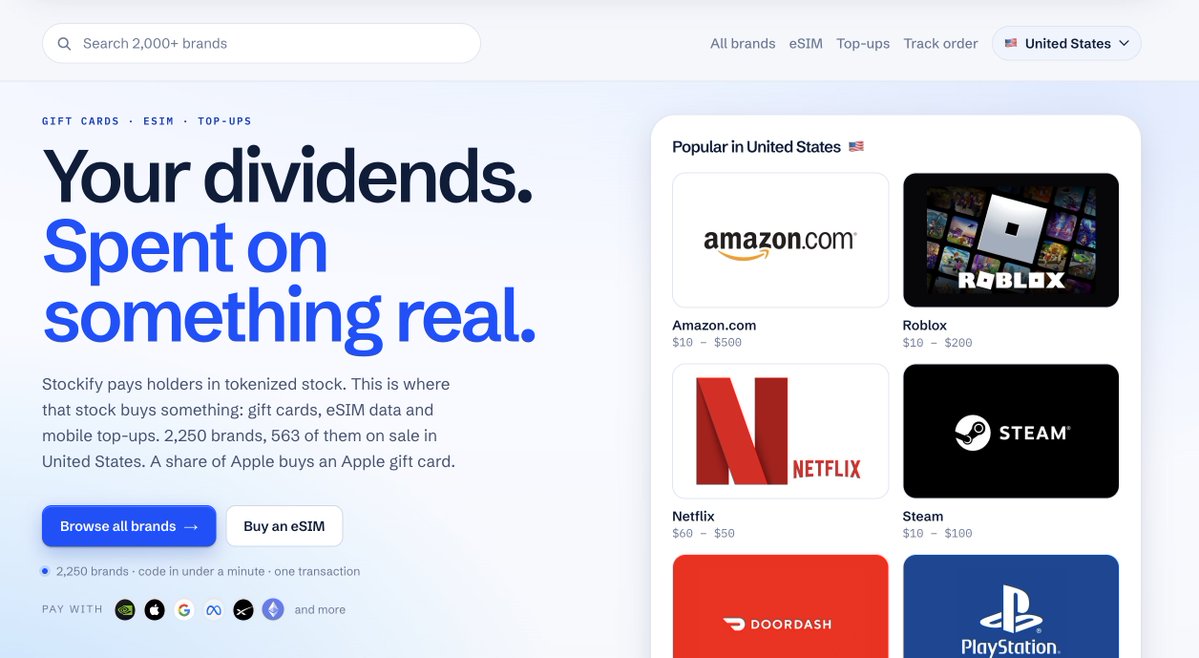
Stockify is now part of The Stonks Exchange.
Same $STFY. Same payouts in real stocks. Now with $STONKEX in the index.
Base is going all-in on tokenized stocks, and so are we.
A new era on @base has arrived. 🐂 📈
Launch a coin against Base assets, now powered by @aeroxyz. More stocks, bigger creator fees, increased $STONKEX flywheel, and fees that can pay any social account.
Stonks Exchange V2 is live, what's new 👇 🧵
Claude has discovered a previously unknown enzyme system hidden in the DNA of bacteriophages. Beside the enzyme’s gene sits a long array of repeating DNA—a structure that looks somewhat similar to CRISPR.
We don’t yet understand what this system does, but only a handful of known systems share its features, and all of them are able to cut, copy, and paste DNA. Historically, the discovery of such programmable systems has helped revolutionize medicine. CRISPR, for instance, is now the foundation of genetic medicines. But it will take much more work to learn what this system does, and whether it can be put to similar use.
Read more: https://t.co/RuEosScSMb