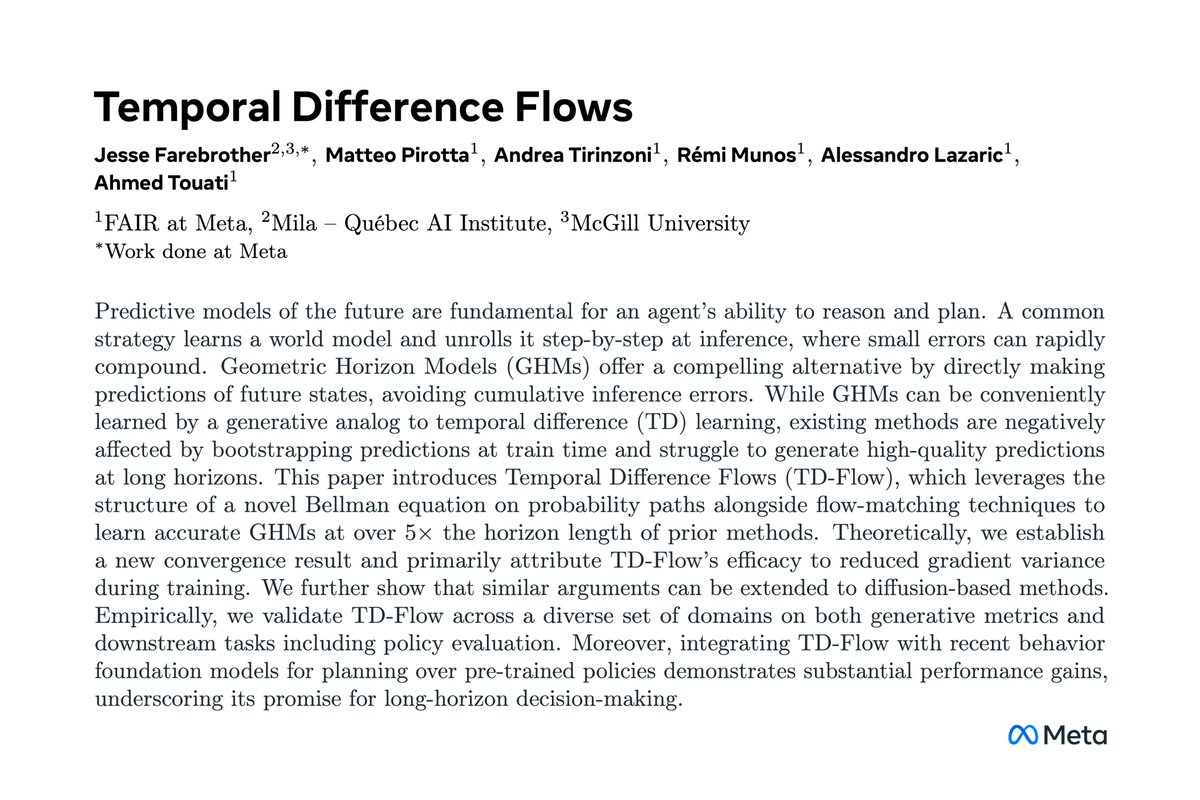
Honored that our paper Temporal Difference Flows received the Best Paper Award at the #ICLR2025 World Models Workshop, and has also been accepted as a spotlight for #ICML2025! All made possible with the exceptional team @AIatMeta!
📄https://t.co/bMxoJDiH5X
https://t.co/qsn7mYkoR7
Neural networks were mostly built up in the single-task, supervised learning setting and I believe taking this optimization perspective can be useful to propose new building blocks for neural networks more suitable for continual learning and RL. Excited to see where this goes!
#NeurIPS2024
Come see our poster on "Parseval Regularization for Continual RL" tomorrow from 11am to 2pm in the West ballroom, poster #6304!
https://t.co/gXkbtvCdsA
We propose a simple solution to mitigate loss of plasticity and enable learning of sequences of RL tasks.
More...
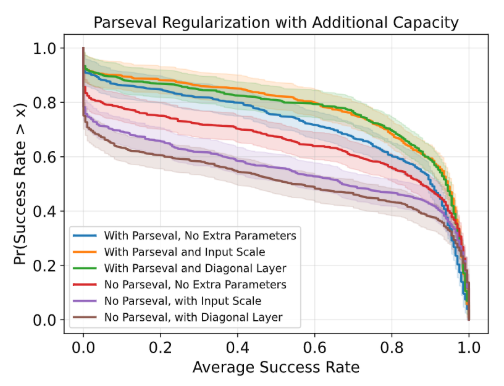
When using Parseval regularization, the network's expressivity may be overly constrained so we find it useful to introduce a few additional parameters, either as a learnable input scale or as diagonal layers (one additional learnable scale and bias per neuron).
Can reinforcement learning from AI feedback unlock new capabilities in AI agents?
Introducing Motif, an LLM-powered method for intrinsic motivation from AI feedback. Motif extracts reward functions from Llama 2's preferences and uses them to train agents with reinforcement learning.
On the complex NetHack game, Motif solves previously unsolved tasks without needing any expert demonstrations. Surprisingly, Motif's reward leads to better game score than the one obtained by using the score itself as a reward.
Given access to an event captioning mechanism, a few properties make Motif a general method:
• it is entirely based on open models
• the LLM doesn't need direct access to the environment dynamics (e.g., its source code)
• the LLM doesn't need to understand observation and action spaces
The best part? You can start using Motif right now, even on a small compute budget: the whole pipeline can take less than two GPU-days.
Feel free to read our paper and try our code out.
Paper: https://t.co/qHJqpJX6Gl
Code: https://t.co/aqDGr2LsXo
Blog post: https://t.co/ULDRodTcyK
Work co-lead by @MartinKlissarov and myself, with @shagunsodhani@robertarail@pierrelux Pascal Vincent @yayitsamyzhang @HenaffMikael
Learn more in the thread 🧵
What algorithms can Transformers learn?
They can easily learn to sort lists (generalizing to longer lengths), but not to compute parity -- why?
🚨📰 In our new paper, we show that "thinking like Transformers" can tell us a lot about which tasks they generalize on!
We're pleased to inform you that your ICML'21 submission Beyond Variance Reduction: Understanding the True Impact of Baselines [...] has been accepted!
Huge congrats to Wesley & Valentin for their persistence and hard-work!
w/ @wes_chung*, @lanternol* & @le_roux_nicolas.
🧵👇🏻
I wrote a blog post on how baselines affect much more than variance in policy gradient methods. It discusses a paper we recently put out on arXiv.
Blog post: https://t.co/6KiGU5Ziuw
Paper: https://t.co/URRfFSHKcS
This paper is with @wes_chung, @lanternol, and @le_roux_nicolas.
[1/6] Our new preprint is now available on arXiv. We revisit baselines in policy gradient methods and show that they have a much bigger role than simply variance reduction! With
Wesley Chung, Valentin Thomas, and @le_roux_nicolas.
https://t.co/4lvyyHXSyB
Discounted reinforcement learning is fundamentally incompatible with function approximation for control in continuing tasks.
To learn exactly why, check out our new paper (w/ Roshan Shariff, @yasuiniko, and Rich Sutton): https://t.co/Xr6apzo53G
The #NeurIPS2019 camera ready version of Resampling for prediction is now on arxiv, and released code all written in @JuliaLanguage! Thankful for all the hard work from my collaborators @wes_chung, Dan Graves, Jian Qian, and Martha White! Check it out here:https://t.co/OsqhfvWzSz
We at @UAlberta and @AmiiThinks have just launched the fourth and final course of the @coursera Reinforcement Learning Specialization. Check it out if you want to learn RL from first principles!
Hello World! This account will share the latest news and updates about what the Reinforcement Learning and Artificial Intelligence (RLAI) Lab at the University of Alberta is up to. Let’s figure out intelligence!