A free website to give you the confidence to search the best databases for academic literature and clinical trials. Follow us for updates. #searchsmart
If you are working in social sciences and are interested in knowledge synthesis, this paper is for you:
"How to search for literature in systematic reviews and meta-analyses: A comprehensive step-by-step guide"
@wesearchsmart is used to identify most suitable databases.
1/📢 NEW PAPER ALERT!
"How to search for literature in systematic reviews and meta-analyses: A comprehensive step-by-step guide" is out! 🎉
🔗 Its open access and available here: https://t.co/KMCNbeiRou
🧵👇
!!! The paper that presents Search Smart is finally online. Read how the tool may help you in finding the most suitable academic databases: https://t.co/Yr5yVRoeKn
🚀 Read my latest publication presenting 𝗦𝗲𝗮𝗿𝗰𝗵 𝗦𝗺𝗮𝗿𝘁—𝗮 𝘄𝗲𝗯𝘀𝗶𝘁𝗲 𝘁𝗼 𝗲𝘃𝗮𝗹𝘂𝗮𝘁𝗲 𝗮𝗻𝗱 𝗰𝗼𝗺𝗽𝗮𝗿𝗲 𝗮𝗰𝗮𝗱𝗲𝗺𝗶𝗰 𝗹𝗶𝘁𝗲𝗿𝗮𝘁𝘂𝗿𝗲 𝗱𝗮𝘁𝗮𝗯𝗮𝘀𝗲𝘀. It allows you to filter and sort databases based on 583 criteria: https://t.co/1fw3m1ee6X
@dr_asadnaveed https://t.co/woMcOAQ6tc covers more than 100 academic databases that can be compared and ranked to see which ones fit you best. A recent publication describes how Search Smart improves research methods: https://t.co/Yr5yVRoMzV
Search Smart now includes @academia and CINAHL (basic version) by @EBSCOhost:
- https://t.co/f6GKkvvuLv is a paywalled database that hosts open access literature.
- CINAHL is a comprehensive index for nursing and allied health literature. Explore more at: https://t.co/pN6IpLmdT6
In the past, we often found that search FAQs at various databases do not reliably display search functionality. We encourage researchers, especially those doing systematic searches, to be aware of search functionality limitations to avoid database biases. https://t.co/Q9KLpVReyd
@ResearchGate had more than 100 mio. page visits last month, making it one of the most popular academic databases and search systems (more popular than @PubMed, just short of Google Scholar).
Their search page notes "you can use AND, OR, NOT, "" and () to specify your search."
While our data shows that @ResearchGate is second-best in forward citation coverage, their search and export capabilities are very limited. Details: https://t.co/ztsra4T6uS
Most people love it as a social media tool, and indeed it should be used that way rather than for search.
Overton covers formats from white papers to national guidelines, making it interesting for research impact assessment. It works well for systematic keyword searching and backward citation searching - also due to generous export options.
🔗 More details: https://t.co/VWvTkgA7LB
📢 Exciting news! Search Smart now covers the @overtonio databases for both scholarly articles and policy documents.
🌐Overton states to offer the world’s largest collection of policy documents, currently indexing over 13 million from more than 188 countries.
🔍 Excited to share my latest research in Research Synthesis Methods! I've analyzed 59 databases, including Google Scholar, @Scopus , @webofscience, and @Lens to find the best for forward/backward citation searching.
📖 Access the open-access study here: https://t.co/tGQpBPSSMs
Interesting for systematic reviewers: @ProQuest now supports bulk downloads of up to 20,000 records. Just create a MyResearch account and download the search results there.
Thx @RaziaAliani for introducing https://t.co/woMcOAPyDE: “Go use this goldmine that people do not know about!“
There are hundreds of databases that noone uses - despite their specific advantages.
Try it out, and be surprised which ones work best!
Stop searching only Google Scholar -> get more RELEVANT
Here's what others won't tell you about choosing from 90+ #databases very EFFICIENTLY
— Go to searchsmart(dot)org.
— Define Your Discipline: Start by specifying your field, like Medicine.
Tip: You can use 𝐤𝐞𝐲𝐰𝐨𝐫𝐝𝐬 as well to be more specific
— Ensure Keyword Search Capability: Check that your databases offer systematic #keywordsearch functionality.
Tip: Check out backward and forward citation features too - pretty useful!
— Assess the Coverage: Look for databases with both high absolute and relative subject coverage.
Tip: Include at least one database SPECIFIC to each subject area of your review for depth and precision (and so look for relative subject coverage) .
— Narrow Down Choices: Pinpoint a few databases, then COMPARE their coverage and functionalities in detail.
Search smart provides you a VERY detailed comparison, example when you're looking to:
- Track historical trends or the development of a topic, 𝐫𝐞𝐭𝐫𝐨𝐬𝐩𝐞𝐜𝐭𝐢𝐯𝐞 𝐜𝐨𝐯𝐞𝐫𝐚𝐠𝐞 helps you gauge the depth and evolution of research over time.
- Zero in on relevant articles, 𝐫𝐞𝐥𝐚𝐭𝐢𝐯𝐞 𝐬𝐮𝐛𝐣𝐞𝐜𝐭 𝐜𝐨𝐯𝐞𝐫𝐚𝐠𝐞 helps you filter databases by your specific research area.
- Explore extensive content options, 𝐚𝐛𝐬𝐨𝐥𝐮𝐭𝐞 𝐫𝐞𝐜𝐨𝐫𝐝 𝐭𝐲𝐩𝐞 coverage indicates a wide array of documents available in the database.
You can maximize its utility by excluding specific fields that aren't relevant to your research.
For eg, if your study is in medicine, you might EXCLUDE energy or psychology to tailor the database's output to your needs.
Remember: The goal is to pair the vast reach of multidisciplinary databases with the FOCUSED depth of specialized sources.
------------------------------------------------------------
Need help with using LLMs & choosing the right tools for your research?
Join the waitlist for an immersive Masterclass next month: https://t.co/2tkLw6thRY
------------------------------------------------------------
Found this helpful? Pass it on!
🔄Scroll to the top: Like and retweet
------------------------------------------------------------
Want FREE tips on using AI in research?
✍ 𝐒𝐢𝐠𝐧 𝐮𝐩 to join 2800+ hashtag#researchers
🔗 https://t.co/NS6wbyr31e
I post about AI in #research & #analysis
🔔Click Follow to simplify your workflow
----------------------------------------------------------
#aiinresearch #literaturereview #searchengine https://t.co/2tkLw6thRY
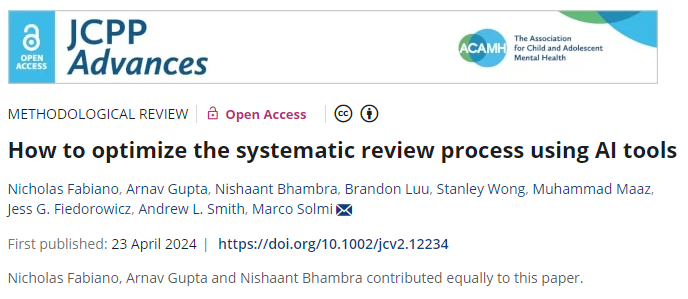
Our new methodological review in @TheJCPPadvances describes how to use AI tools to optimize the systematic review process.
We provide an overview of the AI tools and describe how they can be incorporated to improve efficiency and quality. https://t.co/o6N4dQCYkl
🧵1/28
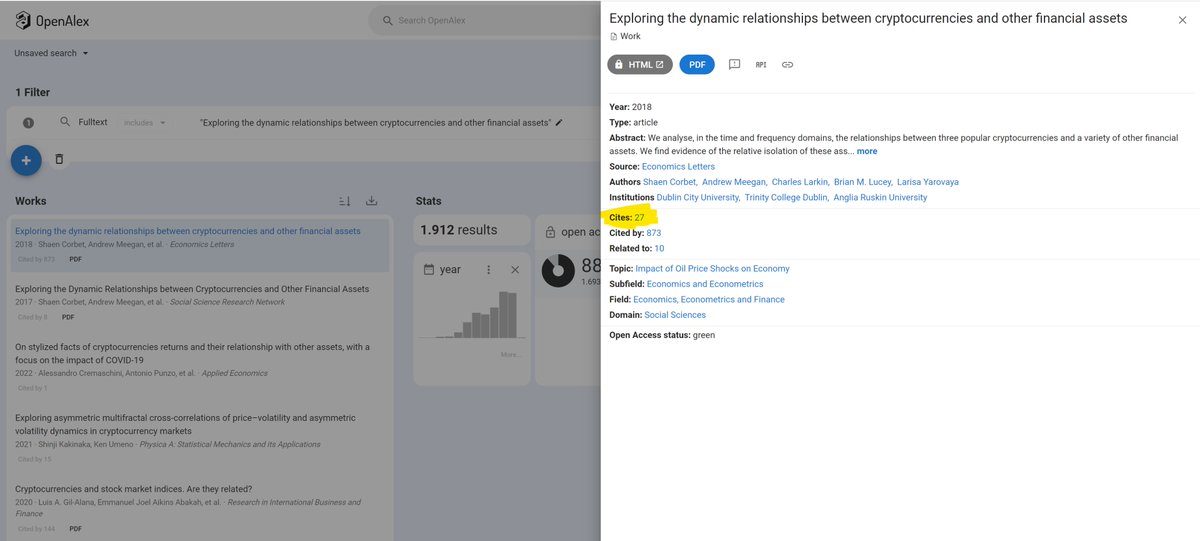
@OpenAlex_org have updated their search interface. They now display backward citations, in addition to forward citations and related documents. Very cool! (before they only provided the info via their API)
🌟 Search Smart has just added a new database: HAL Science (@hal_fr), an open access repository that can be also effectively searched via Boolean queries. Find details here: https://t.co/TMRcyRBeo3
#searchsmart
🧪📖 And there's more! We're thrilled to include @ACSPublications, the journal platform by the @AmerChemSociety. Check out its features and functionality here: https://t.co/0DCPR7dhnP
Stay tuned for some exciting updates in the coming weeks! #searchsmart
🎉 Time to celebrate! 🚀 We've just hit a milestone by adding our 100th database to Search Smart! Welcome @archivescholar, a rising star in search with over 250 million records, some dating back to the year 1500! 📚✨Learn more about what it can do: https://t.co/6PtbkEiaQr
Yet, there are still some caveats to @OpenAlex, particularly for systematic reviewers: it's still missing field codes, backward citations, and our tests show that Boolean searches aren't exact yet. We are excited to see how the system evolves over the next months.
🚀 Exciting News: #OpenAlex is now listed on Search Smart. This platform become a game-changer in scholarly search. What we already like? It's free, fast, comprehensive, and offers innovative features. 🔍📚 Dive into our in-depth analysis at: https://t.co/ZYHrLCevba?~()