We pasteurise milk to kill the bacteria, then sell people probiotic capsules to put the bacteria back, then sell them lactase tablets to digest the milk that used to digest itself.
Three products where the cow already provided one.
Genius, if you happen to own all three companies.
Bear Grylls is about the last man on earth you would expect to be rescued by a steak, which is exactly why his story lands so hard.
The survivalist who has eaten raw goat testicles, camel intestinal fluid and live grubs on camera went vegan in real life, and not by halves. In 2015 he wrote a plant-based cookbook, "Fuel for Life," attacking the "unnatural ways of breeding, keeping and killing animals" driven by our appetite for meat. He told the public, with all the authority of a man who can keep himself alive in a frozen wilderness, that this was better for them and better for the planet.
Then his own body sent the invoice. By his account he was living on endless raw vegetable smoothies and ended up with kidney pain and stones, feeling skinny and weak, sleeping badly. The diet he was selling to everyone else was quietly dismantling the toughest man on television.
So he tore it up and went the other way completely. Red meat, eggs, butter, organ meat, fruit, honey. He says his kidneys settled, his skin and gut cleared, his strength came back, and that he has "never been better" and never feels hungry. He points to the nutrient density he now gets from blood, bone marrow and red meat that years of vegetables, he felt, never delivered.
Plant-based campaigners and several nutritionists have pushed back hard, and fairly so. But high-oxalate foods really can drive stones in susceptible people, which is rather his whole point.
The most striking line was not medical at all. Grylls said he feels embarrassed that he ever promoted veganism, having concluded, after years of study and experience, that he was wrong on both counts. The health and the planet.
When the man who eats anything to survive decides the thing he got wrong was giving up meat, it is worth a moment of your attention.
A quick tour of the plant-based "milks" that were going to save you and the planet.
Almond milk. Ingredients: water, almonds (2%), calcium carbonate, sunflower lecithin, locust bean gum, gellan gum, potassium citrate, dipotassium phosphate, sea salt, natural flavour, vitamin mix. Each litre uses around 1,600 gallons of irrigated water in a state that has been in drought for a decade.
Oat milk. Ingredients: water, oats, rapeseed oil, dipotassium phosphate, calcium carbonate, tricalcium phosphate, sea salt, riboflavin, vitamin A, D2, B12. Hexane-extracted seed oil with a dusting of grain in it. Spikes your blood sugar like a can of Coke.
Soy milk. The soy was grown for the oil. The leftover meal, normally fed to pigs and chickens, is what you are drinking. The industrial by-product of seed oil production, sold to you as the ethical choice.
Coconut milk. Thickened with carrageenan, shown in studies to provoke gut inflammation. Driving deforestation across Southeast Asia. Some Thai producers still use chained monkey labour to harvest the coconuts.
Rice milk. Ingredients: water, rice, sunflower oil, calcium carbonate, sea salt, gellan gum, locust bean gum, vitamins. Sugar water with a faint memory of rice and another splash of seed oil for good measure.
Pea milk. Engineered in a lab in 2015. Ingredients: water, pea protein isolate, sunflower oil, cane sugar, calcium phosphate, sea salt, gellan gum, xanthan gum, sunflower lecithin, natural flavour. The contents of a chemistry set in a carton.
Hemp milk. Tastes like a barn floor. Still contains sunflower lecithin and gellan gum, because nothing in this aisle is allowed to exist without an emulsifier.
Cashew milk. The shells contain a chemical so caustic that the women in Vietnam who hand-process them routinely suffer permanent skin damage. The world's most exploitative latte.
Cow's milk. Ingredients: cow's milk.
Eight thousand years on the table. No marketing budget required.
Yovana Mendoza was, in 2019, the most successful raw vegan influencer in the Spanish-speaking world.
1.3 million followers on Instagram. Two YouTube channels with nearly 2.5 million combined subscribers. A 21-day raw challenge selling on her website for up to $99. Her brand, "Rawvana," was a complete lifestyle package: raw fruit, no animal products, no compromise. She had built her career on the claim that this way of eating had saved her from health problems, alcoholism, and nicotine. Her business depended on her followers believing it had saved her.
Mendoza flew to Bali in March. She called it, on Instagram, "a plant-based paradise."
What had not been disclosed to her followers was that, two months earlier, she had quietly started eating eggs and fish on doctor's orders. The list of diagnoses behind that decision: small intestinal bacterial overgrowth, near-anemia, a non-functioning thyroid, hormone levels her doctor described as pre-menopausal, and a menstrual cycle that had been absent for two years following a 25-day water fast.
In Bali, she went to dinner with a fellow YouTuber named Paula Galindo. Galindo was vlogging. The camera panned across the table. Mendoza, sensing the lens approaching her plate, moved to cover it.
She was too slow.
What the camera caught, for approximately five seconds, was a piece of fish.
The internet, with the forensic precision it reserves for moments like these, freeze-framed it within hours. The 33-minute apology video went up the following weekend. In it, Mendoza walked through the diagnoses, the recovery, the fear of telling anyone. She said her body, after six years of raw veganism, had simply stopped working.
The followers were not interested in the diagnoses. They were interested in the timeline. She had launched her raw ebook in February. She had captioned a gym photo "VEGAN BOOTY GAINS." She had replied to a fan calling her body proof of plant power with a heart emoji. All of it after January. All of it while privately eating fish.
They renamed her "Fishvana." They filled her comments with fish emoji. They calculated the dates.
The body had told her the truth in 2018. She kept selling the lie through March. The fish was what the body wanted. The ebook was what the brand required.
The body won. It usually does. The brand just takes longer to catch up.
Things people forget when they say our ancestors were plant-based:
- Our ancestors were also small.
- Our ancestors also had brains the size of an orange.
- Our ancestors also couldn't speak.
- Our ancestors also couldn't make fire.
- Our ancestors also couldn't make stone tools.
- Our ancestors also couldn't throw a spear.
- Our ancestors also couldn't count past three.
- Our ancestors also couldn't form an abstract thought.
- Our ancestors also flung their own faeces when they got annoyed.
If you'd like all of that back, the plant-based diet is exactly the correct approach.
If you'd like the brain that wrote this post, a different diet was required.
Choose your priorities.
Here's the simple reason ruminant meat (beef, lamb) is metabolically superior to monogastric meat (chicken, pork).
Monogastrics store whatever they're fed. Grain goes in, linoleic acid ends up in the fat. Pork fat now runs around 20% PUFA. Chicken fat around 25%. The bird and the pig are, in 2026, walking vehicles for the seed oils they were finished on.
Ruminants are built differently. The four-chambered stomach biohydrogenates polyunsaturated fats, converting unstable plant oils into stable saturated and monounsaturated fats before the fat is ever laid down.
Grain in. Beef fat still around 2-4% PUFA.
The cow eats the seed oil substrate and quietly disarms it on the way through. The pig and the chicken eat it and pass it on to whoever is eating them next.
Beef and lamb: built-in detox.
Pork and chicken: storage tanks for the food system you were trying to avoid.
If you've cut seed oils out of the cupboard but you're still eating chicken every day, the bottle isn't gone. It's just on a plate.
Kale. Superfood. The leafy green so morally superior that the supermarket has built an entire chiller cabinet around it. The smoothie ingredient your colleague mentions twice a meeting. The garnish that earned a New York Times trend piece, a Beyoncé t-shirt, and its own day on the calendar. Let's have a look at what you actually bought.
Kale is a brassica. Brassicas come loaded with goitrogens, compounds that interfere with iodine uptake and can suppress thyroid function in people who eat them regularly, especially raw, especially in smoothie quantities. The thyroid is the small organ that runs your metabolism, your temperature, your energy, and your mood. The wellness influencer in the kale smoothie advert is not telling you any of this.
It contains a moderate dose of oxalates. Not the worst on the green spectrum, but enough that the daily-kale-smoothie crowd are quietly assembling kidney stones over months and wondering where the back pain came from.
The fibre content the marketing leans so heavily on is insoluble plant matter that the human gut cannot meaningfully digest. It scours the intestinal lining on the way through. Some people tolerate it. Many don't, and discover this only after years of "doing everything right."
The iron is non-haem and poorly absorbed. The calcium is bound by the same oxalates that built the kidney stone. The vitamin K is real, but you'd get more from a couple of yolks and absorb it twice as well alongside the fat.
Then, having eaten the kale, you spend the afternoon bloated, slightly chilly, slightly anxious, and faintly proud.
Three eggs and a piece of grass fed butter would have done the job in eight minutes for less money, with no oxalates, no goitrogens, and no need to talk about it in the office.
Let's talk about the fat.
Not the lean bit. The fat. The white seam running through a ribeye that you've been told to cut off, trim away, render out, discard. The fat removed before the nutrition label is calculated so the numbers look better on the front of the pack. The fat that every chef from Escoffier to your nan knew was the point of the cut.
That fat is roughly half oleic acid, the same monounsaturated fat in olive oil. The fat with a Mediterranean diet named after it, a documentary made about it, and a PR campaign running since 1990.
That fat is largely stearic acid, which is neutral on LDL, raises HDL, and is so well-behaved that even the most nervous cardiologist can't pin anything on it.
That fat is the carrier for vitamins A, D, E, and K. The fat-soluble vitamins. Called fat-soluble because they require fat to be absorbed. Which makes choosing the lean cut and wondering why nothing's improving one of the great metabolic ironies of modern dietary advice.
The fat was never the problem.
The fat is the nutrition. The fat is the satiety. The fat is the flavour. The fat is the reason your great-grandfather worked all day on two meals while you need three and a snack drawer.
Stop cutting it off.
A sheep that is not sheared, dies.
Slowly. Wetly. With flies in the fleece and a temperature it cannot regulate.
The modern sheep, descended from twelve thousand years of selective breeding, no longer sheds its fleece naturally. It cannot. If left unshorn, the fleece keeps growing, traps moisture against the skin, attracts flies, develops fly strike, and kills the sheep slowly and unpleasantly over the course of a wet summer.
Shearing is not done to the sheep. Shearing is done for the sheep.
The shearer arrives in May. The sheep is held still for ninety seconds. The fleece comes off in one piece. The sheep stands up, shakes itself, and walks back into the field roughly four kilograms lighter and visibly relieved. The fleece becomes a jumper that will outlive three of your phones.
The alternative, the one being marketed as compassionate, is acrylic. Polyester. A petroleum-derived plastic spun into fibres that shed microplastics into every wash, every wear, every breath of wind, for as long as that garment exists. Which is forever. Acrylic does not biodegrade. It only breaks down into smaller pieces of acrylic.
The sheep needed shearing. The oil rig did not need drilling.
Have a think about which one is actually cruel.
Bone broth was free with the meat. They sold you collagen sachets.
Liver was cheap. They sold you a multivitamin.
The yolk came with the egg. They sold you a choline supplement.
Fermentation was free. They sold you probiotic capsules.
Tallow was cheap. They sold you a seventeen-step skincare routine.
Sunlight was free. They sold you vitamin D capsules.
Walking was free. They sold you a step counter.
Sleep was free. They sold you melatonin and an app.
Silence was free. They sold you a meditation subscription.
Cold water was free. They sold you a plunge barrel.
Salt was cheap. They sold you electrolyte powder.
Your great-grandmother had none of the products.
She had none of the deficiencies the products are correcting.
The deficiencies arrived with the products.
The products arrived after the advice removed what she had.
Char on a steak contains heterocyclic amines and polycyclic aromatic hydrocarbons. These compounds, in extremely high doses, in isolated laboratory conditions, in rats, have shown carcinogenic effects.
The doses used in those studies, scaled to human equivalents, would require you to consume the charred outer crust of approximately several thousand steaks per day for the rest of your life.
Humans have been cooking meat over open fire for somewhere between two hundred thousand and a million years. The crust on a roasted joint, the bark on a brisket, the blackened edges of a chop pulled from the embers: this is the food our species was built around.
If burnt-edge beef caused cancer at the rate the headlines imply, we would not be here to read the headlines.
Eat the steak.
Enjoy the crust.
To be truly fluent in English,
you must know your shits
Part 2
Dogshit: Very poor quality
Bullshit: Not true
Horseshit: Nonsense
Apeshit: Rambunctious
Batshit: Insane
Chickenshit: Cowardly
Ratshit: Poor quality
No shit: Obviously
Holy shit: Unbelievable
Hot shit: Very good
Dipshit: Total dumbass
Tuff shit: Take it or leave it
Jack shit: Nothing
The shit: Perfection
Deep shit: Big trouble
Shitfaced: Drunk
Shitstorm: Chaos
Piece of shit: Lousy person/thing
Full of shit: Lying
Shit-ton: Huge amount
Shithead: Jerk
Shithole: Terrible place
Brick shithouse: Curvy/voluptuous
No shit, Sherlock: Sarcastic obvious
Don’t give a shit: Don’t care
Shit happens: Oh well
I shit you not: Truth
Shit stirrer: Drama starter
The shits: Diarrhea
Good shit: Excellent
Crock of shit: Nonsense
Shit sandwich: Bad situation
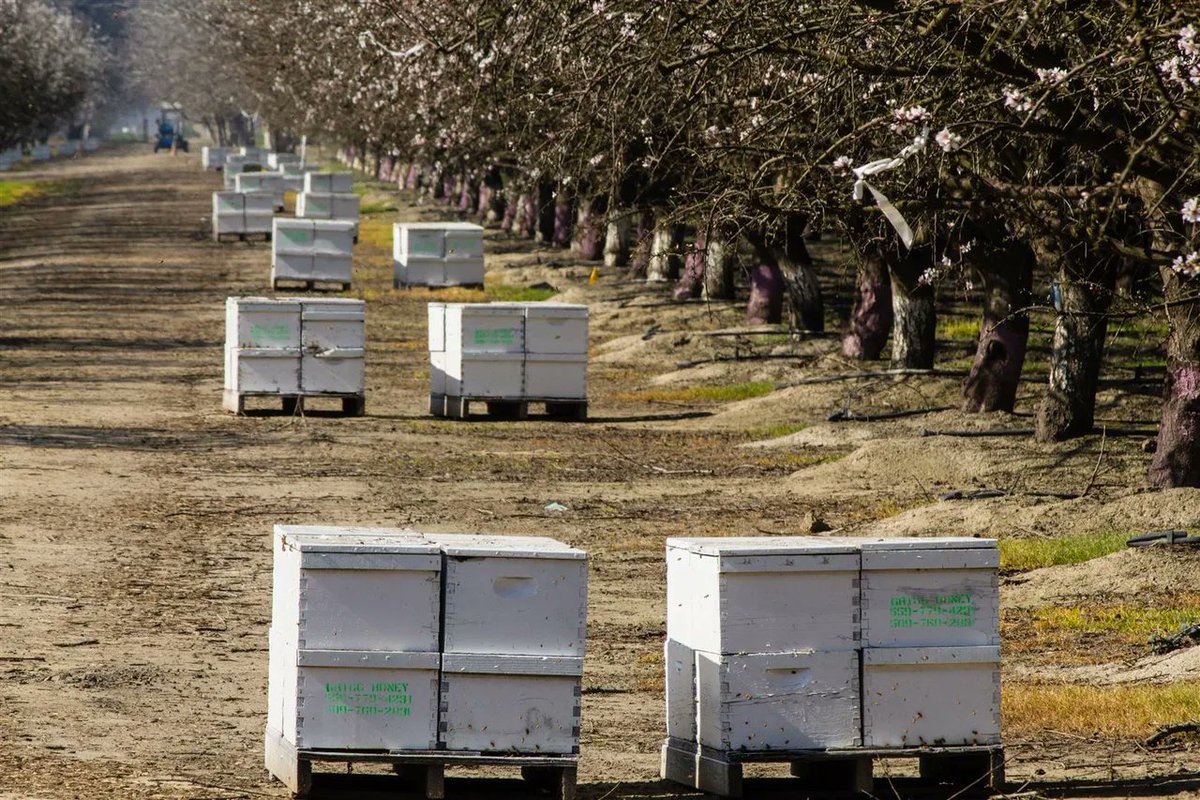
Every February, 70% of the commercial honey bees in the United States, roughly two million colonies, are loaded onto lorries and driven to California. They are going to pollinate the almonds.
80% of the world's almonds come from one valley in California. Over 1.3 million acres of nothing but almond trees, blooming for three weeks in monoculture, requiring more pollinators than the state can produce on its own. So the bees are trucked in from every corner of the country. Florida. New York. Montana.
The bees are fed sugar water for the journey because their own honey has been removed to lighten the load.
They arrive in the Central Valley to a landscape that is, for three weeks, pink and white blossom, and for the other forty-nine weeks of the year, dead. Nothing to eat. No forage. No diversity. Just almond trees and bare dirt, sprayed regularly with fungicides and insecticides that were deemed bee-safe in adult bees but turn out to be lethal to larvae when combined.
In February 2025, commercial beekeepers reported the worst die-off on record. Around 60% of commercial honey bee colonies in the United States dead in a single pollination season. Financial losses estimated well over $139 million. Some beekeepers lost 90 to 100% of their colonies.
The almonds are marketed as plant-based. Clean. Ethical. The preferred alternative.
The preferred alternative requires the single largest managed pollination event in human history and it is quietly killing the pollinators faster than they can be replaced.
Every glass of almond milk is, statistically, a small contribution to the largest pollinator die-off on record.
This is not in the advertising.