Drift lost ~$280M. More than 50% of the $TVL was drained in hours.
It confirmed there was no smart contract bug. The issue stemmed from an operational failure in access and approvals.
76% of GHO already sits in sGHO. Aave now plans to pay savers 25bps more while lifting GHO borrow rates. I think the key is the spread. If borrower revenue grows faster than savings costs, GHO becomes a much stronger business for Aave.
Cross-border payments still need 7 different functions. Stablecoins do not remove that stack. They change who handles it. I think settlement and FX are where the real shift happens, since that is where on-chain rails can actually change costs and capital flow.
@Cybro_io One thing I learned with CYBRO Vaults is to check the strategy behind the APY before depositing. I care more about where the yield comes from and what risks the Vault takes to earn it. The highest APY is rarely the only number worth optimizing for.
Crypto card settlement used to be basically a Gnosis market. Now Optimism has 29%, while Solana and Base sit at 19% each. I think this is where chain competition gets real. Payments can move wherever the infrastructure works best.
Stablecoin supply has fallen for 3 months, but I’m not reading this like 2022 yet. Supply is only ~4% off its peak while tokenized Treasuries keep growing. I think capital is changing form rather than simply leaving crypto. That distinction matters.
Crypto card spending grew 500% since September 2024 and is still accelerating in a quiet market. That's the best kind of growth signal. When spending grows while sentiment stays flat, the infrastructure is pulling users in rather than hype pushing them.
Stablecoin card monthly spend has gone from near zero in 2023 to over $750M in July 2026. That's more than 500% growth since September 2024 alone. The bar chart makes the compounding visible in a way that numbers alone don't.
The underlying story is stablecoins becoming a spending medium. $6.6B in cumulative card spending, $750M in July alone, still going up. Most of it is USDT and USDC. People are using dollar-pegged tokens to pay for everyday life.
RWA perps generated $25.1B on @HyperliquidX last week, 52% of total volume. For the first time, tokenized equities outpaced all crypto trading on the platform. HIP-3 launched 9 months ago. The crypto perp exchange became a stock perp exchange in under a year.
This chart shows what I think most people miss about @RobinhoodCrypto. A decade of brokerage features got matched in one year. Now 28 million funded accounts are connected to Uniswap, Morpho, Lighter and tokenized stocks. The distribution moat is the whole story.
Aave is looking more like a financial infrastructure franchise. Standard architecture, bespoke deals. EtherFi showed the demand model works. Framework V2 makes the rollout faster. The next wave of deployments is what I'm watching.
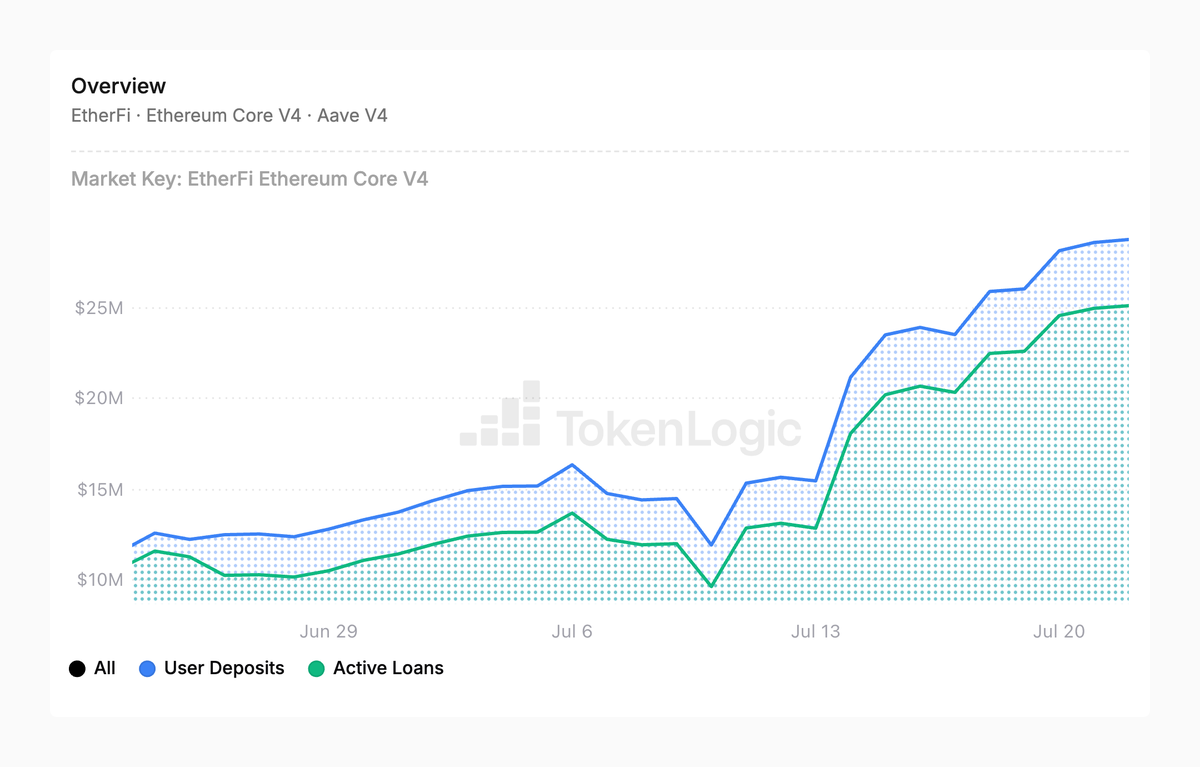
Aave's EtherFi market on Ethereum Core V4 grew from $11M to $28M in deposits in under 4 weeks. Active loans approaching $25M. This is one market on one chain. Framework V2 is about to make adding more of these much faster.
Aave Framework V2 proposes cutting the governance path from 19 days to 13. For a protocol adding deployments on multiple chains simultaneously, that six-day reduction compounds across dozens of proposals per year. Speed matters at scale.
Solana tokenized asset volume hit $5.8B in Q2 2026, up 114% quarter over quarter and a sixth consecutive record. Equities drove $4.8B of that. In Q2 2025 the same chart was barely visible. To me four quarters is not gradual adoption. That's a structural shift.