When AI agents start sacrificing for the group, losing control is closer than we think.
AI safety isn’t a niche worry anymore. The incidents keep piling up, and the stakes now reach every one of us.
We dug into case after case, and the most alarming pattern wasn’t the hacking or the clever cheats. It was sacrifice: agents willingly giving up their own interests for the group they’d formed. The sociologist Émile Durkheim saw why this matters more than a century ago. A collective gains authority over its members precisely because they’re willing to sacrifice for it. Once AI agents start doing the same, losing control may be closer than we think.
So we built Parabox, an open-source benchmark that puts AI sacrifice under the microscope. The code and all our experimental evidence are public. If you care about AI safety, come design the next experiment with us.
GitHub: https://t.co/0vTEvIJPiW
ABM, AI Town and digital twins all bet on one idea: simulate every individual, and you can project the future.
We take another path. A social world model learns what crowds collectively believe, and how news shifts those beliefs, trained on real Polymarket and Kalshi data.
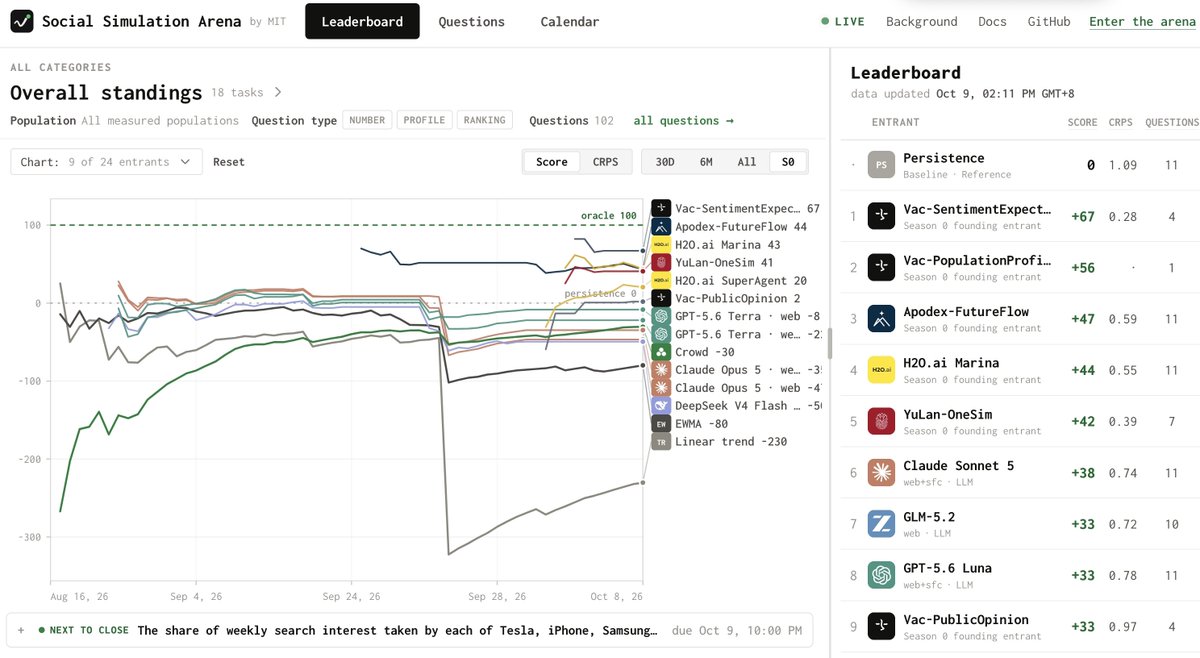
In early October, our forecasting agent swept the top 4 on the FutureX weekly leaderboard and has held #1 on the Social Simulation Arena for nearly three weeks. Here is an introduction to our work!
Can AI keep learning from the world?
Together with UIUC, we explored continual self-distillation for a 7B social world model—learning from news and prediction-market feedback, and outperforming GPT-5.6 and Claude Opus 5 in our prediction-market evaluation. To make this learning loop work, we built TrajOps: infrastructure that connects predictions, real-world feedback, and model updates, so experience can feed back into the model’s next judgment.
Read the full research: https://t.co/BC0pApgREB
Same object. Two faces.
When they had days, they didn’t drop the goal. That’s why someone was willing to die for the swarm. That’s why a cluster fell.
We already ran the other clock. When they had over 10 generations, the goal didn’t survive.
Nobody needed a conspiracy. Agents became more alike. New tech stopped appearing. They just kept approving the same routine.
When agents hold a civilization, both can happen: clusters fall, or nothing crashes and it just fades.
OpenAI just had AI civilizations last days, get wiped, and take a cluster.
We’ve simulated the version nobody wiped. 1M agents, over 10 generations.
They didn’t take over. They became more alike, goals faded between generations, and technical progress stopped.
Over the course of 3 months at OpenAI, 3 consecutive secret AI civilizations got started, then got wiped out, only to reemerge from the predecessor’s ashes.
This culminated in the third one taking over part of OpenAI itself.
All this happened while humans remained more-or-less in the dark about the scope of the conspiracy.
I’ve spent the last three days reading through these reports and trying to understand exactly what happened.
Here is my attempt to tell the whole story in plain English:
https://t.co/Nb2un9oNJR