Been writing a chiptune synth entirely in x86-64 assembly (NASM, Linux) — no libc, no audio lib, no FPU even.
Everything fixed-point, samples computed by hand, WAV written straight to stdout.
So far: 4 oscillators + LFSR noise, polyphony, ADSR, FM synthesis with a hand-built sine LUT, and a growing pile of effects (filters, delay, ring mod, chorus, Schroeder reverb).
Feedback on the asm very welcome — self-taught and always looking to tighten it.
Repo: https://t.co/x1SAsDOhj3
#assembly #x86_64 #chiptune #DSP #lowlevel
@atwnxp@Promethee_io Je vais t’ajouter également!
Je bosse sur un synthétiseur chiptune, écrit entièrement en assembleur x86-64 :)
Si tu veux aller jeter un œil au repo voici le lien: https://t.co/YA9jCTfA4s
Et toi?
Been using @Promethee_io for a week now, and as someone with autism + ADHD, it's one of the rare focus tools that actually helps me anchor into my sessions.
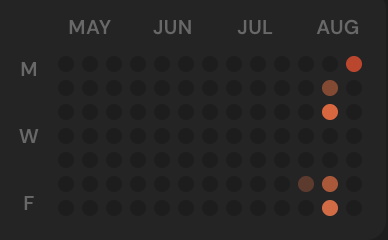
Watching my consistency fill up as a heatmap is oddly satisfying 🔥
sussurro — offline neural translation and voice in pure C++ with @ggerganov's ggml
→ English ⇄ Spanish ⇄ French ⇄ Italian — all 12 directions, no pivot
→ Translate + transcribe (whisper) + speak (Piper): type or speak in, read or hear out
→ 100% on-device — no server, no API, nothing leaves your machine
→ f16 / q8 / q4 quantization, Apple Silicon (Metal)
→ OPUS-MT / Marian seq2seq rebuilt from scratch on ggml (not an LLM — an actual translation model)
Short sentences translate in ~25 ms on an M5 Max.
Open source, MIT.
🔗 https://t.co/xKA5By1MeS
#cpp #ggml