hey @Samiksha2908 , thank you for introducing us to the more in-depth nuances of memory.
i have always been fascinated, and honestly a little amazed, by this beautiful engineering of simulating—or in a way mimicking—the human brain and memory to make agent memory systems more efficient and useful.
the idea that an agent should not just store information, but remember, retrieve, forget, prioritize and reason over context in a meaningful way is incredibly interesting to me.
this is one of the few areas in AI that genuinely excites me.
it is not even close to my usual obsession with low-level systems and writing code close to the metal. i still love that world, and probably always will.
but there is something beautiful about the engineering behind memory systems...
i think my curiosity is now slowly moving towards observability and evaluations as well. understanding how these systems are actually behaving, where they fail, how we measure them, and what work still needs to be done to make them better.
lots to explore. lots to learn....
When you write code yourself, your brain chunks patterns , a for-loop becomes one unit, a design pattern becomes one unit. You build a library in your head over time.
When you paste AI code without thinking or using it to write for you unconsciously, none of that chunking happens.
Your brain never stores the pattern. So next time you see similar code, you're starting from zero again. Sometime those Excali-draw diagrams are much needed to be drawn by you
so the worst part is , you start trusting variable names you didn't choose, abstractions you didn't build, logic you never questioned.
And when something breaks, you're debugging a stranger's thought process with an empty mental model.
If you can't read the code without the AI explaining it back to you, you don't own it.
And The devs who'll win in the next 5 years aren't the ones prompting the best.
They're the ones who understand what comes back.
JAVASCRIPT IS DEAD.
REACT IS DEAD.
NODE.JS IS DEAD.
NEXT.JS IS DEAD.
EXPRESS IS DEAD.
TYPESCRIPT IS DEAD.
VUE IS DEAD.
ANGULAR IS DEAD.
PYTHON IS DEAD.
DJANGO IS DEAD.
FLASK IS DEAD.
FASTAPI IS DEAD.
JAVA IS DEAD.
SPRING IS DEAD.
KOTLIN IS DEAD.
PHP IS DEAD.
LARAVEL IS DEAD.
C++ IS DEAD.
RUST IS DEAD.
GO IS DEAD.
C# IS DEAD.
RUBY IS DEAD.
RAILS IS DEAD.
SWIFT IS DEAD.
DART IS DEAD.
FLUTTER IS DEAD.
SCALA IS DEAD.
PERL IS DEAD.
SQL IS DEAD.
TAILWIND IS DEAD.
SASS IS DEAD.
FIGMA IS DEAD.
It’s interesting how every few months, developers declare a language, stack, or framework “dead,”
while those same tools continue powering billion-dollar companies behind the scenes.
Languages don’t really die.
Trends shift.
The developers who endure aren’t the ones constantly chasing what’s new.
They’re the ones who focus on the craft beneath the syntax.
Hype comes and goes.
Skills take time to build.
Tools may change, but strong fundamentals last.
Pick one language.
Learn it deeply.
Build real things.
Mastery still gets hired.
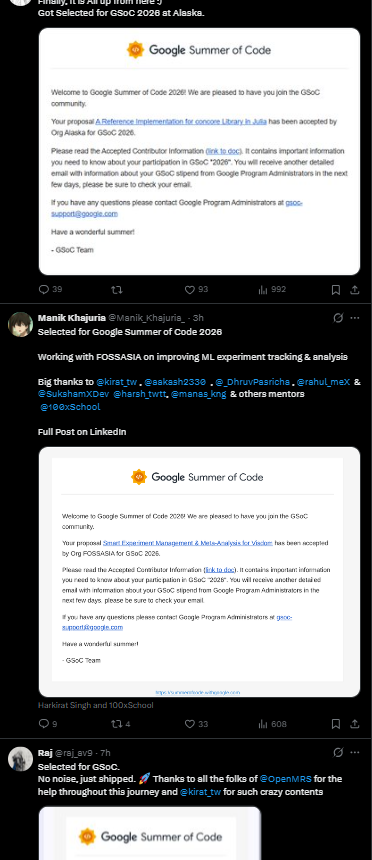
I think I am the only one who's not selected for gsoc😭
No hate to anyone guys, they worked hard so they got into it.
If I had done the same, maybe I would’ve gotten selected too.
@kirat_tw@100xSchool@harsh04044@Manik_Khajuria_@Gautam929 Congratulations to everyone who got selected! I put in a lot of effort this time—50+ merged and 10+ open PRs (including some large ones like 1000+ lines of code) . I was quite confident, but unfortunately my project didn’t get selected this year.