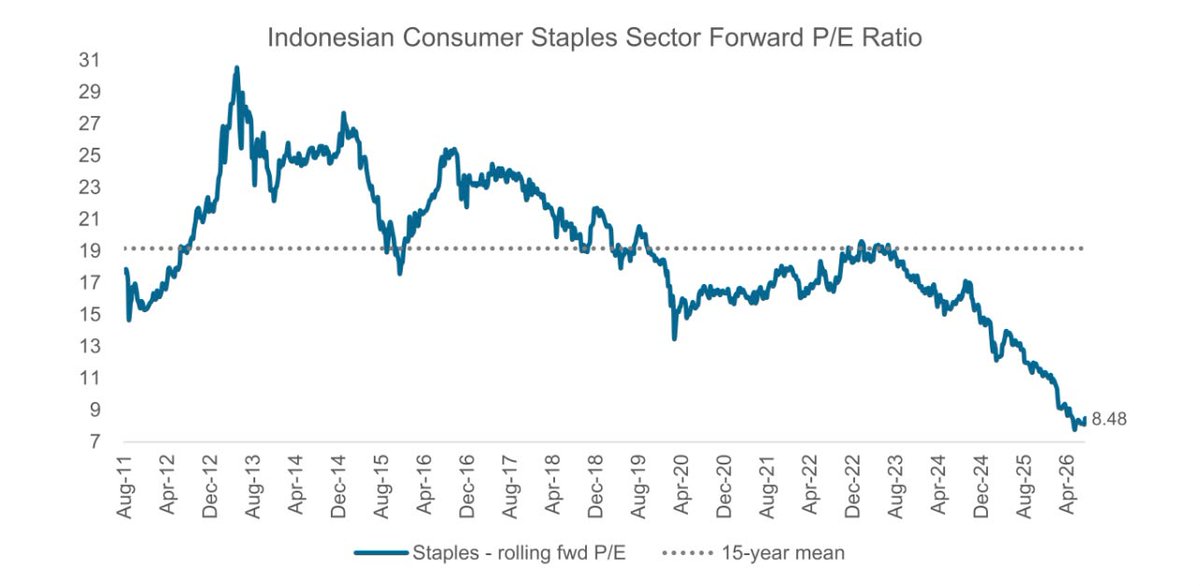
Someone sent me a monthly letter from a Singapore-based fund showing Indonesian consumer staples trading at only 8.48x forward P/E, versus a 15-year average of roughly 19x.
At first glance, it looks absurdly cheap.
My view: there are very good reasons why it is cheap, and anyone expecting Indonesian staples to simply mean-revert back to 20x, 25x or 30x P/E is probably looking at the wrong Indonesia.
The good old days when Indonesian consumer staples routinely commanded 25x to 30x earnings are way, way behind us. Valuation ultimately comes down to two things: Earnings × the multiple investors are willing to pay for those earnings.
On the earnings side, many Indonesian staples remain remarkably resilient. The problem is the second part of the equation. The market is no longer willing to pay the same multiple for Indonesian consumption.
Why?
Because the structural consumer story has deteriorated. Job creation in Indonesia sucks. Good job creation sucks even more. We can celebrate a historically low unemployment rate all we want, but if people are increasingly absorbed into informal, low-productivity employment and the overwhelming majority of new workers earn very little, that does not create the next generation of consuming middle class.
Even among people who managed to find jobs over the past decade, roughly 80% were earning below Rp3 million per month, around US$170. Think about what that means for the consumer ladder.
The entire old Indonesia staples thesis was built around millions of households climbing from subsistence consumption into discretionary consumption: better nutrition, branded foods, personal care, healthcare, dairy products, restaurants, travel and financial services.
But if income progression stalls, the ladder stops moving. You still sell shampoo. You still sell instant noodles. You still sell medicine. But investors stop paying 30x earnings for 5% growth.
That is exactly what happened to Unilever Indonesia. UNVR once traded around 50x P/E because investors were willing to pay an enormous premium for the Indonesian middle-class growth story. Today, nobody cares that it used to trade at 50x. The stock has derated toward the mid-teens because the market changed its assessment of the growth opportunity.
That is the important lesson from this chart.
A stock does not become cheap simply because it trades below its historical multiple. Sometimes the historical multiple was pricing a country that no longer exists.
Of course, there are still bright spots. Cimory ($CMRY), for example, continues to deliver attractive earnings growth because the underlying sector thesis remains compelling. Indonesia's dairy consumption is still relatively low, domestic milk production is insufficient to meet demand, and rising protein consumption should structurally benefit the category.
But even CMRY's share price struggles to break away meaningfully.
Why? Because bottom-up excellence can only fight top-down gravity for so long.
There simply are not enough active foreign investors left looking at Indonesia deeply enough to discover and continuously support stories like CMRY.
And that brings us to the second problem, which has almost nothing to do with consumers.
Indonesia's capital market itself became distorted.
From roughly 2023 until early 2026, Indonesia stopped being primarily an earnings market and became a conglomerate stock market.
Capital poured into concentrated, low-float stocks belonging to large business groups.
Remember the period when the Prajogo Pangestu-linked stocks were trading at 300x, 400x, even 500x earnings, and somehow the stocks kept outperforming?
That liquidity had to come from somewhere. Indonesia does not have an infinite pool of institutional capital. Money flowing into one part of the market means money is leaving another part.
Domestic fund managers were essentially given two choices. Play the conglomerate stocks. Or underperform the index.
Those who joined the trade reduced positions elsewhere, including consumer staples.
Those who refused to participate watched their relative performance collapse, suffered redemptions, and were subsequently forced to sell even more of the stocks they actually liked.
This created an extraordinary feedback loop. Conglomerate stocks went up. Their index weights increased. More passive money was forced into them. Traditional stocks lost weight. Fund managers sold traditional stocks to fund the new benchmark exposures. Their prices fell. Their weights fell again. More money left.
Indonesia's conglomerate boom did not merely inflate conglomerate valuations. It cannibalized the rest of the market.
That is why I think the timing in this chart is extremely revealing. The structural collapse in staples multiples accelerated precisely during the period when Indonesia's market became increasingly dominated by conglomerate stocks.
And because Indonesia is a relatively small weight within MSCI Emerging Markets, index inclusion is almost a zero-sum game. One in, one out lol When another giant conglomerate stock enters MSCI, something else needs to lose weight or leave.
Names such as Kalbe Farma ($KLBF), Indofood ($INDF) and Indofood CBP ($ICBP) became casualties of this combination of derating, relative underperformance and changing index composition. I think Charoen Pokphand Indonesia ($CPIN) could be one of the next victims if the relative market-cap and liquidity dynamics continue moving against it.
This is why simply saying, "Staples are trading at 8.5x versus a 19x historical average, therefore buy," is far too simplistic.
Yes, the sector is trading at roughly 55% below its 15-year average multiple. But historical mean reversion requires the forces that created the historical mean to still exist. Today, several of them do not.
So can Indonesian staples rerate now that the conglomerate-stock pumping cycle appears to be ending?
Possibly.
If domestic institutional investors rotate back toward fundamentals, staples are an obvious destination. Balance sheets are generally cleaner, earnings visibility is better, cash flows are real, governance is easier to understand, and valuations have already been destroyed.
But there is another problem: Who is the marginal buyer? Domestic mutual-fund AUM needs to recover. Domestic fund managers need inflows before they can meaningfully rebuild positions.
And I seriously doubt foreign active managers are suddenly going to rush back into Indonesian staples.
Indonesia's weight in MSCI EM is now only around 0.4% lol At 0.4%, a global emerging-market portfolio manager can practically ignore Indonesia and still sleep perfectly well.
That is incredibly important for valuation. A market rerates when incremental capital competes for assets. If there are very few incremental buyers, cheap stocks can remain cheap for years.
And the foreign-investor problem goes beyond country weight. Indonesia's capital-market ecosystem desperately needs new faces.
Many Indonesian sell-side institutions have effectively lost credibility with serious foreign institutional investors. Talk to investors in Singapore or Hong Kong and Indonesia has developed an ugly reputation as a market where foreign investors are sometimes treated less as partners in price discovery and more as exit liquidity for domestic players.
That reputation is toxic.
And find me a really good Indonesian institutional salesperson today who can sit in front of a global fund manager and discuss ROIC, competitive dynamics, channel checks, capital allocation, industry structure and valuation at the level expected in Singapore, Hong Kong, New York or London.
Maybe zero.
You cannot complain that foreigners do not invest in Indonesia while simultaneously destroying the research, governance, liquidity and market structure required to attract them.
So what would actually make me structurally bullish on Indonesian staples again?
Not merely lower interest rates. Not another consumer stimulus package. Not stocks becoming "cheap."
Indonesia needs to rebuild the middle-class formation machine. Create good jobs. Pay people good salaries. Increase productivity. Move workers from informal employment into productive formal employment. Give households confidence that next year's income will be higher than this year's. Then consumption upgrades naturally.
That is what eventually drives sustainable volume growth, premiumization and operating leverage for consumer companies.
And separately, Indonesia must repair its capital market. Restore credible price discovery. Increase genuine free float. Clean up nominee structures. Bring serious foreign institutional investors back. Rebuild the quality of sell-side research and institutional sales. Grow domestic mutual-fund AUM. Stop designing a market where a handful of concentrated stocks can suck liquidity out of hundreds of fundamentally healthier companies.
Only then can the valuation architecture normalize.
Until those things happen, I would be extremely careful using Indonesia's historical consumer-staples multiple as a valuation anchor.
The chart says 8.48x versus a 19x historical mean.
Someone might look at it and see a screaming buy. I look at it and see the market delivering a message.
Indonesia's staples are not only being priced for lower earnings growth. They are being priced for weaker middle-class formation, weaker institutional liquidity, weaker foreign participation and a fundamentally lower willingness to pay for the Indonesia consumer story.
Some individual companies will absolutely outperform. CMRY can grow. ICBP can compound. INDF can generate cash. KLBF can remain resilient. CPIN can deliver excellent cycles. But a good company does not automatically deserve its old multiple.
For the entire sector to sustainably rerate, Indonesia needs something much bigger than better quarterly earnings. It needs to rebuild both the consumer and the market that used to pay a premium for that consumer.
Until then, 8.5x may look cheap compared with history. But history is not obligated to come back.