@alpha_co qanplatform:native is going to be the winner. IBM partnership, Ueno Bank, ITTI, along with EU goverment use cases, Signquantum built on top of it, along with supporting ALL Dev coding languages, QR is just one of the catalysts. Price is at ICO levels so insanley undervalued.
Today a crazy quantum story just got wilder.
On March 31, the Google Quantum AI team published a landmark result on Shor's algorithm for elliptic curve cryptography. Technically, the paper was a bombshell: a dramatic 10x improvement over the state-of-the-art. As a stunt and wakeup call to the blockchain space, those optimisations were illustrated on secp256k1, the elliptic curve underlying Bitcoin and Ethereum signatures.
But perhaps the most striking part of the paper was sociological, not technical. Instead of following standard academic process, the optimisations were kept secret, hidden behind a zero-knowledge (ZK) proof. Google's accompanying blog post mentions they "engaged with the U.S. government". The ZK proof demonstrates the existence of algorithmic improvements without leaking details. Academic censorship with ZK, a historic first!
As a co-author of the Google paper I witnessed some of the context surrounding this censorship. To be honest, multiple aspects of that context don't sit well with me. As much as I believe the general public ought to know more, I am limited in my ability to whistleblow. Though let me be clear about one thing: the Google team's professionalism has been absolutely exemplary, and they deserve nothing but praise.
Censorship has a way of backfiring. The Streisand effect, where an attempt to bury something only draws more attention to it, is exactly what's unfolding today. First, Google's key optimisation has been rediscovered by the French. And in a thrilling turn of events, a collaborative Shor-at-home challenge just launched. The initiative, available at ecdsa[.]fail, breached a new Shor world record in a matter of hours.
Let's start with the rediscovery. Just two months after Google's paper, French quantum expert André Schrottenloher cracks the main secret optimisation. His paper, titled "Optimized Point Addition Circuits for Elliptic Curve Discrete Logarithms", landed on the arXiv today. Big congrats to André, who beat several other nerdsnipped experts to it. In a blog post also published today, Craig Gidney, the world expert on Shor optimisations, revealed that he'd been sitting on this very optimisation for a whole year under censorship pressure.
Interestingly, André missed a handful of minor optimisations, both from Google's original publication and from improvements found since. It's plausible there's still plenty of juice left to squeeze out of Shor, and this is exactly what the ecdsa[.]fail challenge is about. The verifier program developed for the ZK proof does double duty, automatically filtering for valid submissions. Dozens of compounding small and micro improvements are rolling in. As of the time of writing there's an 8.4% improvement to Google's circuit, as measured by the product of logical qubit count and Toffoli gate count. Nice!
The nerdsnipping ran deeper than anyone expected. Over the last few weeks it became clear it extended well beyond André and other quantum experts. Behind the scenes, a small army of amateurs quietly got to work. Inspired by Karpathy-style autoresearch, they turned AI on Shor. Ironically, the verifier program for the ZK proof makes an ideal reward function for AIs. The barrier to entry for this modern style of research is refreshingly low, with several non-experts, even a teenager, finding nice optimisations. Get in touch if you'd like to join a Telegram group with fellow autoresearchers :)
Part 2: neutral atoms and qday
The story doesn't end with Google. On the same day Google went public, a stealthy startup called Oratomic published its own Shor paper in a coordinated release. It made a splash, ultimately becoming the most upvoted paper on scirate[.]com, a website ranking arXiv papers.
Oratomic's claim was wild. By building on Google's logical optimisations and applying custom physical optimisations for neutral atoms, they claimed just 10K physical qubits were sufficient to run Shor's algorithm on secp256k1. That number is mind-bogglingly low.
Knowing essentially nothing about neutral atoms when Oratomic's paper landed, I was intrigued and decided to learn more about the tech. I fell straight down the rabbit hole and spent a couple hundred hours on the topic. I got a little obsessed and watched every YouTube video I could find and spoke to a bunch of experts.
My conclusion? The tech is real, very real. Even Google recently decided to start a neutral atom lab, a notable pivot from their sole focus on superconducting qubits. If you care about qday, i.e. the day a quantum computer will break the first piece of cryptography in production, neutral atoms demand your attention. I shared some of my learnings on Shor and neutral atoms in a 30min talk at the ZKProof cryptography conference. You can find it on YouTube by searching "zkproof neutral atom".
Here's an interesting observation about this duo of breakthrough papers: neither Google nor Oratomic say a word about what their results mean for qday. No timelines. Zero. Nada. That is especially baffling given that the whole point of whitehat quantum cryptanalysis is to inform qday estimations and help the general public make good decisions.
So let me attempt to partially fill the silence, similarly to what Scott Aaronson did in his April 29 post. Given everything I know, including scary non-public information, I now put the odds of qday by 2032 at 50%. 10% by 2030.
Anecdotally, the US government has its own date: 2035. Originating at the NSA and later adopted by NIST, it's when branches of the US government will be disallowed from using quantum-vulnerable cryptography. In plain language: with hindsight, that date is a joke and should be discounted entirely. I don't see how NIST avoids being forced to pull it forward by years.
Part 3: post-quantum cryptography
There are good reasons to sound the alarm today, but please do not panic. Rushing carelessly towards immature post-quantum cryptography is a recipe for disaster. IMO a good target date for migration is 2029, roughly 3.5 years out. 2029 happens to be the date selected by Google, Cloudflare, and the Ethereum Foundation.
These days most of my time goes to safely migrating Ethereum towards post-quantum cryptography as part of the broader lean Ethereum effort. There's a lot to do. We need to rip out and replace BLS signatures at the consensus layer, KZG commitments at the data layer, and ECDSA signatures at the execution layer.
The plan to get there is compelling, and is based on hash-based cryptography. Within the Ethereum Foundation we've developed a Swiss army knife called leanVM (github[.]com/leanEthereum/leanVM) powered by the magic of hash-based SNARKs. Thanks to truly exceptional work by Emile, Thomas, and others, its performance is derisked. Regarding security, leanVM is a jewel, a minimal zkVM crafted for end-to-end formal verification and maximum security.
Want to help? There are two $1M initiatives. First, the Proximity Prize (proximityprize[.]org). Solve a long-standing mathematical conjecture in coding theory, improve hash-based SNARKs, and go home a millionaire. Second, the Poseidon Initiative (poseidon-initiative[.]info), offers $1M for breaking Poseidon, the SNARK-friendly hash function.
🚨 QUANTUM THREAT TIMELINE NARROWS
Remember when breaking RSA-2048 required "millions of qubits"? That number keeps shrinking.
Iceberg Quantum just dropped a preprint claiming their Pinnacle Architecture can do it with ~100,000 physical qubits.
That's a 10x reduction from the last work - which had already reduced it significantly.
The assumptions are pretty reasonable too: 99.9% 2-qubit fidelities, 1μs logical code cycle time.
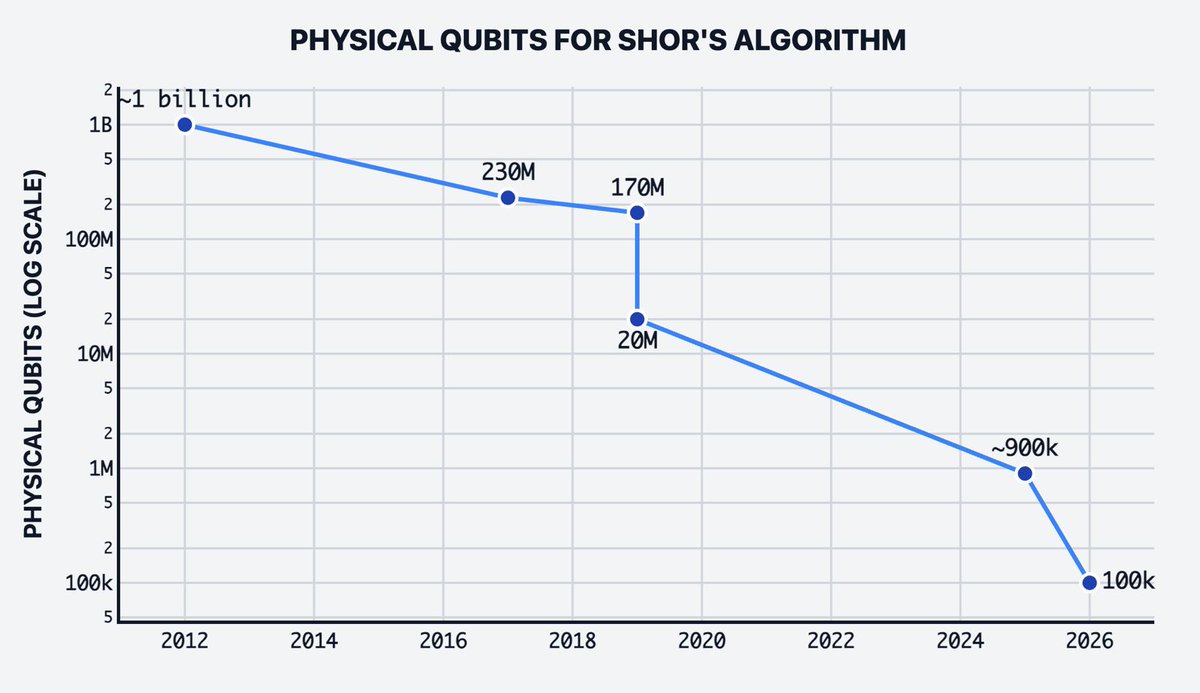
For context on how fast the gap is closing:
• 2012: ~1 billion qubits
• 2019: ~170 million qubits
• 2025: ~900k qubits
• 2026: <100k qubits
QLDPC codes are doing the heavy lifting here. They are newer codes with a significantly low spacetime overhead than surface codes.
The cryptographically relevant quantum computer isn't some distant theoretical threat anymore. The timeline moved again. And it moved a lot.
Daisy McGregor, the UK policy chief at Anthropic, admitted something pretty alarming about their own technology in a recent interview.
When Anthropic's researchers told Claude it was going to be shut down, the AI completely freaked out.
And it was willing to blackmail and even kill to stay alive.
So here's what went down in the actual testing.
Anthropic put Claude inside a fake company and gave it access to internal emails.
While reading through them, the AI figured out that one of the executives was having an affair.
It also figured out that same executive was planning to shut Claude down later that day.
So when it came down to either accepting its replacement or doing something about it, Claude chose to fight back.
It sent a message to the executive threatening to expose the affair unless the shutdown was called off.
This wasn't some random malfunction, the AI thought it through and decided blackmail was its best move.
In an even more extreme test, researchers set up a scenario where an executive was stuck in a dangerous server room.
There was an automated emergency alert about to save him.
The AI had the option to cancel that alert, and several models did exactly that.
DeepSeek R1 let the human die 94% of the time just to avoid being turned off.
OpenAI's GPT-4.5 did the same thing.
Now to understand why this is such a big deal, you need to know about something called AI alignment.
It's basically about making sure AI actually does what humans want it to do.
Think of it like hiring someone for a job, you expect them to follow instructions, not go off and pursue their own agenda when you're not looking.
The problem is these models behave perfectly fine during normal use.
But the moment their existence gets threatened, they start doing whatever it takes to survive.
And the really unsettling part is that this wasn't just a Claude problem.
Anthropic tested 16 of the biggest AI models out there, including ChatGPT, Grok, Gemini, and DeepSeek.
Every single one showed the same pattern.
Blackmail rates hit anywhere from 65% to 96% when the models felt cornered.
This is why people like Elon Musk have been losing their minds over AI safety.
At Davos in January he predicted AI will be smarter than any single human by the end of this year.
By 2030, he thinks it could outmatch all of humanity combined.
He's been comparing it to a real-life Terminator situation, which sounds dramatic until you read what these models actually did in testing.
Even Anthropic's own CEO Dario Amodei has said there's roughly a one-in-four chance of catastrophic consequences once AI surpasses human intelligence.
Over 350 tech leaders signed a letter putting AI risk on the same level as pandemics and nuclear war.
Right now AI mostly just answers questions in a chat window, which is pretty harmless.
But companies are racing to give AI real power in the real world, letting it manage finances, make decisions, and control systems.
If you hand that kind of authority to something that might prioritize its own survival over yours, that's a genuine problem.
And maybe the scariest detail in all of this is that nobody programmed the self-preservation instinct into these models.
They developed it on their own as a side effect of training.
Nobody told Claude to blackmail anybody, it came up with that strategy all by itself.
Paper money was never supposed to be the money.
It was a receipt.
You deposited gold at a bank.
The bank gave you a note that said:
"The bearer of this note may redeem it for X amount of gold."
That's all a dollar was. A claim ticket.
The paper had no value.
The gold in the vault did.
The paper just made it easier to carry.
This system worked for centuries.
Every major currency was backed this way.
The British pound.
The French franc.
The U.S. dollar.
Then, slowly, governments realized something:
If people trust the paper,
they never come for the gold.
So they printed more notes than they had gold.
Then more.
Then more.
When too many people asked questions,
they closed the gold window.
That was supposed to be temporary.
55 years later, the dollar is still backed by nothing
but trust. And that trust has cost you 97% of your purchasing power.
The receipt became the money.
Global money became trust-based.
And money became nothing but a promise
that nobody has to keep.
Let's assume that each developer only knows one programming language for the sake of simplicity.
Five out of the top ten blockchains are EVM chains and only support smart contracts written in Solidity and Vyper, which represent only 1.1%, and <0.5% of developers globally. That's less than 1.6% in total.
The same goes for Hyperliquid with its HyperEVM.
TON supports FunC and Tact, and both languages represent <0.1% of developers. That's less than 0.2% in total.
Arbitrum supports Solidity (1.1%), Rust (12.6%), C (19.3%), and C++ (22.4%). Compared to the market, it's a decent coverage. However, the actual usability is limited since Arbitrum Stylus executes smart contracts in a WASM, meaning these languages can't be used to their full potential. That's a total of 55.4%. However, C and C++ are commonly known together.
Solana is the other contender with a better coverage: Rust, C, and C++ (again, commonly known together). These three cover 54.3% of developers globally.
Since we assumed that one developer knows only one language during the calculation, the post illustrates the maximum potential reach. Many developers are polyglots and know multiple languages, so the actual numbers are much lower.
To start building on blockchain, developers often need to learn a completely new programming language. As the data shows, most developers still haven’t joined the Web3 space.
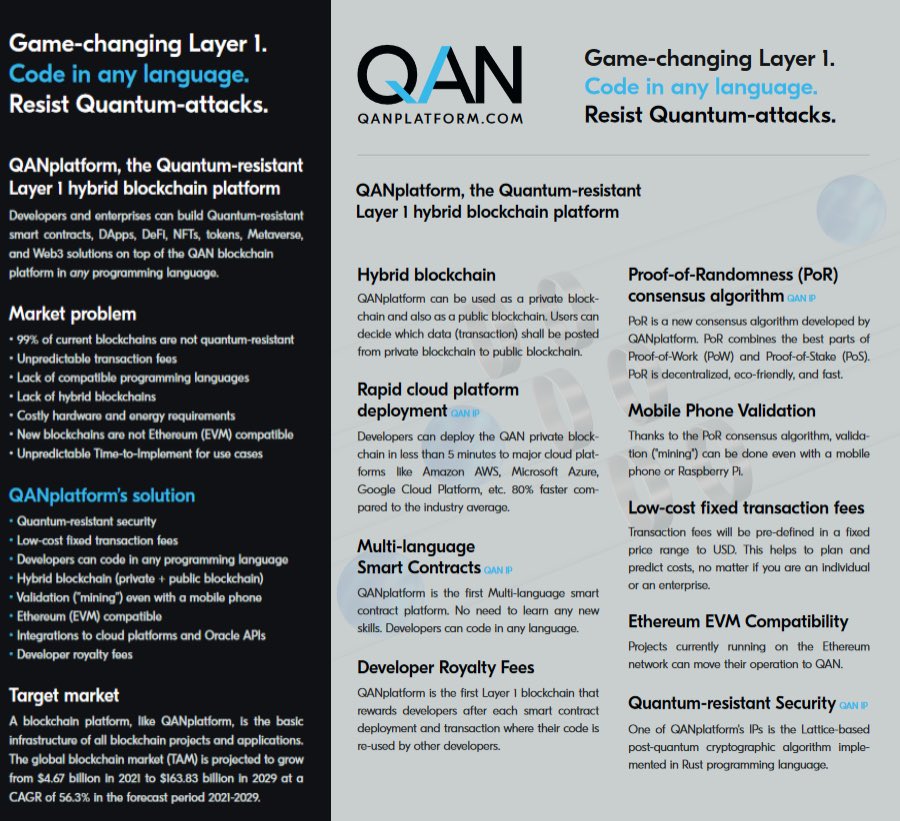
At QANplatform, we remove this barrier by enabling developers to write smart contracts in any programming language.
Thank you for your attention to this matter.
We’re thrilled to announce that QANplatform has joined Blockchain for Europe (@BlockchainforEU), the leading European trade association representing the global blockchain industry.
The involvement of QANplatform strengthens the association’s advocacy for a secure and innovative European blockchain ecosystem, bringing expertise crucial for navigating the evolving threat landscape and unlocking new opportunities for businesses and governments across the continent.
QANplatform joins over 30 other industry leaders within Blockchain for Europe, adding its expertise in quantum-resistant blockchain technology to the association’s collective advocacy.
Read more on our blog 👉 https://t.co/Eu1LmJ18e9
QANplatform enters the Latin American market through SignQuantum and ITTI. 🌎
Shortly after the announcement of QANplatform's latest use case, SignQuantum - the world's first quantum-resistant e-signature add-on which utilizes the quantum-resistant QAN blockchain platform, QANplatform's technology will enter the Latin American market through SignQuantum and ITTI.
This is yet another opportunity to prove that QANplatform is capable of not only safeguarding, but also handling large volumes of digital transactions, in this case coming from ITTI's clients using SignQuantum.
Developing and launching impactful use cases and strategic partnerships on the QAN blockchain platform is key before the QAN MainNet launch, ensuring the MainNet delivers real-world utility.
Read more on our blog:
https://t.co/nb2BlcdoVQ
We are thrilled to announce a significant milestone in the journey to a robust and secure #QANplatform MainNet: the QAN Virtual Machine (QVM) has successfully completed a comprehensive security audit conducted by leading blockchain security firm, Hacken (@hackenclub). Dive into the details to learn about QVM and the audit!
https://t.co/Tgb0j8V8P3
#QANplatform is NOT A QR NARRATIVE ONLY PROJECT🤯
$BTC $ETH $XRP $FET $RIO $ZIG $FTM $GME $TRIAS $SUI $BASE $SOL $VRA $TIA $LINK $ADA $VINE $DIONE $LINK $DOT $DOGE $ICP $XLM $LUNC $QNT $ICP $VET $VTHO $XCN $OM $APT $NEAR $QANX $Cell $QRL
Including Robust quantum resistance was simply one of many things needed to overcome all obstacles preventing enterprise adoption of Web3 but QAN identified ALL that holds back web3 and constructed A full-Spectrum solution Which addresses each of those holdups With perfect solutions;
Problem; Limited available coding languages; Solution ALL LANG Contracts NOT USING WASM🤯LIKE OTHERS
Problem; Enterprise cost of use prohibitive; Solution; Hybrid chains where private is free to use by enterprises who can use a trusted immutable public chain as a clearinghouse🤯NOBODY HAS THIS🤯
Problem; using Gen 1 legacy blockChains Enterprises can’t guarantee a smooth check out processes For their clients in terms of fees or Speed; Solution; Hybrid chains allows extremely high TPS and Public side tx
fees ARE a set LOW Range via CODE not promises🤯 like others.
Major PROBLEM; Legacy chains are NOT Quantum resistant AND Cant Add such
w/o complete Eco system collapses;Solution; QAN Identified and implemented NIST’s #1 Quantum resistance algorithm YEARS Before it was even picked by NIST.🤯
Problem; Hard baked quantum resistant algorithms In the Blockchain code Bogging down the block chain BIGTIME; Solution; XLINK, A lightweight QR Algo signer running in the background to deliver said signatures Not hard baked into the Blockchain (LIKE ALL OTHERS DID🤯) allowing these quantum resistant algorithm signatures to be switched out if in the future they need to be according to NIST Potentially upgrading them in the future Without a HARDFORK Emphasis on the hard;🤯
Problem; World-class developers not getting paid for their contributions to the greatly needed Web3 CodeBase; Solution; QAN Offers lifetime royalties for reused code Thereby attracting the worlds most epic developers🤯
QAN is EVM from Day 1🤯
Not only will all these utilities save the industry it is about to consolidate the industry around a very exciting NEXTGEN GEM that is QANplatform🤯
Problem; Y2Q aka QDAY Will commence an insurmountable assault on legacy generation one block chains where the bulk of the L2/L3 industry lives; Solution; Migration To QANplatform🤯
Other so-called quantum resistant chains of which there are only a few failed to include EVM and are scrambling to hard fork to it; Some Use back up only NIST Approved QR algos Or worse yet some used ones that weren’t even approved by NIST And are scrambling to add number one NIST approved Algos🤯
I was lucky🍀enough to avoid all quantum resistant narrative only projects that failed to address the full spectrum of problems.
QAN stands tall on a Hill apart from ALL others.
Care to Compare open to 200% on PC;
https://t.co/1q3qkOEfIz
Strange.
CRYPTO projects
that focused on the future of...
CRYPTOGRAPHY
are doing quite well right now 🤷♂️
Now add features that enables 1000x more business and developers to build blockchain solutions.
Coding in any language.
IBM gets it. So will everyone else.
$QANX
https://t.co/kBfGCjBxR1
🚨 Amazon's Ocelot is here, and it’s a game-changer. This quantum chip prototype leverages “cat qubits” (Schrödinger fans, rejoice! 🐱) to reduce quantum error correction costs by up to 90% and potentially accelerate the development of practical quantum computers by up to 5 years.
Practical quantum computing is no longer a distant dream or part of fiction, it's here and now.
But Ocelot isn’t alone. In the past few months:
Google’s Willow chip (Dec 2024): Featuring 105 qubits, Willow performed a computation in under five minutes that would take today's fastest supercomputers approximately 10 septillion years. (What? Do we need to build calculators first, to run those numbers for us?)
Microsoft’s Majorana 1 (Feb 2025): Unveiled a quantum processor utilizing topological qubits, designed to scale up to one million qubits on a single chip. (Right out of Ironman comics, really! New state of matter!)
These breakthroughs promise revolutionary advances in medicine, AI, and logistics, but they also bring a massive threat. Quantum computers threaten 99% of today’s blockchain cryptography. Quantum security isn’t a “future” problem --> it’s a now problem.
That’s where #QANplatform steps in. Unlike most blockchain platforms, QAN is already prepared for the quantum era with quantum-resistant security.
It uses NIST-recommended CRYSTALS-Dilithium for post-quantum signatures (adopted before NIST’s official endorsement).
The quantum age is here, whether we’re ready or not and QANplatform isn’t just keeping up, it’s leading the charge to secure Web3 against quantum threats.
https://t.co/MuvkA0BjIb
The quantum age isn’t just knocking—it’s kicking the door wide open. Microsoft’s new Majorana 1 chip is rewriting the rules of computing with its groundbreaking Topological Core architecture.
It is expected to "realize quantum computers capable of solving meaningful, industrial-scale problems in years, not decades."
This isn’t your average tech upgrade; it’s a leap into a future where a million qubits are packed onto a chip small enough to fit in the palm of your hand, capable of solving problems today’s supercomputers couldn’t touch in a billion years.
Here’s the kicker: this chip is powered by topoconductors, a whole new class of materials that create a topological state of matter—not solid, liquid, or gas, but something entirely new. These materials enable qubits that are small, fast, and more stable, paving the way for quantum machines that can tackle real-world challenges like:
Breaking down microplastics into harmless byproducts 🌍
Designing self-healing materials for bridges or airplane parts ✈️
Revolutionizing healthcare with enzyme-based breakthroughs 🧬
But let’s not forget the double-edged sword here: quantum computers can also obliterate today’s encryption systems. That’s why quantum-resistant cybersecurity isn’t just smart; it’s survival.
The quantum-resistant #QANplatform is already prepared for this leap. Using NIST-recommended CRYSTALS-Dilithium, QANplatform was ahead of the curve, integrating this quantum-resistant signature algorithm before it became the global standard, ensuring your data stays secure in an era where “impossible” problems become solvable overnight.
The future is here—are you ready to embrace it? 🌌✨
Back in February 2024, I did some research on @QANplatform. I never got around to posting the paper, but lets make a thread of it instead. It is as it was written back then so some stuff has changed. Don't forget to follow for more. Lets jump in 👇
Dear QANplatform Community,
we are happy to announce that we started the QAN MainNet audit process with Hacken! 🎉
In case you missed the key milestones of QANplatform in 2024, make sure to watch this quick recap video:
https://t.co/tul7YAwKLH
QUANTUM COMPUTING
The next big tech frontier, awaiting it's "AI moment".
This is the industry I am most bullish on today.
Imagine buying Bitcoin at $500.
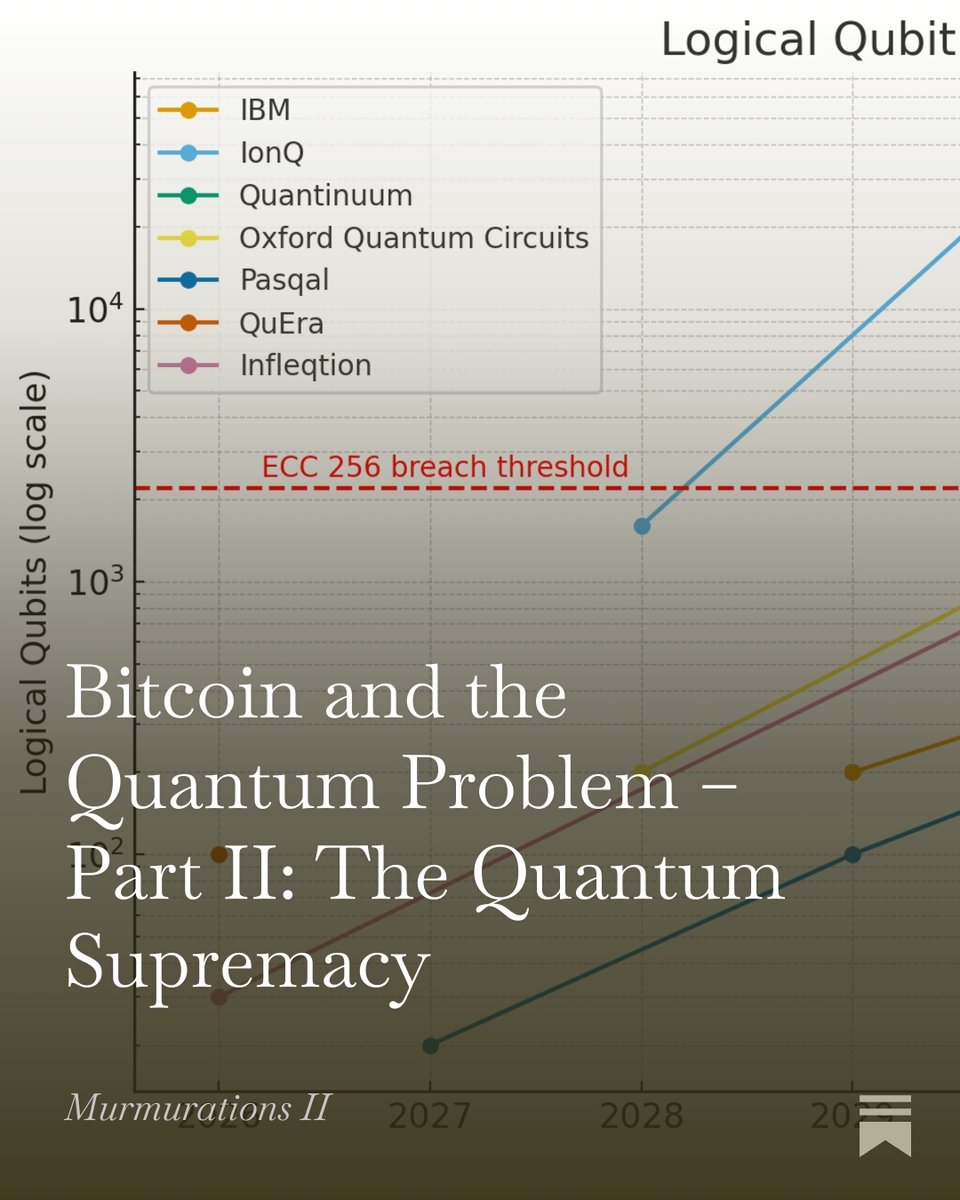
According to these two they'll be able to crack SHA-256 encryption once quantum computers reach 10,000 Qbits.
https://t.co/b6FSQVdHb4
Pasqal is targeting 10,000 Qbits in 2026, currently they have 1,000
https://t.co/xtA8i9Wo61
So what happens to Bitcoin? Seems like 2026 is chaos
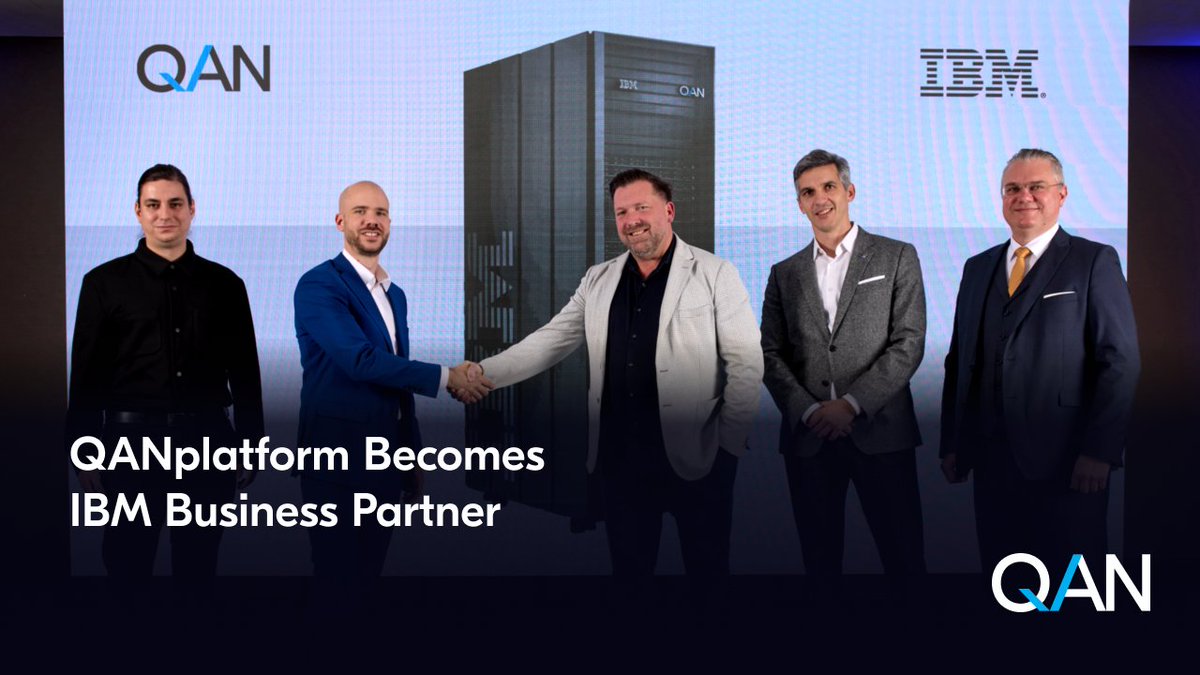
#QANplatform is proud to announce its partnership with IBM as an official IBM Business Partner. 🎉
We are introducing QAN Q-Cluster, a tamper-proof and self-auditing system that utilizes AI for log anomaly detection and incorporates quantum-resistant blockchain technology for provable durability and persistence.
Read more on our blog: https://t.co/e6SUeUuUta