1-Nobody does anything for free, the US has enjoyed the benefits of that superiority along with its $ dominance.
2- what about the GCC countries who’ve been paying that fee all those years. Those got the shittiest deal it seems.
Food for thought.
Trump, Hormuz and the End of the Free Ride
For half a century, Western strategists have known that the Strait of Hormuz is the acute point where energy, sea power and political will intersect. That knowledge is not in dispute. What is new in this war with Iran is that the United States, under Donald Trump, has chosen not to rush to “solve” the problem. In Hegelian terms, he is refusing an easy synthesis in order to force the underlying contradiction to the surface.
The old thesis was simple: the US guarantees open sea lanes in the Gulf, and everyone else structures their economies and politics around that free insurance. Europe and the UK embraced ambitious green policies, ran down hard‑power capabilities and lectured Washington on multilateral virtue, secure in the assumption that American carriers would always appear off Hormuz. The political class behaved as if the American security guarantee were a law of nature, not a contingent choice. Their conduct today is closer to Chamberlain than Churchill: temporising, issuing statements, hoping the storm will pass without a fundamental reordering of their responsibilities.
Trump’s antithesis is to withhold the automatic guarantee at the moment of maximum stress. Militarily, the US can break Iran’s residual ability to contest the Strait; that is not the binding constraint. The point is to delay that act. By allowing a closure or semi‑closure to bite, Trump ensures that the immediate pain is concentrated in exactly the jurisdictions that have most conspicuously free‑ridden on US power: the EU and the UK. Their industries, consumers and energy‑transition assumptions are exposed.
In that context, his reported blunt message to European and British leaders, you need the oil out of the Strait more than we do; why don’t you go and take it? Is not a throwaway line. It is the verbalisation of the antithesis. It openly reverses the traditional presumption that America will carry the burden while its allies emote from the sidelines.
In this dialectic, the prize is not simply the reopening of a chokepoint. The prize is a reordered system in which the United States effectively arbitrages and controls the global flow of oil. A world in which US‑aligned production in the Americas plus a discretionary capability to secure,or not secure, Hormuz places Washington at the centre of the hydrocarbon chessboard. For that strategic end, a rapid restoration of the old status quo would be counterproductive.
A quick, surgical “fix” of Hormuz would short‑circuit the dialectic. If Trump rapidly crushed Iran’s remaining coastal capabilities, swept the mines and escorted tankers back through the Strait, Europe and the UK would heave a sigh of relief and return to business as usual: underfunded militaries, maximalist green posturing and performative disdain for US power, all underwritten by that same power. The contradiction between their dependence and their posture would remain latent.
By declining to supply the synthesis on demand, and by explicitly telling London and Brussels to “go and take it” themselves, Trump forces a reckoning. European and British leaders must confront the fact that their energy systems, their industrial bases and their geopolitical sermons all rest on an American hard‑power foundation they neither finance nor politically respect. The longer the contradiction is allowed to unfold, the stronger the eventual synthesis can be: a new order in which access to secure flows, Hormuz, Venezuela and beyond, is explicitly conditional on real contributions, not assumed as a right.
In that sense, the delay in “taking” the Strait, and the challenge issued to US allies to do it themselves, is not indecision. It is the negative moment Hegel insisted was necessary for history to move. Only by withholding the old guarantee, and by saying so out loud to those who depended on it, can Trump hope to end the free ride.
In the coming days, both Iran hawks and Iran supporters will try to gaslight you.
Two things can be true at once:
1) Trump and Netanyahu are untrustworthy and have defended the strikes dishonestly
2) Iran’s regime is a real threat that must be addressed
I spent 100 hours over the past week researching, writing and editing the piece we just put out.
It’s a scenario, not a prediction like most of our work. But it was rigorously constructed, dismissing it outright requires the kind of intellectual laziness that tends to get expensive.
And we’ve released it for free. Hopefully you enjoy it.
https://t.co/YK8E11GcDU
During the dot-com era, individuals said the internet would wipe out newspapers (free online news), travel agents (self-booking), banks (e-banking replacing branches), & retail (online shopping).
Well today, they’re all still around.
What happened instead is the internet automated routine work, crushed old models, & forced adaptation. The jobs evolved rather than disappeared.
Fast forward to today, no one knows what the future will look like in 5-years but AI is being framed as an extinction event for white-collar jobs. Sure, lots of jobs will likely be displaced but maybe it won’t turn out to be the extinction event everyone thinks at this given moment as humans & companies will just adapt & AI gets absorbed into workflows.
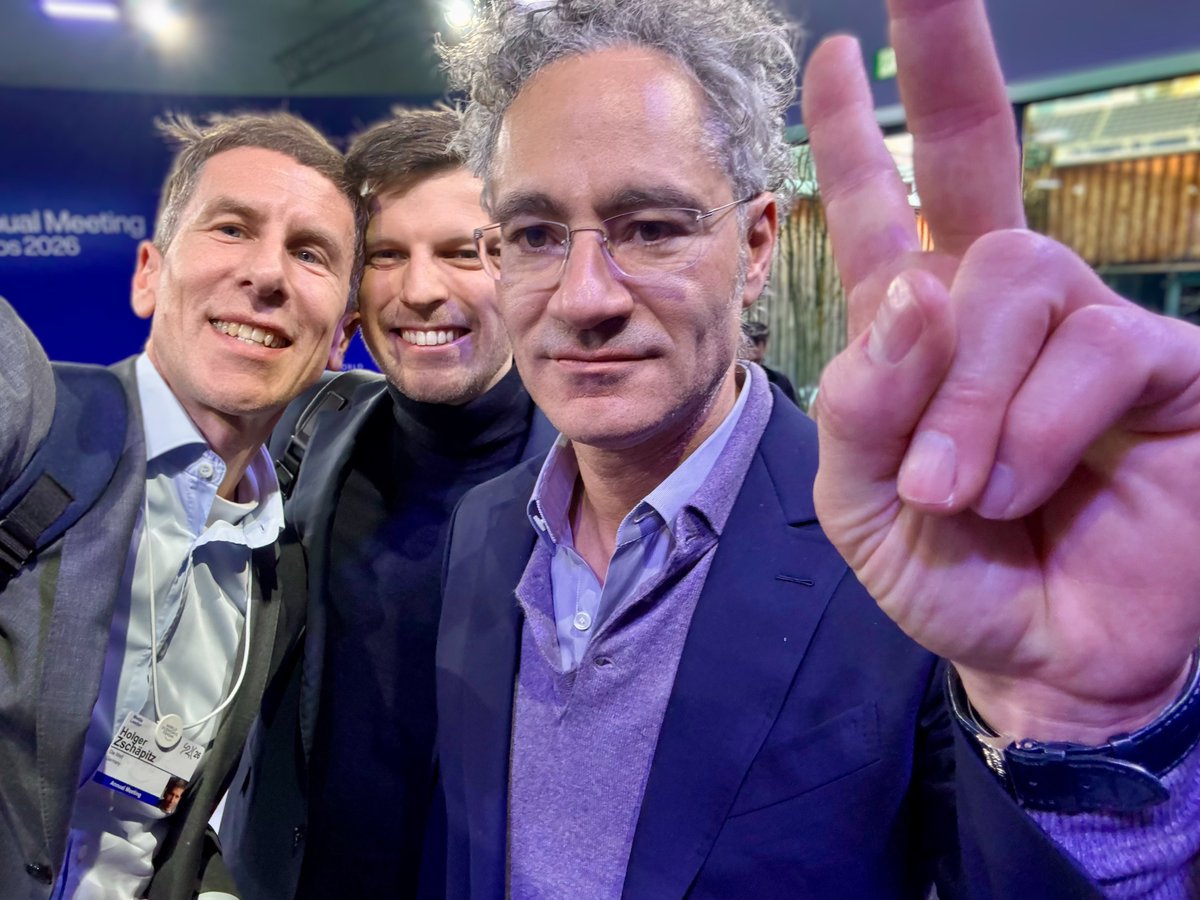
Hello from Davos – What did I learn at this year's #wef26? 🇨🇭🏔️
It was my 13th time at the WEF, but I have never experienced intensity like this.
After the departure of Klaus Schwab, many predicted the Forum would lose relevance. They were wrong. Between Trump’s arrival and the "Greenland Showdown," Davos was once again the center of the world—arguably more relevant now than the Munich Security Conference.
Here are my 7 theses on the new global economy:
1️⃣ Nostalgia is not a strategy
Canadian Chair Mark Carney nailed it: Appeasement toward a hegemon like Trump isn’t diplomacy; it’s simulated sovereignty and actual submission. Middle powers (like Germany) must forge alliances to create critical mass. Carney’s warning was stark: "If you are not at the table, you are on the menu."
2️⃣ Politics vs. Markets: The Great Decoupling
While politicians broadcast doom and gloom, markets remain eerily calm. Investors are looking at numbers, not noise. As long as profits flow, political theater is just background static. Despite the chaos (or perhaps because of it), the USA remains the undisputed "place to be" for business.
3️⃣ The Applause Barometer
Substance was rewarded; slogans were punished. German Chancellor Friedrich Merz received a tepid 8 seconds of applause—little vision. Trump didn't fare much better. The low point? US Commerce Secretary Lutnick, whose attacks on Europe were so fierce that Christine Lagarde walked out of the dinner in protest.
4️⃣ Democratization of Coding
Nvidia’s Jensen Huang dropped the mic: "AI is software that doesn't need to write software. You don't write AI, you teach AI." We are moving from programming to training. In this new era, everyone builds their own custom assistant.
5️⃣ Where is the AI ROI?The anecdotes are great (Cisco doing 19 man-years of work in weeks), but the balance sheets are sober. JPMorgan spent $2B on AI to save $2B. According to PwC, only 1 in 8 CEOs are seeing actual cost reductions or revenue jumps so far. We are still in the investment phase.
6️⃣ "Headcount Flat" is the new "Jobless Growth"The new CEO mantra: Growth without hiring. BlackRock COO Rob Goldstein was clear—they aim to grow massively while keeping headcount flat. If AI drives productivity but freezes hiring across the board, we are steering toward a massive macroeconomic challenge.
7️⃣ Larry Fink’s Humble-Brag: WEF Co-Chair Larry Fink opened panels with a fascinating bit of coquetry. He noted BlackRock’s stock has returned 21% annually since 1999. Impressive? Not compared to the guests he was interviewing: Jensen Huang (40% avg since ’99), Elon Musk (47% since 2010), and Alex Karp (81% since 2020). Top Tech beats Finance, though 21% is still double the market average.
My Verdict: The world is getting rougher, technology is getting faster, and alliances are getting more fragile. "Business as usual" is officially dead.
Meanwhile, every soft landing has had a period of a few months where the jobs market looks dicey. Employment is flat or flirts with contraction. That is always the point where the Fed freaks out and cuts rates, a response that probably helps (but it is hard to say how much)
@TaPlot Been in your shoes buddy, a hard journey but hopefully you’ll come out of it all the better.
Daily tasks, work and family are what will get you through the psychological part.
Wish you all the best mate!
Crypto Community: euphoric for wall street’s adoption.
Reality: Crypto is wall street’s whore now. Playing with it and milking it for fees.
An asset class that is just like any other risk-gauge one.
Donald Trump's plan to stop the chemical, physical and emotional mutilation of America's youth.
1. "Revoke Joe Biden's cruel policies on so-called gender-affirming care."
2. "Sign a new executive order instructing every federal agency to cease all programs that promote the concept of s*x and gender transition at any age."
3. "Ask Congress to permanently stop federal taxpayer dollars from being used to promote or pay for these procedures and pass a law prohibiting child s*xual mutilation in all 50 states."
4. "Declare that any hospital or healthcare provider that participates in the chemical or physical mutilation of minor youth will no longer meet federal health and safety standards for Medicaid and Medicare and will be terminated from the program immediately."
5. "Support the creation of a private right of action for victims to sue doctors who have unforgivably performed these procedures on minor children."
6. "The DOJ will investigate big pharma and the big hospital networks to determine whether they have deliberately covered up horrific long-term side effects of s*x transitions in order to get rich at the expense of vulnerable patients."
7. "Investigate whether big pharma or others have illegally marketed hormones and puberty blockers, which are in no way licensed or approved for this use."
8. "Inform states and school districts that if any teacher or school official suggests to a child that they could be trapped in the wrong body, they will be faced with severe consequences."
9. "Promote positive education about the nuclear family, the roles of mothers and fathers, and celebrating rather than erasing the things that make men and women different and unique."
10. "Ask Congress to pass a bill establishing that the only genders recognized by the United States government are male and female, and they are assigned at birth."
11. "Protect the rights of parents from being forced to allow their minor child to assume a gender which is new and an identity without the parent's consent."
@riachi_jean I believe this is irrelevant at this stage. Lebanon is currently not trusted for any type of political maneuvering. What is done is done. Lebanon’s back is now against the wall and its best option is to fight back.
🧵One year ago, Hezbollah made the fateful decision to open a second front against Israel "to support" Gaza.
Israel has since killed its leadership
Destroyed much of south Leb/Beirut
Killed 2,000+
Wounded 10,000
Displaced 1m +
And it seems this is just the end of the beginning.
BREAKING: Toyota has announced it will no longer sponsor LGBTQ parades and events and will no longer make efforts to promote diversity, equity, and inclusion (DEI).
At least 28 on-duty medics have been killed in the past 24 hours in Lebanon, according to the WHO.
Sky's @AlexCrawfordSky is on the ground in Beirut where rescue workers say they are falling victim to Israeli airstrikes.
Read more: https://t.co/DrCbVoNYJ9
The booby-trap attacks in Lebanon have given rise to a fascination and celebration that is important to analyze. Yes, it's a mind-boggling intelligence feat in a merciless war. But there are disturbing undertones to the glee. 🧵
@dcinvestor I strictly use the “following” feed. It is curated to my interests with a diversified number of people who meet my criteria of proper or intelligent thinking/arguments.
The problem interpreting payrolls. 18 mths ago, demand was running way ahead of supply. Massive excess vacancies. Over time, the vacancies have been converted into jobs, and supply has recovered. So vacancies fell and, more recently, employment has slowed. In a normal cycle, those markers could signal an economy approaching its stall speed. But in the current context, it's just really hard to interpret. Sorry if that take is too nuanced for here 🤣