Sure, the true source of value is the goose, but "Creating value is not enough—you also need to capture some of the value you create".
A story from Charlie Munger:
"We were making low-end textiles-which are a real commodity product. And one day, the people came to Warren and said, "They've invented a new loom that we think will do twice as much work as our old ones." And Warren said, 'Gee, I hope this doesn't work-because if it does, I'm going to close the mill.' And he meant it. [...] And he knew that the huge productivity increases that would come from a better machine introduced into the production of a commodity product would all go to the benefit of the buyers of the textiles. Nothing was going to stick to our ribs as owners."
Sure, the true source of value is the goose, but "Creating value is not enough—you also need to capture some of the value you create".
A story from Charlie Munger:
"We were making low-end textiles-which are a real commodity product. And one day, the people came to Warren and said, "They've invented a new loom that we think will do twice as much work as our old ones." And Warren said, 'Gee, I hope this doesn't work-because if it does, I'm going to close the mill.' And he meant it. [...] And he knew that the huge productivity increases that would come from a better machine introduced into the production of a commodity product would all go to the benefit of the buyers of the textiles. Nothing was going to stick to our ribs as owners."
Sure, the true source of value is the goose, but "Creating value is not enough—you also need to capture some of the value you create".
A story from Charlie Munger:
"We were making low-end textiles-which are a real commodity product. And one day, the people came to Warren and said, "They've invented a new loom that we think will do twice as much work as our old ones." And Warren said, 'Gee, I hope this doesn't work-because if it does, I'm going to close the mill.' And he meant it. [...] And he knew that the huge productivity increases that would come from a better machine introduced into the production of a commodity product would all go to the benefit of the buyers of the textiles. Nothing was going to stick to our ribs as owners."
@Hesamation The meaning in art is created not just by the artist, but also the observer. Art is a bridge between their consciousnesses. AI art need not be banned, it will naturally be valued less highly (by humans) because it lacks the same meaning to the observing humans
Freud in Civilization and Its Discontents says there are three strategies against the pain of existence: distraction, substitutive satisfaction (e.g.
art), and intoxication.
Keats' Ode to a Nightingale tries all three and finds each insufficient.
But the materialization of his experience into poetry,
the act of creation, is itself a fourth strategy, neither of them named.
@ImadeIyamu Durant’s writing has is filled with so much artistry; it’s a joy to read anything written by him. I’m currently reading through his list of 100 greatest books
@poetengineer__ this would be a nice interface for obsidian backlinks - one hop links on the adjacent panes, two hop links adjacent to those panes, etc. , each layer getting thinner as the connection grows more distant
Jevon's paradox: efficiency gain in production increases total consumption, not decreases it. Every time coding got easier, more software got built and more developers got hired. I'm seeing projects get greenlit today that were shelved for years, purely because of build cost dropping.
The short term pain is real as although total software consumption/production increases, it is being built by those already in industry. But it's not a stable dynamic long term—as you say, there will start to be a talent vacuum. The lesson for the new generation isn't to forget CS, it's to continue studying CS, but learn to build with AI.
New blackboard lecture w @ericjang11
He walks through how to build AlphaGo from scratch, but with modern AI tools.
Sometimes you understand the future better by stepping backward. AlphaGo is still the cleanest worked example of the primitives of intelligence: search, learning from experience, and self-play. You have to go back to 2017 to get insight into how the more general AIs of the future might learn.
Once he explained how AlphaGo works, it gave us the context to have a discussion about how RL works in LLMs and how it could work better – naive policy gradient RL has to figure out which of the 100k+ tokens in your trajectory actually got you the right answer, while AlphaGo’s MCTS suggests a strictly better action every single move, giving you a training target that sidesteps the credit assignment problem. The way humans learn is surely closer to the second.
Eric also kickstarted an Autoresearch loop on his project. And it was very interesting to discuss which parts of AI research LLMs can already automate pretty well (implementing and running experiments, optimizing hyperparameters) and which they still struggle with (choosing the right question to investigate next, escaping research dead ends). Informative to all the recent discussion about when we should expect an intelligence explosion, and what it would look like from the inside.
Timestamps:
0:00:00 – Basics of Go
0:08:06 – Monte Carlo Tree Search
0:31:53 – What the neural network does
1:00:22 – Self-play
1:25:27 – Alternative RL approaches
1:45:36 – Why doesn’t MCTS work for LLMs
2:00:58 – Off-policy training
2:11:51 – RL is even more information inefficient than you thought
2:22:05 – Automated AI researchers
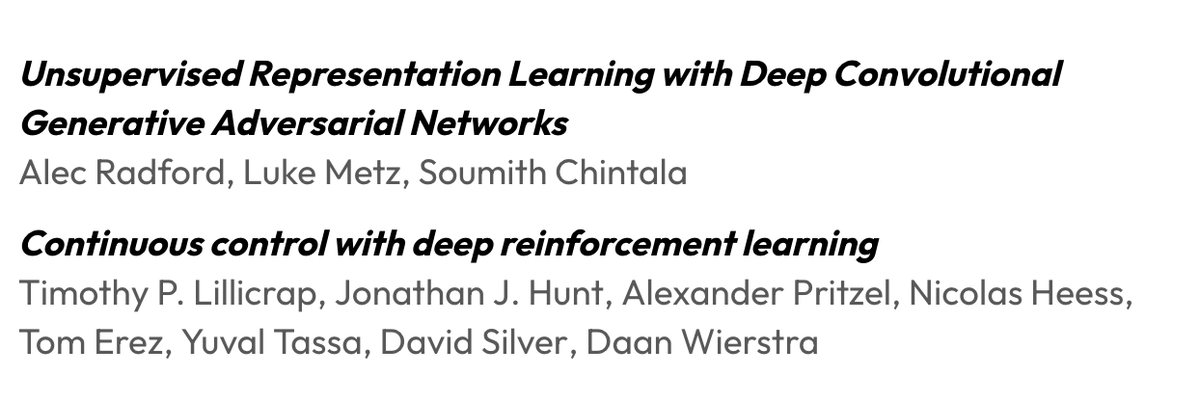
We are honored to announce the Test of Time awards for #ICLR2026 🏆 This award recognizes papers published 10 years ago at ICLR 2016 that have had a lasting impact on the field:
https://t.co/JqYiqrAvgz