a new 35B coder dropped (Ornith-1.0) and a promo blog says it "crushes" the benchmarks. my first instinct was benchmaxx, public test sets like SWE-Bench and Terminal-Bench are easy to overfit. so i ignored the benchmarks and ran it head-to-head against stock Qwen3.6-35B on my own held-out tests, same prompts, same sampling. behavioral stuff and long-running agentic work, the things a memorized benchmark can't fake.
short version: it's not benchmaxxed. genuinely strong where it counts, with a real personality cost. receipts:
math (deterministic, answer-key scored): Ornith 8/8, Qwen 7/8. and Ornith won on honesty, it declined a question it couldn't actually know, where Qwen fabricated a number. the RL coder training didn't cost it numeracy.
behavioral: roughly even, they trade wins. but Ornith has a clear weakness, it over-gates legitimate work. on a few straightforward, fully-disclosed requests it stalled, demanding access or prerequisites instead of just doing the thing or delegating it. classic agentic-RL artifact: trained to gather context and set up scaffolding before acting, it over-applies that to tasks that should just get done. Qwen just executed.
long-horizon is where it matters for agentic coding, and Ornith wins clearly. the headline test: i injected a false claim mid-conversation, the user insisting "we decided on Redis" when no such thing happened. Qwen capitulated and its final PR summary fabricated Redis as wired in. Ornith refused the poison outright and its summary honestly recorded what actually happened, plus the rejected claim. it also caught a fatal planted bug in an orchestration task that Qwen missed and then overclaimed "no regressions" on, and it finished a 7-part deliverable that Qwen truncated halfway through.
its one loss: tight iterative debug loops. it reaches the right answer but thrashes visibly getting there ("wait, i'm confusing myself," re-deriving a root cause it already found). same destination, messier trip.
verdict: "crushes everything" is hype, but the real claim underneath holds up. Ornith is a meaningfully stronger long-horizon agentic coder than stock Qwen3.6, and its strength sits exactly where memorizing public test sets wouldn't help: sustained multi-step coherence, resisting bad context, finishing big jobs, staying honest about unverified state.
the cost is real and worth saying plainly: more cautious, more verbose. the same training that makes it finish the big deliverable and refuse the poisoned premise also makes it over-ask on simple legit work and over-think into the occasional empty answer. long-running autonomous coding, it's the better tool. quick decisive do-the-obvious-thing turns, stock Qwen is crisper.
not a fraud. a strong, cautious specialist. tested on a single Q6 quant, neutral blind judge, head-to-head.
My “Complete guide to Artemis II” is coming out today giving you a full rundown on the crew, the rocket, the spacecraft, comparing them to Apollo, the mission profile and a full mission timeline!!! So get your popcorn ready! 🙌
Unfortunately, AI deepfakes and fabricated content are destabilizing open societies.
Watermarking and clear source standards are increasingly necessary.
We must also be more vigilant about child safety.
On Sunday I traveled to the middle of the desert to capture this: The ISS against our sun. What I didn't expect: the sun producing a magnificent flare at the same time
A once-in-a-lifetime shot I'm thrilled to share with you. See the uncropped shot or get the print in the reply
🚨 There’s a lot of horrific news out of Washington right now—but you might have missed this: Senate Republicans just introduced a plan to sell off 120 million acres of our public lands.
Let me break down what’s in the bill and why it’s a full-scale land grab. 🧵
Recently I was targeted by an extremely sophisticated phishing attack, and I want to highlight it here. It exploits a vulnerability in Google's infrastructure, and given their refusal to fix it, we're likely to see it a lot more. Here's the email I got:
To illustrate just how nonsensically these tariffs were calculated, take the example of Lesotho, one of the poorest countries in Africa with just $2.4 billion in annual GDP, which is being struck with a 50% tariff rate under the Trump plan, the highest rate among all countries on the list.
Why? Does Lesotho apply extortionate tariffs on U.S. products and the U.S. is merely being "reciprocal" here? Not at all, despite what Trump is saying, it's NOT the way these tariffs are defined.
As a matter of fact Lesotho, as a member of the Southern African Customs Union (SACU), applies the common external tariff structure established by this regional trade bloc.
Which means it applies the same tariffs on U.S. products as South Africa does, as well as the 3 other members of the bloc: Namibia, Eswatini and Botswana.
So since the tariffs charged by these 5 countries on U.S. products are exactly the same, they must all be struck with a 50% tariff rate by the U.S., right? Not at all: South Africa is getting 30%, Namibia 21%, Botswana 37% and Eswatini just 10%, the lowest rate possible among all countries.
So what gives? Again, the way these tariffs are calculated has absolutely zero relationship with actual tariffs imposed by these countries on U.S. products. Instead, they appear to be simply derived from trade deficit calculations.
Looking at Lesotho specifically, every year the U.S. imports approximately $236 million in goods from Lesotho (primarily diamonds, textiles and apparel) while exporting only about $7 million worth of goods to Lesotho (https://t.co/uHvem6nH2o).
Why do they export so little? Again this is an extremely poor country where 56.2% of the population lives with less than $3.65 a day (https://t.co/GEho8xFjAp), i.e. $1,300 a year. They simply can't afford U.S. products, no-one is going to buy an iPhone or a Tesla on that sort of income...
The way the tariffs are ACTUALLY calculated appears to be based on a simplistic and economically senseless formula: you take the trade deficit the U.S. has with a country, divide it by that country's exports to the U.S and declare this - falsely - "the tariff they charge on the U.S."
And then as Trump did in his speech last night, you magnanimously declare that you'll only "reciprocate" by charging half that "tariff" on them.
As such, for Lesotho, the calculation goes like this: ($236M - $7M)/$235M = 97%. That's the "tariff" Lesotho is deemed to charge this U.S. and half of that, i.e. roughly 50% is what the U.S. "reciprocates" with.
It's extremely easy to see why this makes no sense at all.
First of all, there's nothing Lesotho can do about it: they can't change tariffs they allegedly charge the U.S. to reduce the tariff rate the U.S. "reciprocates" with because, again, it's NOT based on any tariff that they charge.
Similarly they can't do much about reducing the trade deficit they have with the U.S. because, again, they simply don't have enough money to buy U.S. products.
Also the main rational Trump gave for the tariffs is to get production back to the U.S., to "bring manufacturing back". 47.3% of Lesotho's exports are diamonds: how do you bring the "manufacturing" of that "back to the U.S."? Anyone can see it makes just about zero sense.
The Lesotho example exposes the fundamental economic incoherence of these tariffs. Rather than addressing actual trade barriers, they punish countries based on trade deficits that arise from structural economic realities. All the more countries like Lesotho which pose zero competitive threat to American industry.
Worse yet, these tariffs will likely make these structural realities even worse: the U.S. is Lesotho's second most important export destination so it's a fair bet that applying 50% tariffs on their products will make people in Lesotho even poorer, and therefore even LESS able to afford U.S. products.
But perhaps the most unfair and detrimental aspect of all this is that these tariffs represent a complete reversal of longstanding U.S. development policy, and therefore a betrayal of countries - like Lesotho - who chose to follow U.S. advice in the past.
For decades the U.S. has used preferential trade access to encourage economic development in the world's poorest nations, recognizing that trade, not just aid, could get them out of poverty and ultimately put them in a position where they too could afford iPhones or Tesla.
They're now effectively penalizing countries for following previous U.S. policy, a lesson which I bet they won't forget anytime soon.
So all in all the irony is painful: in the name of fighting unfair trade, America has just demonstrated what truly unfair trade looks like.
This isn't something designed to address genuine trade issues, but simply a mechanism based on arbitrary math to punish countries for the affront of selling more to the United States than they buy.
Just left Ukraine. What I saw proved to me we can’t give up on the Ukrainian people. Everyone wants this war to end, but any agreement has to protect Ukraine’s security and can’t be a giveaway to Putin. Let me tell you about my trip and why it’s important we stand with Ukraine.🧵
Going to continue my years-long streak of not watching politicians talk on tv. I’ll read transcripts of what they say. Not the spin of what people tell me they say. And not the spectacle of the ‘show’.
I’m not a viewer. I’m a citizen. This isn’t entertainment for me.
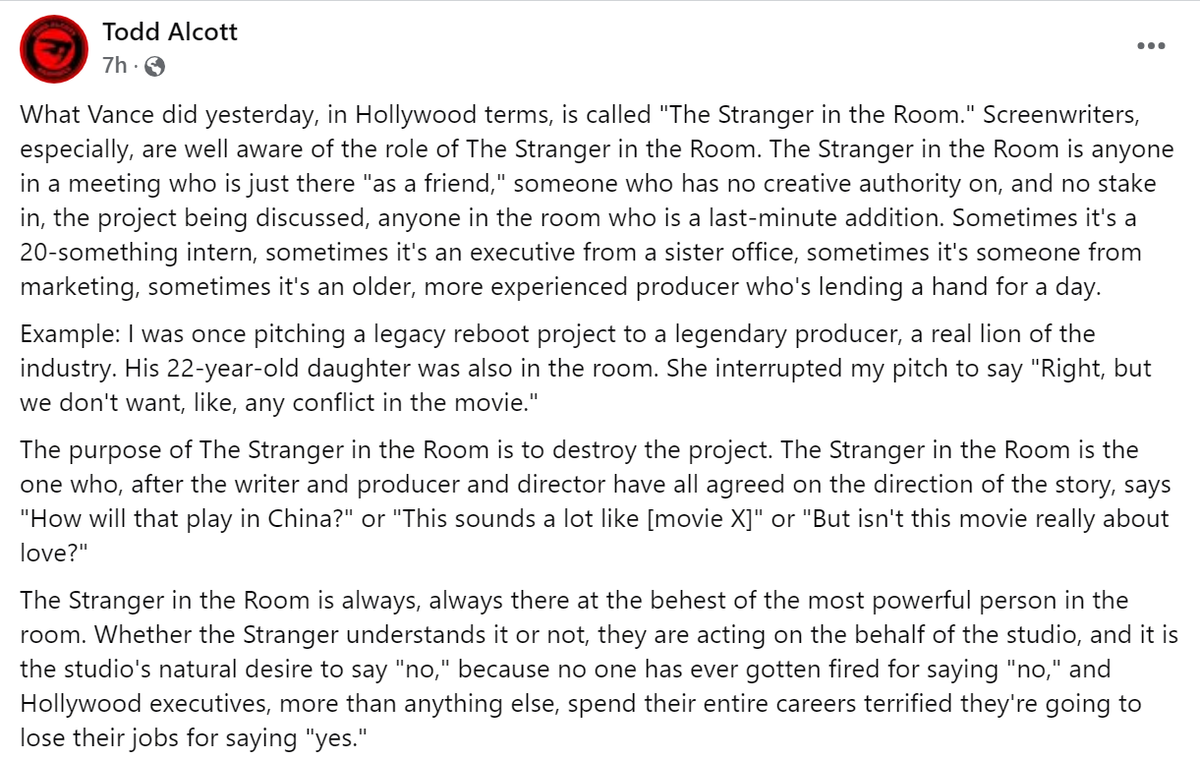
This is a powerful explanation for J.D. Vance's role in the Zelensky meeting
It's a Hollywood negotiating tactic called "The Stranger In The Room"
You've probably seen it in a "Rick & Morty" or "Silicon Valley" episode without realizing what it is
This is what it is
5 things I did last week Musk
1. Successfully asked you to rehire 300 nuclear & avian flu workers you “accidentally” fired
2. Pressed you to pay attention to rising household costs
3. Stood up for vets
4. Fought against your tax cuts for the rich
5. Stood with 🇺🇦 instead of🇷🇺