Elon Musk thinks the entire education system is built on a broken assumption.
That every student should learn the same thing. At the same speed. In the same order. At the same time.
Musk: “Everyone goes through from like 5th grade to 6th grade to 7th grade like it’s an assembly line. But people are not objects on an assembly line.”
The model was designed for a factory economy. Standardized inputs. Predictable outputs.
That economy is gone. The assembly line is gone.
But the education system still runs on its logic.
A student who masters algebra in two weeks sits through eight more weeks because the calendar says so. A student who struggles gets dragged forward because the schedule doesn’t wait.
Neither is being served. Both are being processed.
Musk: “Allow people to progress at the fastest pace that they can or are interested in, in each subject.”
AI doesn’t teach a classroom. It teaches a student.
One at a time. Every time.
It skips what a student already knows. It finds where they’re stuck and approaches it from a different angle.
It adjusts in real time. Not at the end of a semester when the damage is already done.
A student obsessed with basketball learns fractions through shooting percentages. A student who builds in Minecraft learns geometry through architecture.
The subject doesn’t change. The entry point does.
No teacher with thirty students can do this. Not because they lack skill.
Because the math doesn’t work.
AI doesn’t have that constraint.
Musk: “You do not need to tell your kid to play video games. They will play video games on autopilot all day. So if you can make it interactive and engaging, then you can make education far more compelling.”
The brain isn’t broken. The format is.
Kids learn complex systems and strategic thinking for hours voluntarily. Then walk into a classroom and can’t focus for twenty minutes.
That’s not a discipline problem. That’s a design problem.
Musk: “A university education is often unnecessary. You probably learn the vast majority of what you’re going to learn there in the first two years. And most of it is from your classmates.”
Four years. Six figures of debt.
And the real value comes from the people sitting next to you. Not the institution charging you.
The degree doesn’t certify knowledge. It certifies endurance.
Musk: “If the goal is to start a company, I would say no point in finishing college.”
The system was built to train employees. If you’re not trying to be one, it has nothing left to offer you.
Every lecture. Every textbook. Every curriculum. Now available instantly. Personalized to any learner. Adapted to any pace.
The question isn’t whether the old model survives.
It’s how long we keep forcing students through it while the replacement already exists.
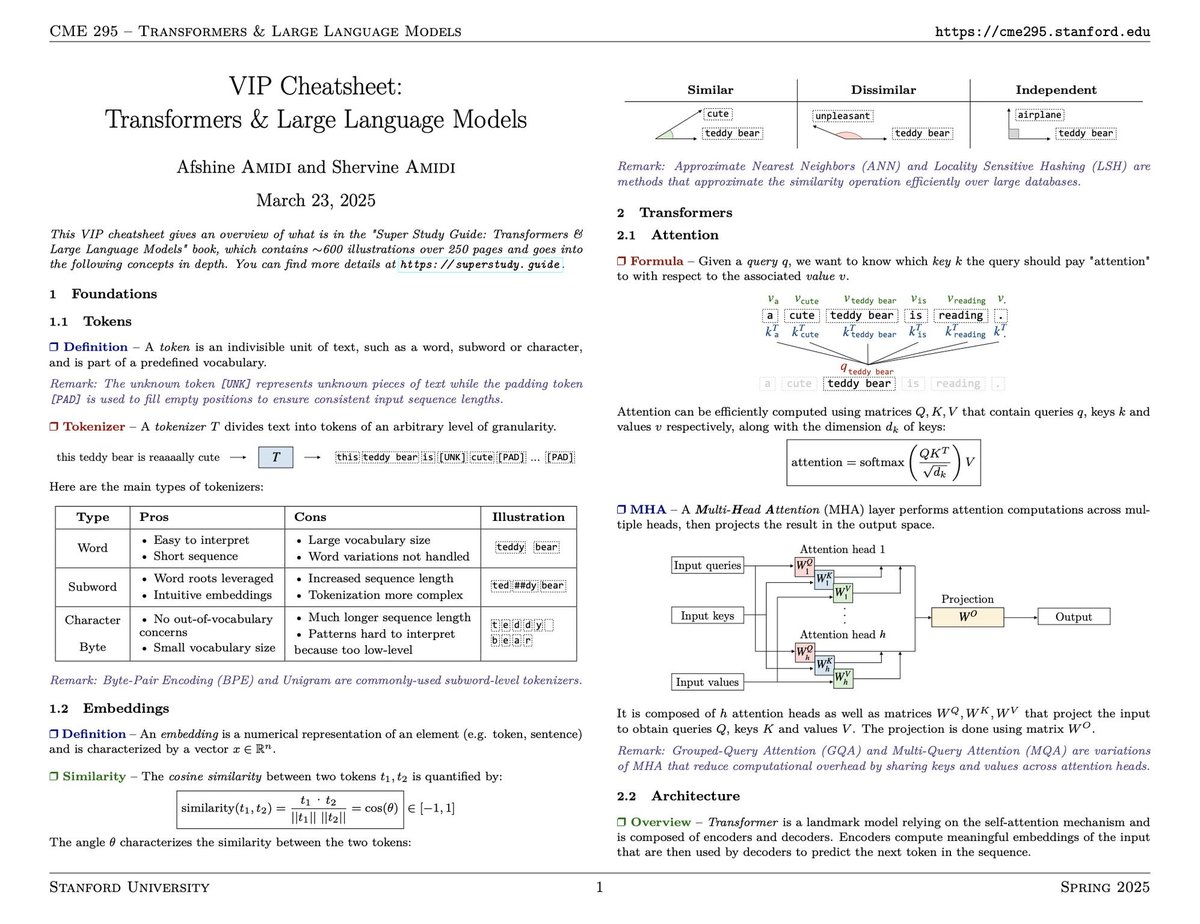
STANFORD UNIVERSITY compressed the entire field of LLMs and transformers into free cheatsheets anyone can use today.
It covers everything from self-attention to Flash Attention, LoRA, SFT, MoE, distillation, quantization, RAG, agents, and LLM-as-a-judge.
100% Free and Open Source
@enjojoyy When something happens, ask does this affect my direction or just my ego? If it's your ego, let it go; if it's your direction, adapt. Be ambitious in what you do but calm in how you feel about it. Detach your identity from the result but not your effort from the process. 🦅🦉.
@paulg@Wikipedia can you create an app that notifies users of one new fact everyday? Can this be integrated into an LLM app so that users can dive deeper if they wish? @paulg, I know you had a human in mind but would this be a close 2nd?
If you’re hunting for a remote job, you just need to figure out how Reddit works, and you’ll never be unemployed for a long time.
Here’s a list of subreddits you should bookmark right now:
How did I end up a Mathematician?
As a child, my dad said to me "our family isn't good in math" and I accepted this as truth.
As an undergrad I studied Biology and CS. The plan was to go into Neuroscience.
But I really liked the math courses, and hated anything applied - be it programming or biology labs, and every semester opening I tried to negotiate replacing programming courses with more math.
One day, I was sitting in a course on Computational Complexity taught by a Postdoc, when he was replaced for one lecture by one Avi Wigderson. I knew nothing about him at the time but he spoke about how some folks are trying to formally prove that it's impossible to settle the P vs. NP conjecture. And I was mesmerized by this. I deceided I want to study this as my MSc. project.
Avi wasn't sure I'm a good fit for him (my math grades were ok, but not straight-A's. Yeah, I wasn't really a straight-A's type of student). To test my capabilities, he gave me a book about Proof Complexity and asked to summarize it.
I read that book once, twice, three times. I didn't understand a word. A few weeks later, Avi asked me to explain a recent paper on degree and size of Polynomial Calculus proofs. I explained.
He asked: "Why can't this be applied to the Resolution proof system?" (Resolution is The most important and basic propositional calculus proof system). I thought a bit and said "Oh, it can. Here's how". Avi got very excited.
I thought we should write an email to the authors of the previous paper, assuming that it can't be something all that special if I understand this stuff.
Avi insisted we should write it up as a paper. I was still convinced it's not worth more than an email, but he insisted.
Good thing I listened to him. It ended up as my most cited and important paper prior to the STARK/SNARK ones.
After that paper, a few other papers came along. With each one, I was sure it's only an email-worthy observation, nothing worth of a paper. Other papers I read seemed hard to understand, and by comparison my own papers seemed to me quite simple. It was only after many years that I understood this is how math works. You think and process and chew on a theoretical concept for a long time until you reach this coin drop moment where you finally "see it". And then it seems clear and simple, but only to you. To others, who haven't chewed on this topic for so long it's complicated.
Anyway, after those initial math breakthroughs, Avi offered I do a PhD. And this is how I ended up a mathematician.
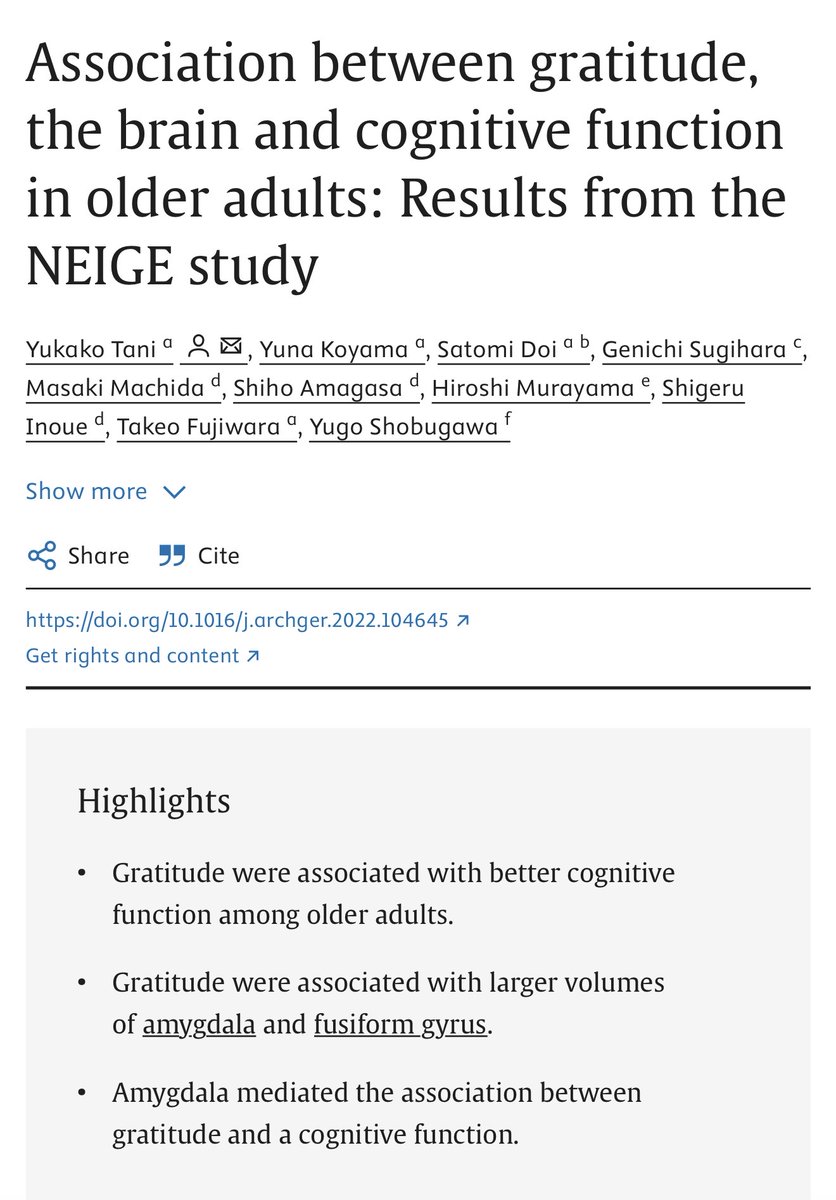
🚨Research confirms that your brain physically reshapes itself when you feel grateful, and the process happens in reverse of what most people think.
The common story about gratitude goes like this: count your blessings, feel better, repeat. Mental health gurus treat it like a mindfulness exercise where you inventory good things until your mood lifts.
The neuroscience reveals something far stranger.
Gratitude doesn’t work by making you notice positive things that were already there. It works by literally building new neural pathways that change how your brain processes all incoming information, positive and negative.
When you experience genuine gratitude, your anterior cingulate cortex lights up in ways that are measurably different from other positive emotions like joy or contentment. The anterior cingulate sits at the crossroads between emotion and attention. It decides which signals get amplified and which get filtered out before they reach conscious awareness.
Most people live with an anterior cingulate trained by evolution to scan for threats, problems, and gaps. This made sense when predators could kill you, but in modern life it means your brain’s default setting is to spotlight everything wrong, missing, or potentially dangerous in any situation.
You walk into a room and immediately notice the stain on the wall, not the ten things that look perfectly fine.
Gratitude practice doesn’t override that system. It builds a competing neural network.
Each time you feel grateful for something specific, you’re strengthening synaptic connections between your memory centers and reward circuits. Your brain begins associating the act of paying attention with positive neurochemical hits. Over time, this creates a new default: your attention system starts scanning for things worth appreciating instead of things worth worrying about.
The really wild part is how fast this happens. Neuroimaging studies show detectable changes in brain activity patterns after just eight weeks of consistent gratitude practice. The prefrontal cortex, which handles executive function and emotional regulation, develops stronger connections to the limbic system, where emotions get processed. People literally become better at managing stress and making decisions under pressure because their neural architecture has physically reorganized.
But here’s where it gets interesting in ways that most gratitude research misses completely.
The brain changes from gratitude practice don’t just make you feel better. They make you perceive reality differently. Your visual cortex, auditory processing, even your sense of time passing, all get influenced by which neural networks have become dominant in your anterior cingulate.
People with gratitude trained brains report that colors look more vivid, music sounds richer, and positive experiences seem to last longer while negative ones seem to pass more quickly. This isn’t metaphorical. Their brains are literally processing the same sensory input through different neural filters than they used before.
This explains why gratitude feels fake and forced when you first try it. You’re asking a threat detection system to appreciate what it’s designed to ignore. The neural pathways for appreciation barely exist yet. It’s like trying to play piano with no finger muscle memory. But once those pathways strengthen, gratitude stops feeling like work and starts feeling like upgraded perception.
The most profound part might be how this rewiring affects social relationships. The neural networks that handle gratitude overlap heavily with the networks that handle empathy and social cognition. When you strengthen one, you automatically strengthen the others.
People who develop strong gratitude circuits become measurably better at reading facial expressions, predicting how others will respond to their words, and maintaining long term relationships. Their brains get better at spotting what others are doing well instead of cataloging what others are doing wrong.
What started as a simple practice of noticing good things ends up rebuilding the fundamental neural infrastructure through which you experience other people and they experience you.
The brain you have today was shaped by every thought pattern you’ve repeated for years. The brain you’ll have next year is being shaped by the thought patterns you’re repeating right now.
Gratitude just happens to be the most efficient way to aim that reshaping process somewhere useful.
Legs are power.
Back is strength.
Chest is confidence.
Abs are discipline,
Arms are pride.
Your physique isn't decoration,
It's a reflection of how you live.
The Olympics banned this technique because it removed the Fear of Failure.
> Long before the modern Olympics,
Greek athletes followed rules that would sound extreme today.
They didn’t only train their bodies.
They trained who they were.
Because to the Greeks,
fear of failure
was the real enemy of performance.
Not weak muscles.
Not missing talent.
Fear.
So they practiced a method
called prokatalēpsis a mental ritual so powerful
it was later banned for giving an “unfair advantage.”
> Athletes described it as:
“the moment the future stopped being threatening.”
Here’s how it worked.
The night before competition,
the athlete did something unusual:
He imagined losing.
Fully.
Clearly.
Painfully.
Without excuses.
Not to discourage himself.
Not to spiral.
But to drain fear of its power.
Because the Greeks believed
you can’t be afraid of
what you’ve already accepted.
Then came the second step the part that made the ritual famous:
After visualizing defeat,
the athlete stood alone in silence
and repeated one sentence
until his body felt it was true:
“What remains after fear
is my true form.”
They believed this revealed
the identity beneath ego,
expectations,
and imagined judgment.
And something strange happened:
Athletes slept deeper,
moved more freely,
and competed with a calm
that felt almost untouchable.
> Modern psychology later confirmed it:
When you vividly face
the worst outcome
and survive it mentally,
your brain reduces the fear response tied to it.
Today it’s called
“exposure reconsolidation.”
The Greeks called it:
“returning to yourself
before the world interferes.”
Try it next time
fear tightens your chest.
Accept the loss
for sixty seconds.
Then say the line.
You may feel
something very old
stirring awake inside you.