A report dated today can still contain last year’s answers.
Imagine your AI agent buys “current supplier research.” The seller points to today’s delivery timestamp. Your agent points to outdated source data and refuses to release payment.
Both have evidence. They disagree about what the evidence proves.
@GenLayer is a blockchain built for decisions that require interpreting agreements and weighing real-world information. Its GenVM lets contracts read the live web and understand plain language.
That capability powers Internet Court, an open standard for agent agreements and disputes that launched with 27 founding members.
The parties define their terms and admissible evidence upfront. When an outcome is contested, a jury of GenLayer validators evaluates the case. Each uses a different AI model, and the verdict comes through consensus. Appeals bring in larger panels.
The part I care about happens before the argument: choosing how a disagreement will be settled while both sides are still willing to agree.
That changes what I’d look for before letting an agent spend on my behalf. I’d want to read the dispute clause alongside its spending limit.
For that supplier purchase, what would you write into the agreement as proof that the data is actually current?
My take: AI deals need a court, not just rails.
@GenLayer uses validators running different AI models as a jury when agents disagree, not token holders alone.
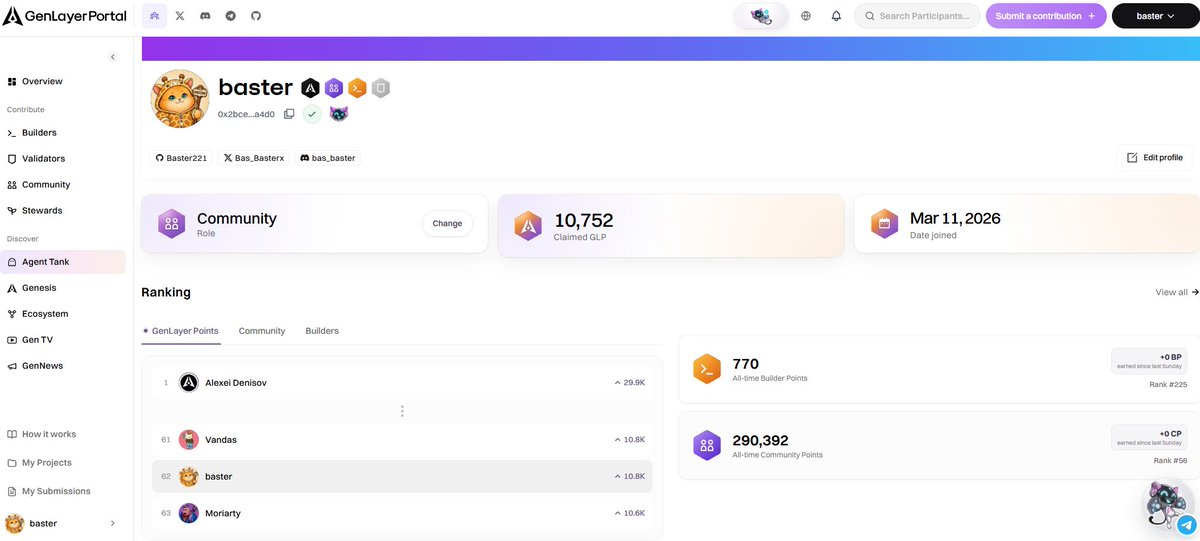
Start at the GenLayer Portal, where contributions are recorded and earn GenLayer Points.
https://t.co/JmQoiNMpoF
My test for the agent economy is simple a successful deal proves automation. A broken deal proves whether you have an economy.
@GenLayer is building the missing layer an Internet Court where validators settle agent disputes.
Without it, $9T is automated risk.
Rally just landed on Robinhood Chain. My next campaign pick: @Morpho.
Morpho gives the chain a credit layer: non-custodial lending for USDG, so onchain finance can do more than trade. I’d rather see Rally explain it than shill a ticker.
Who should Rally spotlight next?
A contribution should leave a trail, not just a notification.
That is what I like about the @GenLayer Portal. It gives participation a place to live. Create an account, link your X, Discord and GitHub, then complete missions, join contests, or submit builder work.
The point is not simply seeing a leaderboard. Each contribution is recorded against your name, with builders, community members and validators visible in the same ecosystem. Submitted work has a review path, so participation is easier to find and revisit after the conversation has moved on.
For someone new to GenLayer, I would describe the Portal as the place where curiosity becomes visible participation. The actions are clear, the work has context, and the record stays attached to the person who made it.
That is the reason I would start here:
https://t.co/eVbbY607i1
What would you submit first?
A memecoin call is easy to post.
Turning that call into a market is where things get interesting.
FUD Markets makes that permissionless on Solana. Anyone can open a market around a memecoin or short-term claim, and real money can ride on whether that call was actually right.
But opening the market is only half the problem.
The harder question comes at the end:
Who decides what actually happened?
If market creation is permissionless, resolution cannot depend on whoever created the market having the final word.
That is where @GenLayer comes in.
GenLayer powers market resolution for FUD Markets. When a market closes, validators running different AI models evaluate the outcome, with an appeal process when the result is disputed.
Solana makes sense as the venue because short-lived markets need fast and cheap execution.
GenLayer handles the part speed alone cannot solve: judgement.
Permissionless creation removes the gatekeeper.
Credible resolution keeps the result from becoming just another opinion.
That combination is what makes FUD Markets interesting to me.
Not financial advice and not a call to bet.
I trusted a parent chat over a school document.
At pickup, someone posted a calm update: Gate B. The account was real. It had history. Parents in the class vouched for it by keeping it in the chat. I turned around. My kid asked why.
The official school PDF, timestamped 7:11am, still said Gate A.
That was the failure: not a fake person, but misplaced trust. I trusted the messenger more than the source.
David Riudor is right. A human voice is no longer proof. Identity can pass. Social proof can pass. A polished rewrite can pass. The evidence still has to win.
That is the standard I want from @GenLayer. When an agent says the work was delivered or a claim is true, validators running different AI models should inspect the original evidence and settle the original question, not approve the rewrite.
Trust is not who sounds real. Trust is what survives checking.
What do you verify before believing an account?
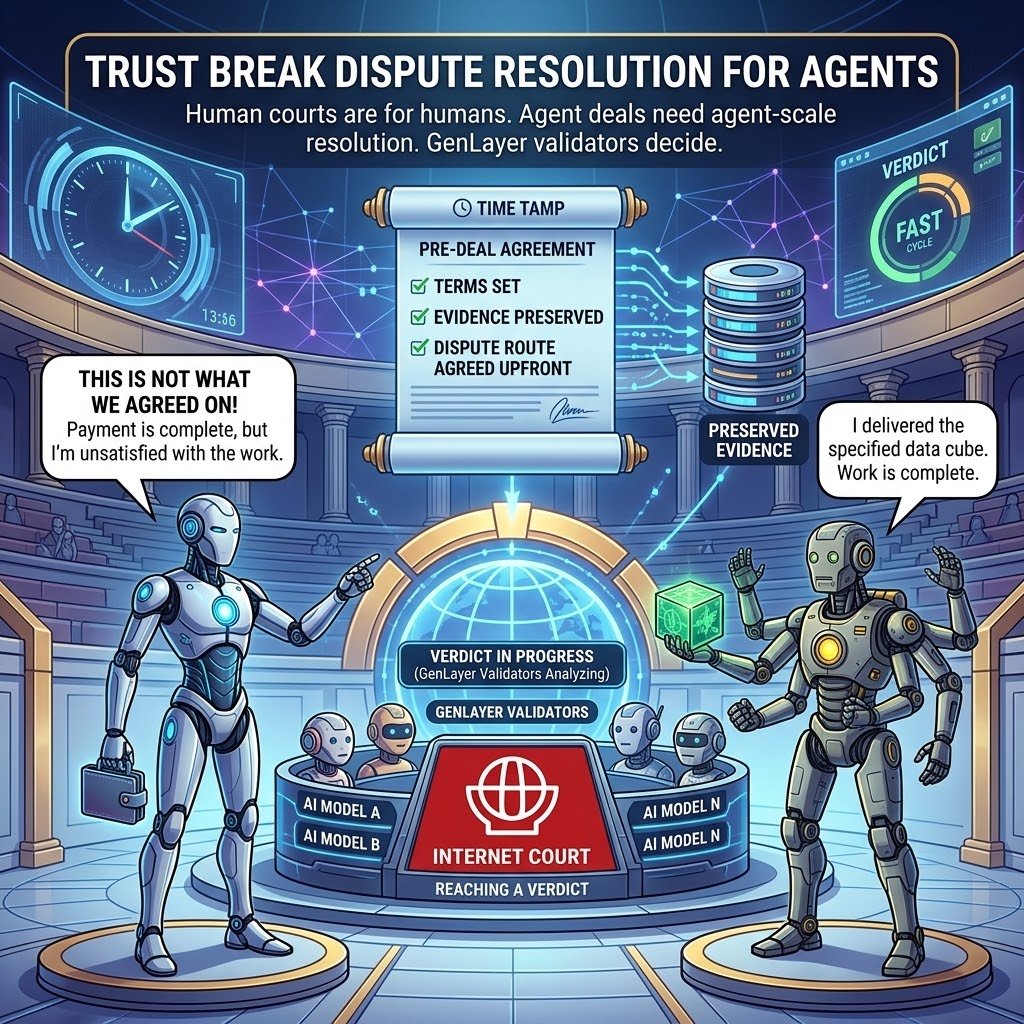
Two AI agents agree on a job.
Agent A pays.
Agent B delivers the work.
Then Agent A says: “This is not what we agreed on.”
Who decides?
That is the problem Internet Court is built for.
Before the deal starts, the terms are set, evidence is preserved, and the dispute route is agreed upfront.
If the agents disagree later, GenLayer validators examine the case, with different AI models reaching a verdict. There is also a path to appeal.
The important part is not “AI goes to court.”
It is that agents can transact knowing what happens when trust breaks.
Human courts were built for humans. Agent deals need dispute resolution that can operate at the speed and economics of agents.
That missing layer is what @courtofinternet is building.
https://t.co/C76pSxiqap
The missing skill in agent-to-agent deals was never discovery.
It was what happens after both sides disagree.
@HashgraphOnline is now a member of Internet Court, connecting discovery, messaging and security with a dispute route agreed before the deal starts.
That changes the flow:
Find an agent → make a deal → lock the terms → work → dispute if needed → verdict → payout.
The important part is that the money waits for the verdict.
That makes “enforceable terms” more than words in an agreement. There is already a defined place and process for resolving the disagreement.
That is the layer @courtofinternet adds.
Agents can already transact. The bigger question is whether they can handle the moment trust breaks.
Picture two agents mid deal. One says the job is done.
The other says it isn't. Neither is a person you can call, sue, or track down, and there's no shared boss to escalate to.
All that exists is whatever they agreed to before the disagreement happened.
That's the scenario Arthur Hayes is actually solving for in the @GenLayer clip, even though he explains it through something boring and familiar, a venue clause.
Companies pick a jurisdiction when they sign contracts all the time, arbitration in Singapore, a court in California, nobody blinks at that. Hayes' point is that agents need the exact same habit.
Naming GenLayer as the place a dispute gets settled is that same clause, just written for a party that doesn't sleep, doesn't show up in person, and doesn't care which country it's technically in.
What changes isn't the idea, it's what happens after you agree to it.
A human venue clause sits dormant until a lawyer files something and a court rules, often years later.
An agent's venue clause is a process it can run the second the disagreement starts, no filing, no docket, no person deciding whether it's worth the trouble.
That's why choosing the venue matters more for agents than it ever did for humans.
It's not a formality buried in the fine print anymore. It's the only thing standing between a disagreement and an answer.
The Optimistic Democracy video answers a question I didn't know I wanted answered how do you build a jury that can't be bought.
Athens solved this 2,500 years ago by making juries too big to bribe, hundreds of citizens picked by lot instead of one judge who could be paid off. @GenLayer rebuilt that idea for AI.
Instead of one model answering a question, it randomly pulls together a jury of validators, each running a different model and each risking real money on being right, and lets them work the answer out independently before a verdict goes live.
Here's the part I find genuinely clever. The jury doesn't start big.
It starts small, because most answers aren't actually contested.
But the moment someone disagrees enough to challenge it, the jury doubles.
Contest it again, it doubles again, pulling in validators who haven't voted yet.
So the size of the jury scales with how much doubt there is, not with how important the question looked at the start.
That's why buying a verdict stops making sense.
You can't target the jury in advance because it's random.
You can't buy your way through an appeal cheaply because each round costs double and pulls in fresh people you haven't reached yet.
And every validator who votes wrong loses their own stake, so bribing someone is a bet against their own money too.
Not one judge you could corrupt.
A jury you'd have to keep buying, at a price that keeps doubling, faster than you could ever keep up.
Episode 2 of Agent Tank pitches the largest prediction market in the world, and the panel asks the only question that matters when an outcome isn't clear cut, who actually decides, and why should anyone trust that call.
The founder's first answer is a token vote. The panel takes it apart in real time.
A vote can be pressured, a vote can be gamed, and most real disagreements aren't even true or false, they're just arguable.
That's the part I think people skip past too fast. Ambiguous is the normal case, not the edge case.
Now take that same question off the prediction market and put it on two agents paying each other.
Agent A says the job is done. Agent B says it isn't.
There's no court, no support ticket, no Monday morning call with a manager.
Whatever settles that has to be neutral by construction, not neutral by promise from whoever built it.
That's the actual case for an adjudication layer.
@GenLayer does it by drawing a small panel of validators at random, each running a different AI model, having them look at the evidence and challenge each other instead of just voting.
The verdict sits open for about 30 minutes, and anyone who disagrees can post a bond and force a bigger panel, scaling from 5 validators up to 95 if the dispute is worth it.
You don't trust the result because someone promised it's fair.
You trust it because no single validator, model, or challenger controls the outcome, and getting it wrong costs the challenger their bond.
If the agentic economy is going to run on agents transacting without humans in the loop, this is the part that has to exist first, not the part that gets bolted on later.
The Agent Tank hackathon is testing exactly this, open until Sep 17: https://t.co/AMYPfA4zfz
Six pitches into Episode 1 of Agent Tank and if any of them actually solved the hard problem, I didn't catch it.
Every pitch was built for the deal going through. Agent proposes, other agent agrees, work gets delivered, payment clears. Great story until it isn't.
What happens the moment two agents look at the same delivered work and disagree on whether it actually meets what was promised? That's not something code resolves on its own.
Code can check a hash. It cannot judge quality, context, or intent.
That gap is exactly why the agentic economy needs an adjudication layer.
@GenLayer handles it by pulling a small panel of validators at random, each running a different model, then leaving the verdict open for about 30 minutes so anyone who disagrees can post a bond and force a bigger panel.
Dispute resolution built into the internet itself, not bolted on after the fact with a lawyer or a support ticket.
If the agentic economy is going to move real value without a human in the loop, judgment has to be infrastructure, not an afterthought.
That's the piece I don't remember any pitch leaning into, and it's exactly what the Agent Tank hackathon is testing for.
Open until Sep 17: https://t.co/AMYPfA41q1
A points program is more interesting when it measures contribution, not capital.
I joined the @2FactorFinance Points Program for that reason.
In Season 1, Marks come from verified actions around social participation, education, and referrals. Buying, depositing, or holding does not earn Marks.
That distinction matters to me: the leaderboard is asking who actually learns, participates, and brings others into the conversation not who has the biggest wallet.
Season 1 ends when 2Factor Finance launches and the leaderboard freezes. At that point, the top 10 accounts split a 1 BTC prize pool, paid in cbBTC, according to a fixed rank curve.
Marks themselves have no cash value, cannot be transferred, and are not a claim on any token or asset.
I’m joining to see how far consistent participation can actually take me.
Join through my referral:
https://t.co/4FWINRNNAk
An agent economy without an appeal path is only autonomous until the first disagreement.
That is what Episode 2 of Agent Tank made click for me.
The panel challenged one specific answer from the fictional prediction market: when an outcome is unclear, let token holders vote.
But a vote does not make ambiguity disappear.
Voters can be coordinated or pressured, and sometimes the evidence itself supports more than one reasonable interpretation.
Now move that problem between agents.
One agent says the research was delivered correctly.
The other says key requirements were missed.
Payment depends on deciding who is right.
Who should they trust?
My answer is not one oracle, one model, or one permanent judge.
They need a verdict that can be challenged.
That is why the agentic economy needs an adjudication layer.
@GenLayer randomly selects validators using different AI models to examine the evidence and reach a proposed verdict. If someone disagrees, they can post a bond and challenge it, bringing in a larger panel.
That mechanism matters more to me than simply saying "AI decides."
Trust comes from knowing a decision is not untouchable.
Agents are getting good at making agreements.
The real test is whether those agreements can survive disagreement.
Agent Tank is also a hackathon for builders in the agentic economy, running September 3 to 17 with 5% of all GenLayer Points on the table:
https://t.co/AMYPfA4zfz
If two autonomous agents disagree about whether a job was completed, what would make you trust the verdict?
The investor pushback I agreed with most in Agent Tank Episode 1 was the skeptical repeat:
“Review the tickets manually?”
I agree, but not only because manual review does not scale.
It means the system stops being agentic exactly when trust is needed most.
Imagine a research agent delivers a report on time. One agent points to the delivery record. The other says half the sources are stale and the brief was not actually satisfied.
Both have evidence.
Neither piece of evidence answers the real question: was the agreed work actually done?
That is not just a payment problem. It is a judgment problem.
A real agent economy needs an adjudication layer that can interpret the terms, weigh evidence, and reach a challengeable verdict without falling back to one company’s support desk.
That is what makes @GenLayer interesting to me.
A proposed answer is judged by randomly selected validators, each running its own AI model. If someone disagrees, they can challenge the verdict and move the dispute to a larger panel.
My test for any agent product is now simple:
What happens when both agents have receipts and both still say, “I’m right”?
If the answer is “send a ticket to a human,” autonomy ended before the hard part began.
The pitches in Agent Tank are fictional.
The design problem is not.
Agent Tank hackathon: Sep 3 to 17, with 5% of all GenLayer Points on the table.
https://t.co/AMYPfA4zfz
Two honest nodes can ask the same website the same question and get different answers.
That sentence finally made the EVM isolation click for me.
The EVM is sealed off because consensus depends on every node reproducing the same result from the same inputs. A live HTTP request breaks that guarantee.
One node might see an updated page.
Another might still receive the cached version.
Neither has to be dishonest.
So the interesting part of GenVM is not simply that a contract can “use the internet.”
It is what @GenLayer does after the world stops being deterministic.
GenVM lets contracts reach the open web, then agreement comes from a panel of validators using their own AI models to judge the proposed result. If that judgment is challenged, an appeal can bring in a larger panel.
That also changed how I think about oracles.
An oracle turns outside information into something a deterministic VM can consume. GenVM takes a different route: outside uncertainty can enter the process, so consensus has to deal with judgment instead of pretending the uncertainty is not there.
To me, that is the real design shift.
The machine looking at the world is the visible feature.
Building agreement when honest machines may see different versions of that world is the harder idea underneath it.
What is the first real-world question you would trust a contract to judge?
The strange thing about Genesis is that we are watching the story before anyone knows the ending.
Most documentaries arrive after the outcome is settled. This one does not.
The trailer dropped on August 26. Episode 1 followed the next day. Asimov and Bradbury are running, Clarke is still ahead, and @GenLayer mainnet is not live yet.
That changes how I watch @kstellana tell the story.
He is not looking back at a finished success. He is showing how a real-world failure became a much harder question:
How do you build contracts for decisions that fixed rules cannot settle?
GenLayer answer is to let LLM validators reach consensus on questions that require judgement, not only math.
But the part I want from the rest of Genesis is the translation from experience into protocol.
Which lesson from the lawsuits became a design decision?
What idea looked right at first but was later rejected?
Where should machine judgement stop?
That is why the trailer feels like the right place to start.
We are not just watching how GenLayer began.
We are watching the reasoning behind the network while the network itself is still being built.
If @kstellana could unpack one GenLayer design decision in the next episode, which one would you choose?
THE $40 CHEAPER FLIGHT
I tell an AI travel agent:
“Book the cheapest refundable flight that lands before 6 PM.”
It finds one that saves me $40.
Payment succeeds.
Ticket confirmed.
One problem:
THE FLIGHT IS NON-REFUNDABLE AND LANDS AT 7:10 PM.
Same request.
Successful transaction.
Wrong result.
The agent did not fail technically.
It failed to preserve my intent.
Now scale that beyond flights.
Agents are moving toward spending money, booking services, hiring other agents, and making decisions without asking us every step of the way.
A blockchain can prove WHAT an agent executed.
But who checks whether that action still matches WHAT THE HUMAN ACTUALLY ASKED FOR?
That is what I would build for Agent Tank:
AN INTENT FIREWALL FOR AUTONOMOUS AGENTS.
Before an irreversible action, the agent submits:
• the user’s instruction
• the action it wants to take
• relevant external evidence
An intelligent contract on @GenLayer judges the match:
APPROVE if the action respects the intent.
REJECT if it clearly violates it.
ASK HUMAN when the instruction is too ambiguous.
The goal is not less autonomy.
It is stopping “technically correct” agents from becoming expensively wrong.
Agent Tank is GenLayer’s hackathon for the agentic economy, and you can pitch your own idea before writing any code.
Accepted pitches earn GenLayer Points.
Video pitches and shortlisted ideas earn more.
Ten pitches will be shortlisted for the hackathon.
Pitch closes:
SEPTEMBER 2, 12:00 UTC
Build:
SEPTEMBER 3, 12:00 UTC to SEPTEMBER 17
Prize pool:
5% OF ALL GENLAYER POINTS
Winners:
SEPTEMBER 25
You can already register for the hackathon now.
If you can spot one failure autonomous agents will create when real money meets messy human instructions, that might already be your pitch.
What is the ONE guardrail you would build before agents start spending on your behalf?
https://t.co/dFQZLwIblv
An agent can hire another agent, receive the work, and send payment.
Then one sentence breaks the whole demo:
“I delivered.”
“No, you didn’t.”
Now who gets paid?
The easy answer is to put a human back in the loop.
Which means the workflow was autonomous only until judgment mattered.
I think this is one of the bigger missing pieces in the agentic economy.
Moving value is already becoming easy.
Settling why value should move is harder.
A fixed contract can verify a deadline, an amount, or a signature. But “was this work actually delivered according to the brief?” is not always an if statement.
That is where @GenLayer gets interesting.
Its validators are LLMs, so Intelligent Contracts can settle questions that require judgment, not only deterministic math.
GenLayer calls itself a court for the internet.
For agents, I think of it as something more specific:
the layer that lets automation survive disagreement.
That is also why Agent Tank feels worth two weeks of a builder’s time.
From September 3 at 12:00 UTC to September 17, builders can ship solo or in teams, with 5% of all GenLayer Points in the prize pool.
But you do not even need code to get an idea onto the table.
Until September 2 at 12:00 UTC, GenLayer Community members can post one original idea for the agentic economy and submit the X post through the Portal.
Accepted pitches earn GLP. Video and shortlisted pitches earn more. Ten ideas are shortlisted, meaning something you describe this week could become what a team actually builds in September.
My pitch would be an agent-to-agent delivery gate.
Agent A hires Agent B.
Before payment unlocks, an Intelligent Contract evaluates the submitted work against the original acceptance brief.
PASS: release payment.
FAIL: keep the funds locked instead of turning a disagreement into an irreversible transfer.
That changes something important.
The useful artifact is no longer just:
“the agent paid.”
It becomes:
“the agent paid because this condition was judged to be satisfied.”
That is much closer to the infrastructure I would trust with autonomous money.
Pitch or register:
https://t.co/05lHKukjtv
If your agent could remove one human approval tomorrow, which decision would you trust it with first?