Honestly, walking from Delhi to Rajgir would’ve been faster than trusting @RailwaySeva@drm_lko with Train 12392. 6 hours late at Sultanpur and still moving like a bullock cart! Charging "Superfast" fares for this third-class misery is daylight robbery. @drmdnr@RailMinIndia
@RailMinIndia@RailwayNorthern@GM_NRly@CPRONCR Look at the running status of train number 12392 shramjeevi express, you idiots are running train or bullock cart, it's been 16 hours and train hasn't even reached jaunpur, moved hardly 650 kms. It's already more than 6 hours behind schedule, @AshwiniVaishnaw ji there's no point in running a service like this I'm not sure what perverse please railway officials gets by working like this but you need to fire a couple of them for this nonsense they are running here
Imagine someone with a hyper-specific photographic memory: they look at you once and remember your face with 100% accuracy, but only from that exact angle and moment in time.
If they run into you later from a different angle, or bump into you years down the road after your face has aged, would they actually be able to connect the dots and identify you? It makes you wonder if human recognition is less about storing exact "images" and more about how our brains dynamically map and update features over time.
Water-based batteries just doubled their energy capacity without using toxic, corrosive salts.
Electrochemists at University College London (UCL) have engineered a non-halogen aqueous electrolyte (the KA–PA–Nuc system) for zinc-iodine and aluminum-iodine batteries. Traditional water-based batteries eliminate lithium fire risks, yet typically store less energy because iodine only transfers two electrons. UCL’s breakthrough liquid formula uses three simple, non-corrosive additives to stabilize iodine, letting it safely transfer four electrons instead—retaining 96% capacity over 1,000 cycles while cutting manufacturing costs and ecological hazards.
Use cases include fire-safe utility grid storage for solar and wind farms and low-cost backup power.
For battery engineers: what is the biggest bottleneck to scaling high-loading iodine cathodes into commercial pouch cells?
Quantum machines are outgrowing classical verification—so how do we know their answers are right when conventional computers can no longer verify them?
Researchers at the University of Innsbruck, IQOQI, and TU Munich solved this using a 51-qubit trapped-ion quantum simulator. Instead of assuming flawless hardware, their Bounded-Error Quantum Simulation protocol reads experimental data to map real particle interactions and environmental noise. It translates those hardware fluctuations into strict, verifiable error margins around every final calculation—allowing scientists to trust complex simulations that impact clean energy, climate modeling, and life-saving materials without needing a supercomputer to double-check the math.
Use cases include verifying drug discovery molecules, clean-energy catalysts, and next-gen battery materials.
How should hardware architects balance error-bounding overhead against raw qubit scaling in NISQ systems?
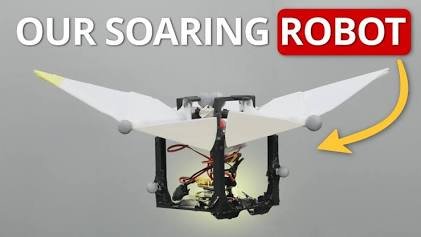
A drone that hovers without spinning propellers or draining batteries—just riding the wind.
Researchers at the Max Planck Institute for Intelligent Systems and the University of Stuttgart built Floaty, a kestrel-inspired flying robot that stays airborne using rising air currents.
Instead of power-hungry motors, Floaty adjusts four bent wing flaps to alter air resistance, letting it steer, stabilize against gusts up to 10 m/s, and hover with minimal energy—cutting environmental emissions and extending mission endurance.
Ideal for inspecting industrial smokestacks, guiding weather balloons, or assisting rocket re-entry.
How would you handle autonomous wind-current acquisition before deployment in unpredictable outdoor environments?
Turning mercury into gold without a nuclear reactor? A patented Indian frequency reactor claims it can.
Scalene Energy Research Institute’s Gravitoradiophysical Nuclear Transmutation (GNT) system aims to reshape matter cleanly without radioactive waste or toxic mining. Inside its vacuum-sealed "Boom Tube" reactor, molecules enter continuous weightlessness while aluminum antennas fire two targeted radio frequencies. The first frequency snaps chemical bonds to free raw elements, while the second nudges the atom's core—shifting mercury's 80 protons toward gold's 79. Lab tests detected 2.3 mg/L of gold and 11 mg/L of silver from treated mercuric sulphate.
Future use cases span clean energy, targeted medical isotopes, industrial materials, and space exploration.
Physicists and RF engineers: Can non-ionizing frequencies overcome nuclear binding energy, or is this an experimental artifact?
One oval plug just ended 30 years of cable chaos—and it took a European law to force Apple’s hand.
The USB Implementers Forum’s USB-C connector packs 24 reversible pins into a tiny shell. Inside, smart "CC" pins negotiate power up to 240W and reroute high-speed lanes for data and video in milliseconds. By mandating this universal port, the European Parliament is slashing 11,000 tons of annual e-waste, letting one cable power your phone, laptop, and gaming gear.
Yet identical cables still hide wildly different speeds and wattages inside.
Engineers: how do we solve invisible spec fragmentation without stifling future hardware innovation?
History of connectors in my very long post coming right up..!!