Astronauts just forged solid metal hardware in zero gravity and honestly its mind bending 🚀
The European Space Agency and Airbus built the Metal 3D Printer and ran it inside the International Space Station Columbus module. Usually deep space missions have to haul heavy spare parts from Earth, burning insane rocket fuel and leaving crews stuck if something snaps mid flight. basically their sealed box swaps air for safe nitrogen gas and uses a hot laser to melt stainless steel wire layer by layer onto a moving plate, proving crews can print tough metal parts on demand without wasting launch weight or shipping trash back home 🛠️
Use cases include printing emergency rocket wrenches, station repair brackets, and future Moon base tools.
How are additive engineers controlling melt pool surface tension when printing complex metal overhangs in microgravity?
A tiny soft robot can now worm its way through your small intestine without pain and honestly its unreal 🩺
Researchers at MIT developed a flexible soft robotic enteroscope designed to explore the deepest, hardest to reach loops of the small intestine. Normally doctors push stiff scopes down the gut, which stretches delicate tissue, causes serious pain, and misses deep ulcers or tumors while requiring heavy anesthesia. basically this soft polymer robot mimics earthworm peristalsis, gently expanding and contracting soft pneumatic chambers to inch forward along slippery intestinal walls on its own while carrying tiny cameras, biopsy tools, and drug delivery nozzles without scraping tissue or creating bulky disposable surgical waste ✨
Use cases include painless small bowel cancer screening, targeted ulcer medication delivery, and deep tissue biopsies.
How are biomedical engineers keeping soft pneumatic actuators responsive and kink free through tight intestinal bends?
Surgeons might soon seal delicate wet organs in seconds without a single needle or stitch 🩹
MIT spinout SanaHeal developed a biocompatible surgical adhesive patch that bonds instantly to slippery internal tissues. Usually sewing up soft organs like the lungs, gut, or heart takes lots of time and causes extra tissue trauma, leaks, and plastic suture waste. basically this dry polymer patch absorbs surface moisture on contact and forms strong physical and chemical bonds in seconds, creating a tight flexible seal that moves naturally with the body and cuts down dangerous post surgery complications ✨
Use cases include sealing lung air leaks, closing gastrointestinal incisions, and fast trauma care.
How are biomedical engineers tuning adhesive degradation rates so the patch dissolves right as internal tissue finishes healing?
@kidtsang China has done what other countries didn't dare to, refining is very resource intensive work, they did it and keep on improving, they don't owe anyone anything and yes these discoveries can change the game.
China controls over 90% of global rare earth refining, holding EV motors, wind turbines, and defense tech hostage 🌍
Here is how Lila Sciences is breaking that wall using their autonomous AI science factory. Instead of just predicting molecules on a screen, they hooked a scientific reasoning model straight to robotic lab hardware. Working 24/7 for 90 days, the system mixed, baked, and acid tested 2,942 metal recipes with zero human intervention. By doping cheap metals with trace elements like indium and manganese, it engineered microscopic atomic cages that mimic ultra rare elements and hold up for 1,000 hours.
This shifts power from who owns the dirt to who owns the algorithm.
Next up are rare earth free magnets for EVs and turbines, plus cobalt free batteries.
honestly crazy to see material discovery shrink from 20 years to 90 days ⚡️
How fast do you think synthetic magnets can replace refined rare earths in commercial EV motors?
Green hydrogen was always stuck behind one massive wall: commercial electrolyzers need ultra rare iridium to survive burning acid baths ⚡️
Lila Sciences just bypassed that bottleneck using their autonomous AI science factory. Instead of guessing molecules on a screen, they hooked a reasoning model straight to robotic lab gear. For 90 days the system mixed, baked, and acid tested 2,942 metal recipes with zero human input. By doping palladium with trace indium and manganese, it built a microscopic atomic cage that blocks acid corrosion while splitting water for 1,000 hours.
Cheap electrolyzers unlock clean fuel for cargo ships, steel mills, aviation, and ammonia fertilizer plants.
unreal to see six iridium free catalysts found in three months 🌍 How soon until these hit commercial stack manufacturing?
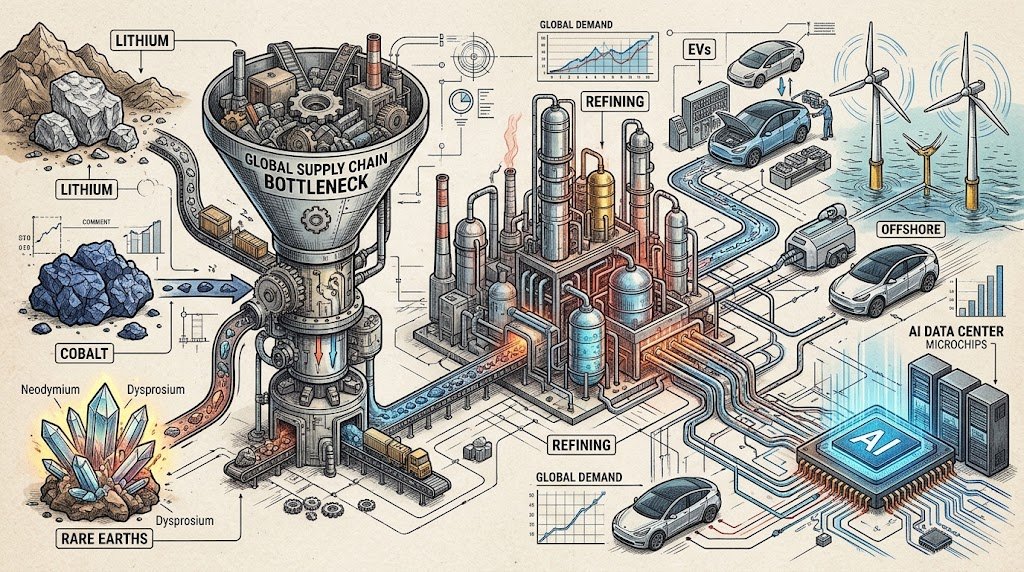
Modern tech hits a hard wall because a few nations control the refining of key minerals 🌍
Here is how the supply chain chokepoint actually works:
Rare Earths (EV motors, wind turbines, defense): mined in China, Myanmar, Australia, and the US, but China controls over 90% of global refining.
Lithium & Cobalt (EV batteries, grid storage): mined in Australia, Chile, and the DRC, yet China handles ~65% to 75% of chemical refining.
Nickel & Graphite (battery cathodes and anodes): Indonesia dominates nickel refining (~43%) while China processes ~90% of battery grade graphite.
Iridium (green hydrogen electrolyzers): mined in South Africa and Russia, with only 7 to 8 tons produced globally each year.
Gallium & Germanium (AI chips, 5G): China controls up to 90% of refining.
still wrapping my head around how concentrated midstream processing is ⚡️
Which mineral bottleneck do you think gets solved first through synthetic alternatives or recycling?
I don't know much how engine works but gemini looks close, also if you ask it to make engine which deliver most per liter of fuel what changes it would suggest, sometime back I've heard that the coherent mixing of fuel and air could deliver most mileage, could you ask it how it would solve the problem and make another design and post here, also I would appreciate if you could tag me in that post
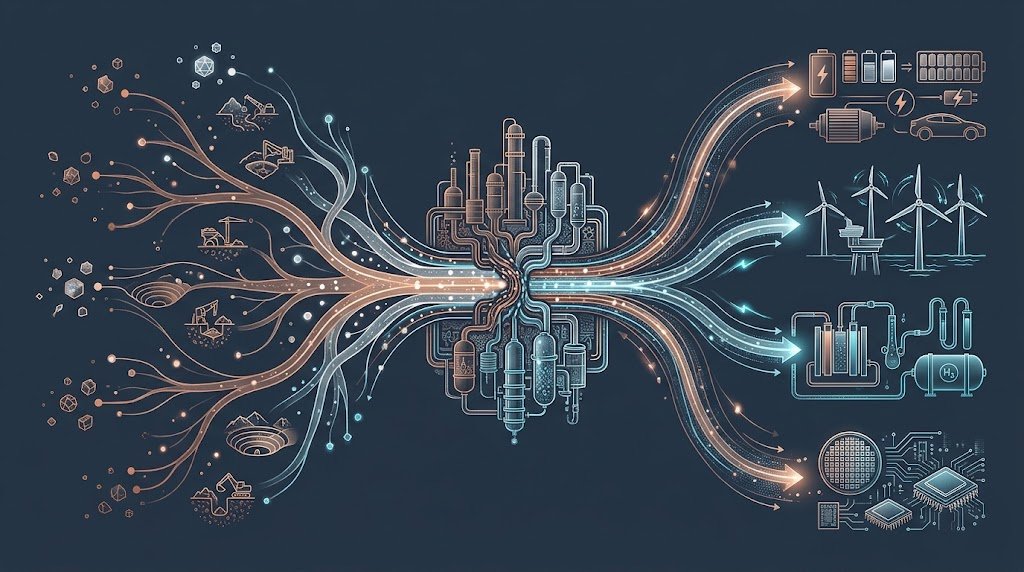
Our entire green tech and AI boom depends on just a few countries refining rare earth minerals and its insane 🌍
Can AI solve this problem, the answer is yes, I will make multiple posts to explain how.
Global supply chains for critical minerals like lithium, cobalt, graphite, gallium, and rare earth elements face massive bottlenecks. Even when raw ores get dug up in Australia, Chile, or Africa, over 70 percent gets shipped straight to China for chemical refining, where they control 90 percent of rare earth magnets and battery anodes. basically building new processing plants takes 15 years and billions of dollars, while export bans on gallium and heavy rare earths already sent western prices jumping 5x higher ⚡
Use cases include EV motors, wind turbines, green hydrogen plants, and AI data center chips.
How can chemical engineers speed up solvent free rare earth separation to bypass traditional refining hubs?