Every time reliance wants to launch a product it goes to same tucchai path of sending government dogs to go after the market leader.
Adani also does same, sends Ed and cbi, these two can't build anything
Forget bullet trains—can @RailwaySeva@drm_lko first figure out how to run Train 12392 without a 6-hour delay at Sultanpur? Stop tormenting passengers with this absolute circus of a schedule. Pathetic management, zero accountability! @drmdnr@RailMinIndia
@RailMinIndia@RailwayNorthern@GM_NRly@CPRONCR Look at the running status of train number 12392 shramjeevi express, you idiots are running train or bullock cart, it's been 16 hours and train hasn't even reached jaunpur, moved hardly 650 kms. It's already more than 6 hours behind schedule, @AshwiniVaishnaw ji there's no point in running a service like this I'm not sure what perverse please railway officials gets by working like this but you need to fire a couple of them for this nonsense they are running here
@nabilajamal_ What's this idiocy instead of requesting corporations why don't he enforce policies which push them to give salary hike, inflation is 10% and there is no hike since last 4 years, only politicians and beurocrates are enjoying with the their black money
Quantum machines are outgrowing classical verification—so how do we know their answers are right when conventional computers can no longer verify them?
Researchers at the University of Innsbruck, IQOQI, and TU Munich solved this using a 51-qubit trapped-ion quantum simulator. Instead of assuming flawless hardware, their Bounded-Error Quantum Simulation protocol reads experimental data to map real particle interactions and environmental noise. It translates those hardware fluctuations into strict, verifiable error margins around every final calculation—allowing scientists to trust complex simulations that impact clean energy, climate modeling, and life-saving materials without needing a supercomputer to double-check the math.
Use cases include verifying drug discovery molecules, clean-energy catalysts, and next-gen battery materials.
How should hardware architects balance error-bounding overhead against raw qubit scaling in NISQ systems?
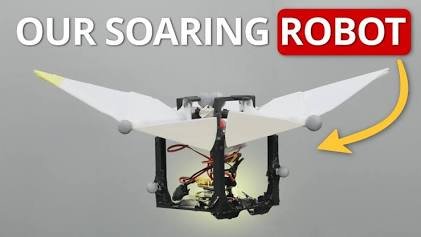
A drone that hovers without spinning propellers or draining batteries—just riding the wind.
Researchers at the Max Planck Institute for Intelligent Systems and the University of Stuttgart built Floaty, a kestrel-inspired flying robot that stays airborne using rising air currents.
Instead of power-hungry motors, Floaty adjusts four bent wing flaps to alter air resistance, letting it steer, stabilize against gusts up to 10 m/s, and hover with minimal energy—cutting environmental emissions and extending mission endurance.
Ideal for inspecting industrial smokestacks, guiding weather balloons, or assisting rocket re-entry.
How would you handle autonomous wind-current acquisition before deployment in unpredictable outdoor environments?
Turning mercury into gold without a nuclear reactor? A patented Indian frequency reactor claims it can.
Scalene Energy Research Institute’s Gravitoradiophysical Nuclear Transmutation (GNT) system aims to reshape matter cleanly without radioactive waste or toxic mining. Inside its vacuum-sealed "Boom Tube" reactor, molecules enter continuous weightlessness while aluminum antennas fire two targeted radio frequencies. The first frequency snaps chemical bonds to free raw elements, while the second nudges the atom's core—shifting mercury's 80 protons toward gold's 79. Lab tests detected 2.3 mg/L of gold and 11 mg/L of silver from treated mercuric sulphate.
Future use cases span clean energy, targeted medical isotopes, industrial materials, and space exploration.
Physicists and RF engineers: Can non-ionizing frequencies overcome nuclear binding energy, or is this an experimental artifact?
Water-based batteries just doubled their energy capacity without using toxic, corrosive salts.
Electrochemists at University College London (UCL) have engineered a non-halogen aqueous electrolyte (the KA–PA–Nuc system) for zinc-iodine and aluminum-iodine batteries. Traditional water-based batteries eliminate lithium fire risks, yet typically store less energy because iodine only transfers two electrons. UCL’s breakthrough liquid formula uses three simple, non-corrosive additives to stabilize iodine, letting it safely transfer four electrons instead—retaining 96% capacity over 1,000 cycles while cutting manufacturing costs and ecological hazards.
Use cases include fire-safe utility grid storage for solar and wind farms and low-cost backup power.
For battery engineers: what is the biggest bottleneck to scaling high-loading iodine cathodes into commercial pouch cells?
Profile of the Apex Predator at the Top
Behold the self-anointed visionary: a glorified con artist who mistook ruthless manipulation for genius. Numbed by early escapes from consequences, their conscience is practically a museum piece. They treat honesty as a peasant’s handicap, dazzle the gullible with cheap spectacle, and step over corpses while calling it "leadership." Perched atop a throne of shattered trust, this morally bankrupt fraud genuinely believes their god complex is a virtue.
This is the profile of everyone sitting on top of every company / organization in whole world, tell me if I'm wrong