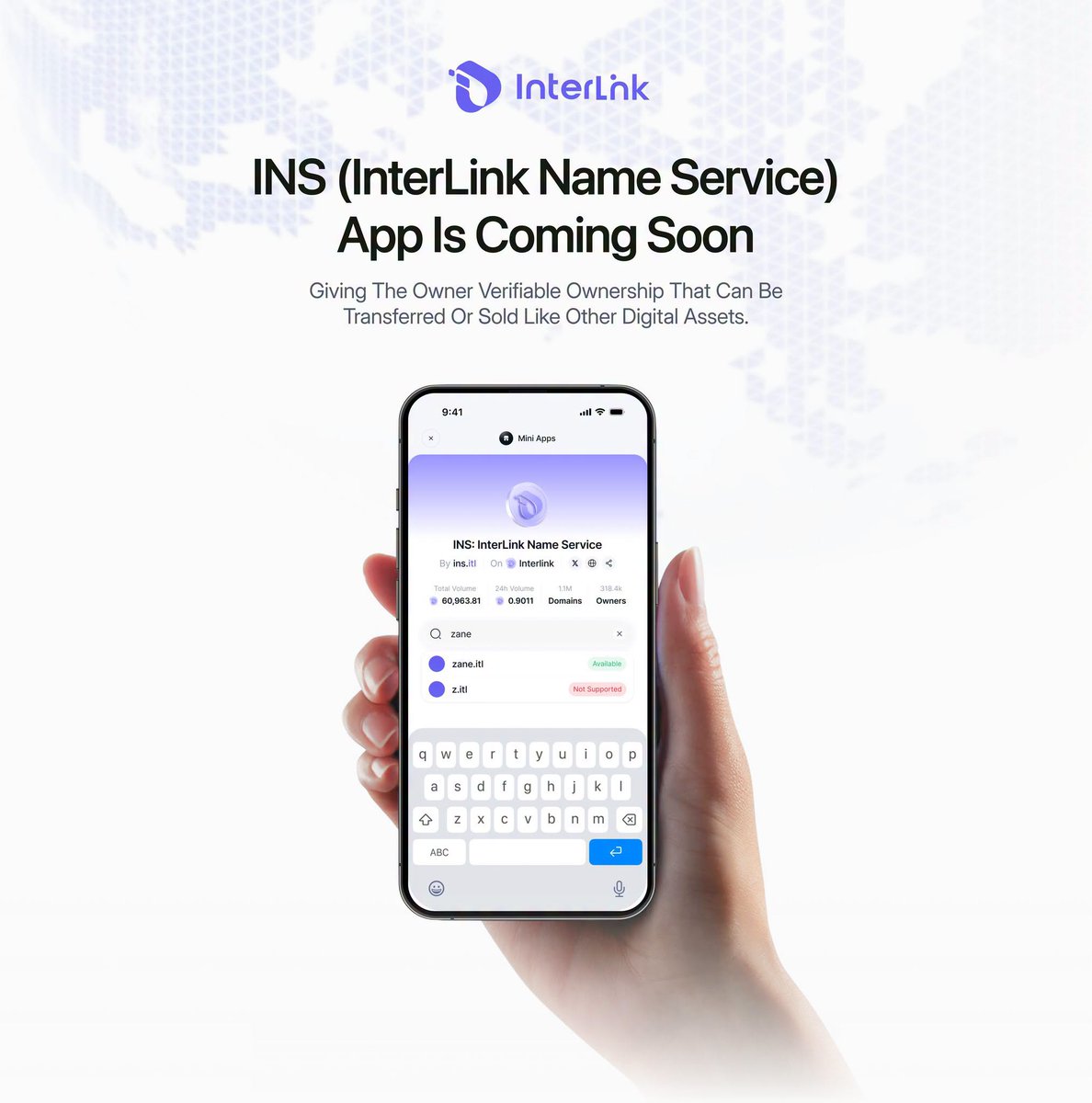
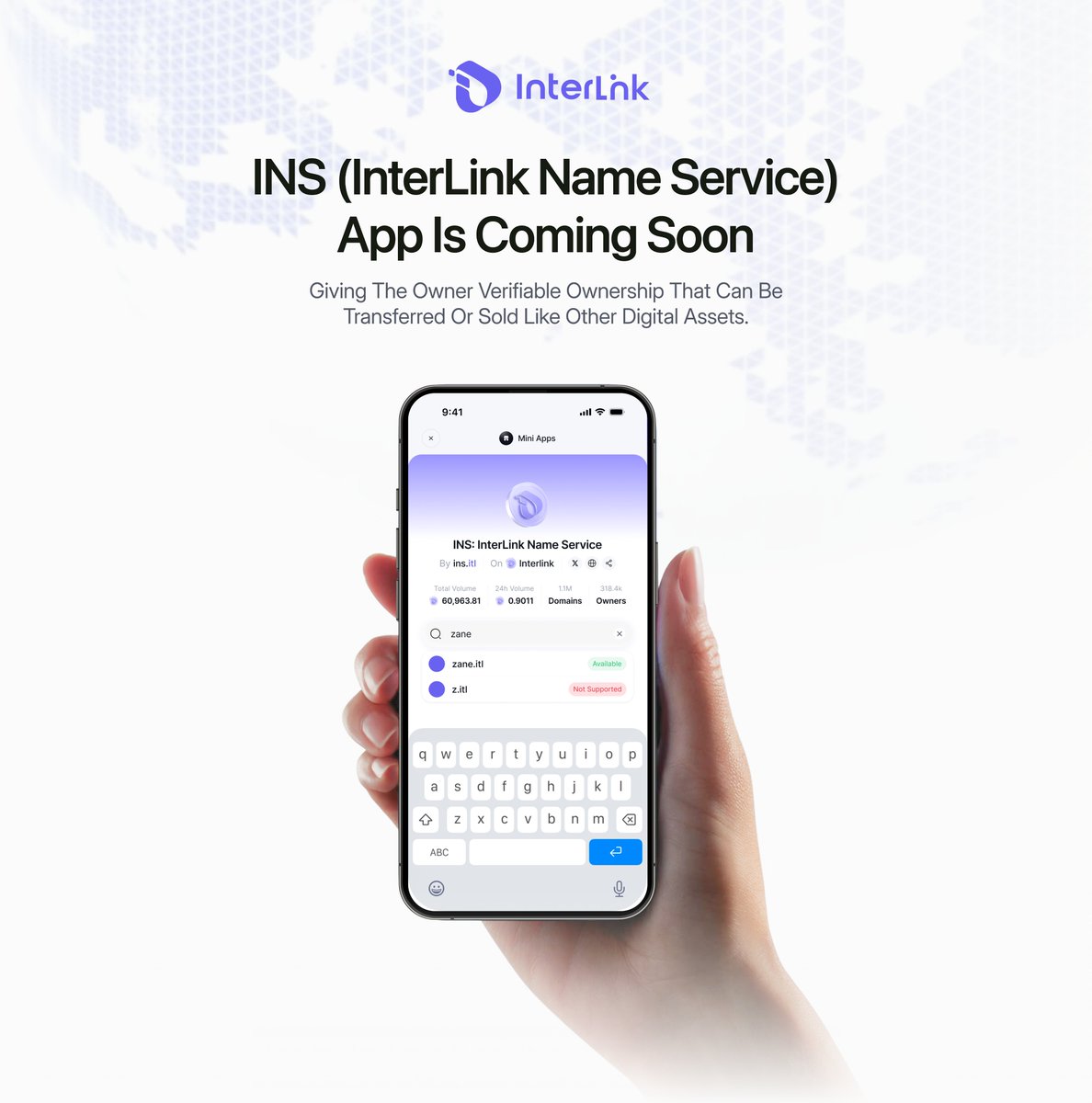
🚀 INS (InterLink Name Service) App is Coming Soon! 🔥
Say goodbye to long and confusing wallet addresses! 👋
With INS, you'll be able to register your own .itl name (like arif.itl) and use it as your digital identity across the InterLink ecosystem.
✨ Why INS is exciting:
• Easy-to-read .itl names instead of long wallet addresses.
• Connect multiple blockchain wallets with one name.
• Add your website, email, and social media links.
• Create unlimited subdomains like shop.yourname.itl or mail.yourname.itl.
• Your INS name is an NFT, meaning you truly own it and can transfer or sell it.
💎 Registering a name will require ITL, with pricing designed to stay stable regardless of market fluctuations.
INS is another major step toward making Web3 simpler, safer, and more user-friendly while expanding the InterLink ecosystem.
Who's ready to claim their .itl name? 👀
#InterLink #INS #ITL #ITLG #Web3 #Blockchain
INS (InterLink Name Service) App is coming soon
What Is InterLink Name Service?
INS is a decentralized naming protocol built on InterLink Chain that lets users register human-readable names ending in ".itl." Each INS name is an IRC-721 non-fungible token (NFT), giving the owner verifiable ownership that can be transferred or sold like other digital assets.
Beyond wallet addresses, INS names can link to cryptocurrency addresses on other blockchains, content hashes pointing to websites or files on decentralized storage networks, and personal metadata such as social media handles or email addresses.
Once live, INS will grow into a community-governed protocol managed through InterLink DAO, which will oversee the INS root and make key protocol decisions.
NameWrapper and IRC-1155 names
The INS NameWrapper contract will allow INS names to be wrapped and represented as IRC-1155 tokens rather than plain IRC-721 tokens. Wrapped names support "fuses," permission settings that control what actions can be taken on a name, such as preventing subdomain creation or preventing the name from being unwrapped. This enables more advanced use cases, including emancipated subdomains that cannot be revoked by the parent name owner.
How Does INS Work?
- Architecture
INS uses a hierarchical structure. At the top are top-level domains (TLDs) like ".itl," each managed by smart contracts called registrars that define registration rules. The INS registry is a central smart contract that records domain ownership, resolver assignments, and cache settings. Resolvers are contracts responsible for translating INS names into addresses or other data.
- Forward and reverse resolution
Forward resolution converts an INS name (such as "alice.itl") into one or more addresses or linked data. Reverse resolution works in the opposite direction, linking an address back to its primary INS name. This allows wallets and applications to display human-readable names instead of full hex addresses.
- Domains and subdomains
Owners of INS domains can create effectively unlimited subdomains that they fully control. For example, owning "alice.itl" allows creation of "mail.alice.itl" or "shop.alice.itl," each pointing to different resources or managed independently. With the NameWrapper, subdomains can be issued with specific permissions baked in.
What Can You Do With INS?
INS simplifies sending and receiving cryptocurrency by replacing complex addresses with readable names, reducing the risk of errors during transactions. A single INS name can link to multiple blockchain addresses, making cross-chain interactions easier to manage.
INS names can also store information such as website links, email addresses, and social media handles, making them useful as decentralized identifiers for personal or organizational branding. Subdomain creation and delegation enable communities and applications to build naming systems on top of an INS domain they control.
Registering and Managing INS Domains
- Registration
Registering an INS domain will require a compatible crypto wallet and ITL to cover the registration fee. The process involves searching for an available name on the INS app and registering it directly. Most names will be available on a first-come, first-served basis without auctions.
- Pricing and renewal
Registration fees will be set in dollar terms but paid in ITL. On-chain price oracles will convert the dollar price into the current ITL amount at the time of payment, keeping the actual cost stable in dollar terms regardless of ITL's market price. Names with five or more characters are expected to cost around a few dollars per year, while shorter names (three to four characters) will carry higher fees due to their scarcity. INS domains will require periodic renewal, with a grace period after expiration that allows owners to renew before a name re-enters the public pool.
#InterLink #ITLG #ITL
EVERY ITL PAID IN TRADING FEES ON IBTE WILL BE BURNED 🔥
Every fee paid in $ITL on the InterLink Business Token Exchange is permanently removed from supply. No recycling. No redistribution back into circulation. Once burned, gone for good.
Most tokens fight against dilution. $ITL fights back.
Most networks reward growth with more emissions, which means more tokens entering circulation over time. IBTE takes the opposite path. Every trading fee collected in $ITL is destroyed permanently, so growth in trading activity works against supply instead of adding to it.
How the burn works
When a business token is traded on IBTE, the exchange fee is paid in $ITL. That fee never returns to a treasury, a team wallet, or a rewards pool. It is sent straight to a burn address and removed from the total supply forever.
Stacking on top of existing burn mechanisms
This is not $ITL's only burn channel. Base fee burns already remove $ITL with every transaction on the network, and validator slashing burns remove $ITL from any validator that misbehaves. IBTE trading fee burns now add a third channel, directly tied to real economic activity rather than network usage alone.
Why growth compounds the effect
As more businesses list and tokenize on IBTE, trading volume increases. As trading volume increases, more $ITL gets burned. This means the more successful the InterLink Business Token Exchange becomes, the faster $ITL supply compresses. Growth and scarcity move in the same direction, not opposite ones.
From trading asset to store of value
Most tokens ask holders to believe in future demand. $ITL backs that belief with a mechanism. Every fee burned is permanent, every burn is public and verifiable on-chain, and every unit of ITL removed makes the remaining supply scarcer. This is what allows $ITL to be positioned as a long-term store of value, not just an asset to trade in and out of.
The more the InterLink ecosystem grows, the less $ITL there is to go around.
#InterLink #ITLG #ITL
🚨 MASSIVE UPDATE FOR LINKERSMAP 🚨
Phase II is officially loading—real business transactions are about to begin! 📈
⚠️ Action Required: Update your product prices in $ITL NOW based on the latest P2P price discovery.
Smooth trading starts here. Are you ready 👇
#OTC#ITL
🚦 What would you do if you encountered a traffic light signal like this? 🤔
Drop your answer in the comments below. Let's see how many people get it right! 👇
#InterLink#ITL#ITLG
Why dApps Are the Most Important Layer of a Blockchain Ecosystem
A blockchain is only infrastructure. No matter how fast, secure, or decentralized it is, its long-term success depends on one thing: whether people actually use it. That usage comes from decentralized applications. dApps are where users make payments, trade assets, play games, invest, communicate, and interact with digital economies. Without dApps, a blockchain is simply a network waiting for activity.
History has already proven this. Ethereum did not become the largest smart contract blockchain because it had the highest TPS or the lowest fees. It became dominant because thousands of developers built products that millions of people wanted to use. DeFi protocols created new financial markets, NFT marketplaces introduced digital ownership, stablecoins enabled global payments, and blockchain games attracted entirely new audiences. Every successful dApp generated more transactions, attracted more users, encouraged more developers to build, and reinforced Ethereum’s network effects.
The value of a blockchain grows exponentially as its application layer expands. Every new dApp becomes another gateway that brings new users into the ecosystem. A payment application attracts merchants and consumers. A decentralized exchange attracts traders and liquidity providers. A Real World Asset platform attracts businesses and investors. A social platform attracts creators and communities. Each application serves a different audience, but all of them contribute to the same blockchain by generating transactions, consuming block space, increasing liquidity, and creating demand for the native token.
This is why developers are the most valuable resource in any blockchain ecosystem. Every new team building on the network has the potential to create an application that brings thousands or even millions of new users. The success of one dApp often benefits every other project on the chain because users who enter through one application can easily discover and use others. This creates a powerful network effect where the ecosystem becomes more valuable as more builders participate.
For @inter_link, the vision goes far beyond launching a blockchain. The objective is to create a complete digital economy where businesses, developers, entrepreneurs, and communities can build applications that solve real-world problems. Whether it is payments, decentralized exchanges, AI services, Real World Assets, business tokenization, gaming, social platforms, or financial infrastructure, every successful dApp strengthens the entire ecosystem while increasing demand for ITL as the network’s core asset.
In the long run, blockchains will not compete solely on technology. They will compete on the strength of their ecosystems. The blockchain with the most useful applications, the largest developer community, and the strongest network effects will ultimately create the greatest long-term value. Technology builds the foundation, but dApps build the economy, and the economy is what determines the success of a blockchain.
#InterLink #ITLG #ITL
ITLX Wallet – Set up & keep safe
🔑 Backup seed phrase & private key properly
📈 ITLG Staking – Follow guide, earn ITL as DAO agreed
🌐 Prepare for dApps, tokens & InterLink future! #InterLink💎 #ITLG#ITL🚀
🔥 Everyone only sees ITL fee burns on the surface. Few understand the true structural advantages that separate $ITL from every other token in crypto. Let’s break down the real long-game logic behind IBTE permanent ITL destruction.
💎 1. Zero Middleman, Instant On-Chain Burn (No Manipulation Possible)
Unlike mainstream exchange tokens that use profit buyback & delayed burns, ITL fees are burned instantly on-chain with zero middle links.
BNB and other platform tokens collect fees into treasury first, then choose when to repurchase and burn tokens manually. There is room for capital retention, cycle adjustment and artificial manipulation. ITL trading fees go directly to burn wallets immediately, no treasury storage, no team wallets, no reward pools. Every destruction syncs perfectly with real transaction volume, fully transparent and untamperable on-chain.
♻️ 2. Real RWA Cash Flow Backed Sustainable Burning (No Fake Speculation)
IBTE builds stable long-term burn power backed by real-world RWA business cash flow, not empty on-chain speculation.
Most project burns rely only on internal chain transfers or meaningless swaps. Once market sentiment cools, burning stops completely. ITL has three independent burn channels: basic network gas burns, validator penalty burns, and brand-new IBTE enterprise token trading burns. Real corporate asset transactions create continuous, stable ITL destruction unaffected by crypto bull and bear cycles.
📈 3. Reverse Crypto Economic Model: Growth = Absolute Scarcity
ITL reverses the entire crypto supply dilemma — ecosystem growth directly boosts token scarcity, not inflation dilution.
Nearly all blockchains face the same fatal issue: more users and more activity = more token emissions, constant supply dilution and endless selling pressure. For InterLink, larger IBTE trading volume = more ITL permanently removed from circulation. The bigger the ecosystem grows, the scarcer ITL becomes. Supply and value rise together in a positive endless cycle.
🛡️ 4. Zero Dividend = Zero Constant Market Selling Pressure
No dividend distribution = zero regular selling pressure, protecting long-term holder value permanently.
Most platforms distribute fee dividends to users, which causes constant secondary market dumping and price suppression. ITL does not distribute any fee revenue at all. All collected fees are erased forever. There is no unlocked selling pressure, no team dump risks, no hidden wallet circulation. Every real business transaction continuously strengthens the bottom price support of ITL.
🎯 To sum up:
Other tokens rely on temporary buyback hype.
$ITL relies on real global RWA business to achieve permanent deflation.
It evolves from a simple trading asset into a genuine long-term decentralized store of value.
🚨 EVERY ITL PAID IN TRADING FEES ON IBTE WILL BE BURNED 🔥
#InterLink #ITLG #ITL @kv_interlink@inter_link #InterLinkSeoulPrivateMainnet