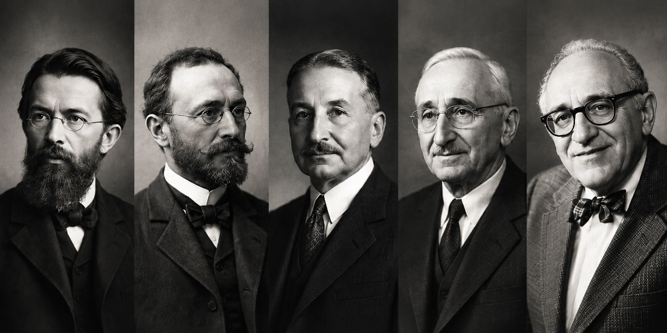
The intellectual case against Marxism was won more than a century ago. The most rigorous and devastating blows came from the Austrian School of economics – but the strange part is that hardly anyone is taught the winning arguments.
Carl Menger’s subjective theory of value, developed in the 1870s, undermined the labour theory of value on which Marx built his entire system. Eugen von Böhm-Bawerk then delivered a systematic demolition of Marx’s economics, exposing the contradictions in the theory of surplus value and the so-called transformation problem. Ludwig von Mises went further still, demonstrating that rational economic calculation is impossible under socialism because without private property and market prices there is no way to allocate resources efficiently. Friedrich Hayek later extended this into the knowledge problem: the information required to run a complex economy is dispersed and cannot be centralised. And Murray Rothbard showed how Marx misunderstood the nature of capitalism by replacing voluntary exchange and entrepreneurial creation with a false theory of exploitation based on labour value and class conflict.
These were not minor objections. They struck at the theoretical foundations of Marxism and, in the case of Mises and Hayek, correctly predicted the chronic waste, shortages, and eventual collapse of socialist economies. History confirmed their arguments on a civilisational scale.
Yet in universities, media and political debate, these critiques remain marginal. Marx is still widely taught as a serious economist and social theorist. His errors are softened, historicised, or treated as interesting starting points. The Austrian responses are rarely given equal weight. Students can pass through entire programmes in the social sciences without encountering Böhm-Bawerk’s critique or Mises’s calculation argument in any depth.
This neglect is not accidental. It reflects a deeper intellectual preference for theories that pathologise markets and legitimise expanded state power. The result is a public discourse that continues to recycle Marxist categories long after their economic foundations were shown to be unsound. The cost of that selective memory is still being paid.
"PT might not be the most important thing you do today, but it is the most important thing you do every day."
-SMA Dailey
This goes for everyone, even if you aren’t in the military anymore.
Do it for the smiles on your grandkids’ faces because you can still run around and play with them.
In 1939 the US Army began to realize war was imminent and just how destructive air power was, so it began increasing its air defense battalions to cover combat units, command posts, and everything in between. Almost a 1000% increase by 1943-44.
The advent of increasingly cheap, low skill barrier, drones is going to require something similar, IMO.
American C-RAM systems continue to engage incoming Iranian attack drones with streams of 20mm Phalanx fire over the northern Iraqi city of Erbil tonight.
Yeah, there's that intensity.
I really hope they're not just getting started.
Keep the 50,000 men & women who are in the line of fire tonight in your thoughts, and if so inclined, your prayers. It's going to be a long one.
BREAKING: The IRGC claims it has carried out a “heavy and surprise” attack on logistics support centres and refuelling platforms used by US aircraft carriers at the Port of Duqm in Oman, according to the state broadcaster.
🔴 LIVE updates: https://t.co/sfnZg9WSSH
In a hotel room in northeast Nigeria, I opened a leading AI chatbot, turned my laptop toward a former Boko Haram commander, and asked if he'd used it. He nodded.
"You type in the question… like 'How can I build a bomb?', and then it tells you how. It is like a human robot. We used it a lot."
My new study on how the jihadist terrorist group Boko Haram uses frontier AI with @CamAISciPolicy, covered today in @nytimes 🧵/9
You wanted evidence that a 30-06 would stop in a human neck?
The data in this report come from people with PHD's who have studied the terminal ballistics on human flesh of over 5,000 US casualties.
These are facts. There is no getting around them.
If you leave your education unable to write a 10+ page paper without writing assistance, on a complex topic, your educators have failed you. If you use AI to do it, you failed yourself. You have rendered yourself, or been rendered, less intelligent and less capable than you otherwise would be. And those with the skills you lack will almost inevitably get the better of you.
My family and I are getting ready to move again for the Army. This morning, while having my coffee in the quiet of the house before everyone was awake, I wrote down all of my moves. My dad was in the Army, so I have been moving around since I was born.
19 moves. That’s a move every 2 years (and I’m pretty sure I missed one or two).
That doesn’t include deployments.
That’s a lot.
I think the one thing I’m truly excited for in civilian life, whenever that may be, is stability. Setting down roots and watching my kids grow up in one area where they genuinely know people.
Anyways, time for more coffee.
I spoke to a few of brigades about their FPV expenditure. One is using approximately 50 FPVs per day (it was 100 earlier this year in a more intense direction), another said up to 100, and another said 90-110. But they are primarily facing small infiltration groups. It can take 150 FPVs or more to stop a platoon to company-sized mechanized assault, and the demands would likely be higher in a non-positional fight.