Getting goosebumps by these quotes from $NVDA CFO Colette Kress:
"We recognize the scale of this support ($500B third-party capital), and we know some will call this circular financing. We see it differently."
"We're going through...the creation of one of the most important technologies in human history."
"These are once in a generation, companies, the technology leadership is proven and their customer traction and usage are skyrocketing."
"We expect them to become the largest technology companies in history."
Bro....
🚨 BREAKING: Apple filed for a PRELIMINARY INJUNCTION against OpenAI AND asked a federal judge to put them under forensic supervision
"Apple respectfully moves the Court for a preliminary injunction to stop THE THEFT OF ITS TRADE SECRETS"
Apple filed NINE sworn declarations, a 28-page memorandum and a concurrent motion for expedited discovery
What Apple now says, under oath:
Chang Liu: 8 years at Apple, now OpenAI "Member of Technical Staff" exploited an authentication bug to steal Apple trade secrets "on AT LEAST FIVE SEPARATE OCCASIONS" from February to April 2026, WHILE working for OpenAI
Liu downloaded "THOUSANDS OF PAGES of Apple's most sensitive trade secrets"
The stolen files, NAMED:
>DisplayNotes.key — "several hundred pages" on Apple's custom display power development program
>Architecture analyses. Fabrication decisions. Testing results
>Engineering data for an UNANNOUNCED Apple product: 'touch, display, and power systems"
>Final.key + V2.key — compilations of two undisclosed Apple R&D projects
>and those are "only four of the dozens of proprietary documents Mr. Liu stole"
Liu fed OpenAI "a steady stream of Apple proprietary information that he actively concealed"
Liu also "coached Yu-Ting "Alyssa" Peng, then still INSIDE Apple, how to access and copy files from Apple workstations "to avoid trouble with the security team" and directed her to communicate with him on the encrypted LINE app "to avoid detection"
Tang Yew Tan: 24-year Apple VP, now OpenAI's Chief Hardware Officer, "used an Apple internal project codename for an unannounced product to elicit still more trade secrets from job candidates."
Tan's own messages, quoted in the motion:
>"Just like last time, bring some parts you worked on" >"mlb, battery, shields type of stuff is interesting"
OpenAI recruiter, quoted: "No, you won't sign anything at the exit interview. If they do ask you to sign anything, let me know asap."
APPLE TOLD FEDERAL JUDGE:
>"OpenAI knows its misappropriation is wrong and has tried to conceal it."
>"This is not a case of 'mere hiring'... it is a case of repeated instances of deliberate theft."
Apple says OpenAI went after its SUPPLIERS:
>OpenAI "directed a trusted Apple partner [name redacted] to perform [Apple's proprietary metal finishing] process for them, knowing it was proprietary to Apple... because they were involved in this partnership while at Apple."
Apple put its own Surface Finishing Manager, Jackie Hughes, under oath to prove it.
Apple named ELEVEN MORE former Apple employees at OpenAI — beyond Liu, Tan, and Peng — Fourteen people total.
Apple also filed a concurrent motion for EXPEDITED DISCOVERY demanding depositions:
- Liu. Tan. Peng.
- A fourth unnamed OpenAI employee
- Plus OpenAI itself, under oath, through Rule 30(b)(6)
Apple has asked a federal judge to put OpenAI under forensic supervision RIGHT NOW:
>Forensic inspection of ALL OpenAI devices
>ALL cloud storage, Slack, email
>Including anything that "previously contained" Apple data — deleted included
Demanding the "first available hearing date," citing "imminent threat" to its trade secrets.
APPLE:
> "The harm is happening now — every day that passes without an injunction allows OpenAI to embed their knowledge of Apple's stolen information into its hardware development efforts."
Hearing: October 1, 2026. Judge Edward J. Davila.
ITS HAPPENING
For my first post, I’m sharing a letter @NVIDIA signed on why open models matter.
AI will transform every industry, power every company, and be built by every country.
Open models strengthen safety and cybersecurity, accelerate innovation and diffusion, and enable sovereignty.
The world needs both frontier closed models and frontier open models.
https://t.co/AUKzoQ5Ikb
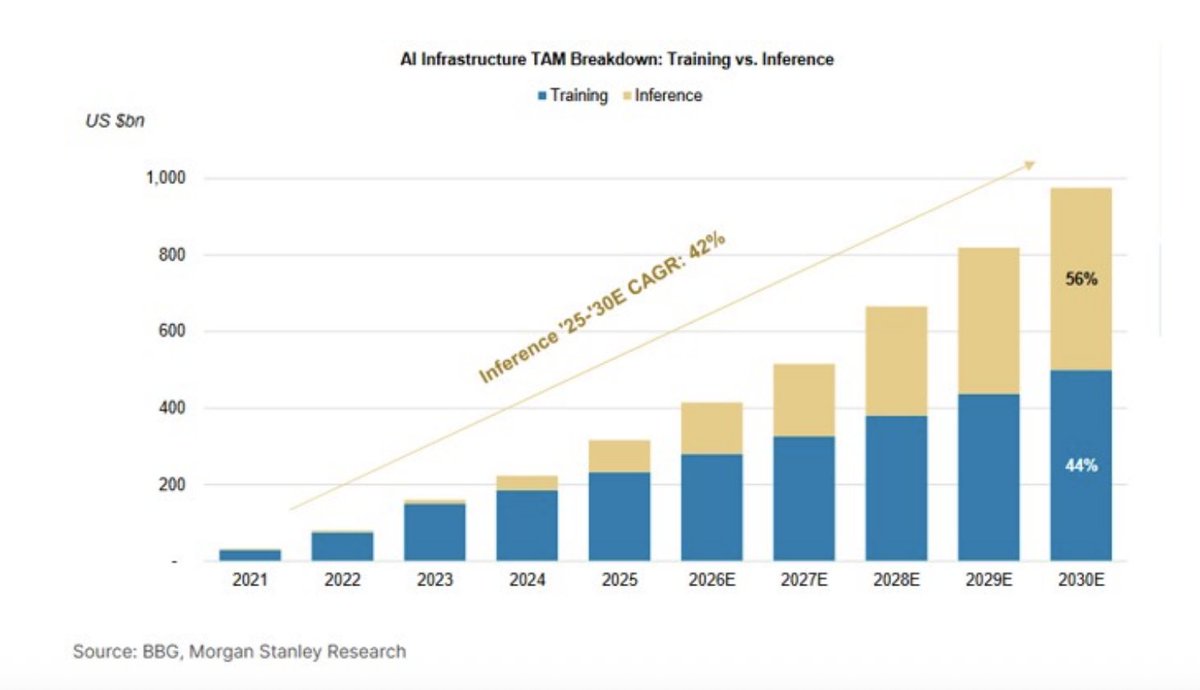
Morgan Stanley: Memory & Inference
AI Infrastructure TAM: Training vs. Inference
> Massive Market Growth: The total addressable market (TAM) for AI infrastructure is projected to reach nearly $1,000 billion ($1 trillion) by 2030.
> The Rise of Inference: While "Training" historically dominated early AI infrastructure spend, "Inference" is expected to grow at a blistering 42% CAGR between 2025 and 2030.
> The Pivot by 2030: By 2030, the market share is projected to flip, with Inference capturing the majority share at 56%, leaving Training at 44%.
Unprecedented Contract and Spot Pricing Mismatches
> DDR5 Pricing Surge: After a long flat period through late 2025, DDR5 prices experienced an unprecedented spike going into 2026. Spot prices surged past $45.00, while contract prices trailed tightly behind around $37.50.
> SSD (NAND) Disconnection: For 512GB PCIe 4.0 SSDs, a massive gap opened up in 2026. Interestingly, the OEM Contract price spiked dramatically higher to $118, while the Channel Spot price leveled off and dropped lower to $84.
> Inventory Normalization: Total supply-chain inventory weeks (across suppliers, PC OEMs, servers, and smartphones) peaked around mid-2024 to early-2025 and have steadily declined/normalized through 2026.
Cyclical Nature of Memory ("Rinse & Repeat")
> Predictable 4-Year Cycles: The historical data highlights clear, supply-driven memory cycles that repeat roughly every 4 years (e.g., peaks/troughs around 2010–2014, 2014–2018, 2018–2022).
> An Anomalous 2026 Spike: The current cycle moving into 2026 shows an outlier, nearly vertical surge. The DRAM Contract Year-over-Year (YoY) growth has skyrocketed to a historic high of 820%, shattering all previous cyclical peaks from the last 15 years.
$MU $NVDA $AMD $INTC $GOOGL $CBRS $AMZN
Tesla has released a new video of them tearing down the Model S and Model X production lines at Fremont ahead of the installation of the Optimus lines.
When fully ramped, this space will be able to produce 1 million Optimus robots per year.
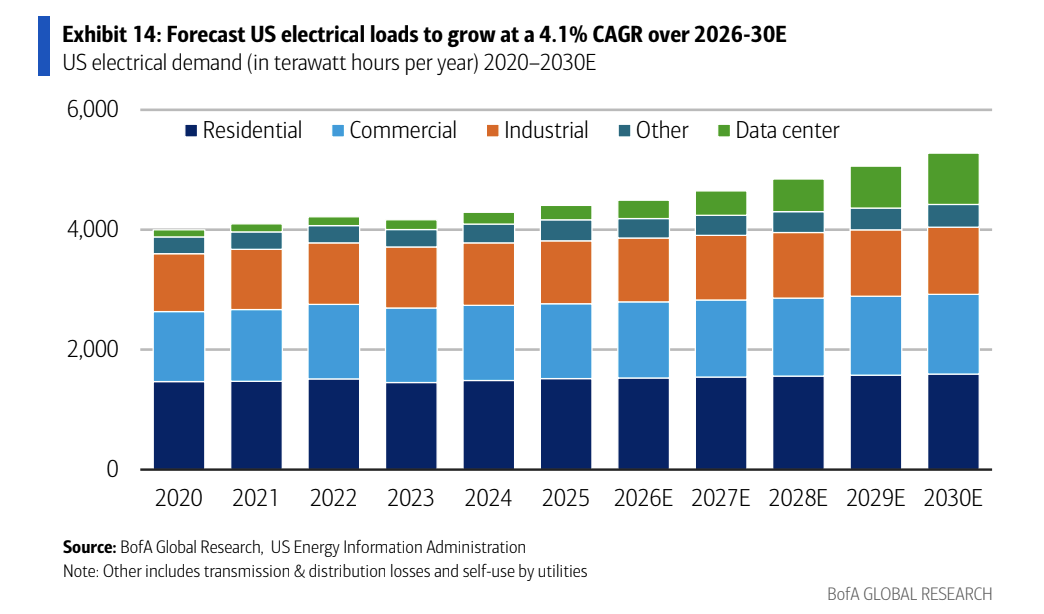
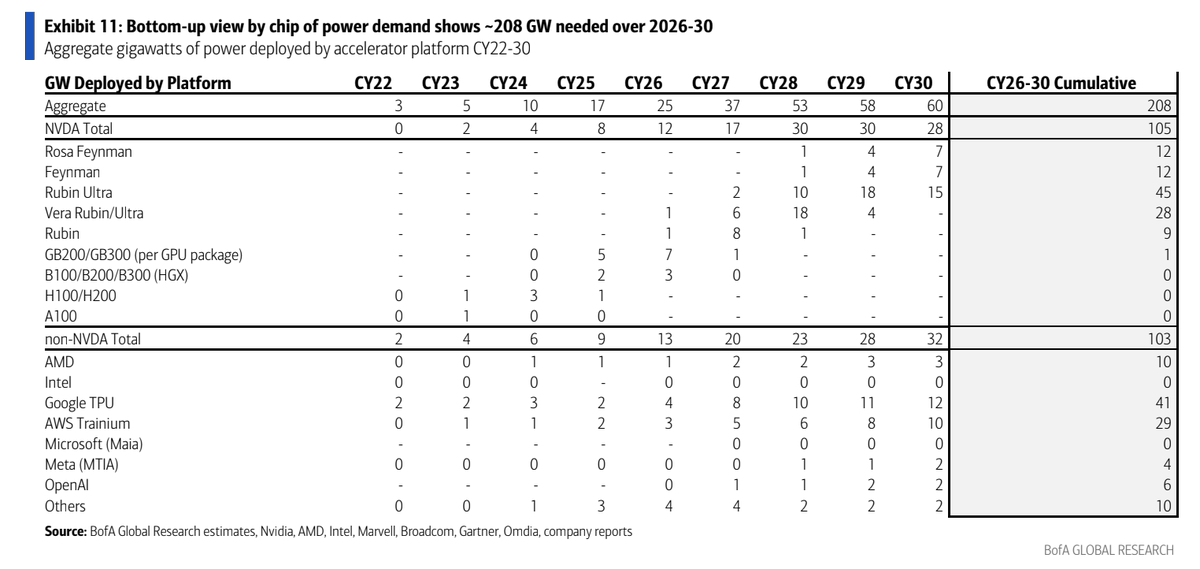
BofA: AI Power Demand
> 100+ GW Supply Gap: The US is projected to face an electricity generation shortfall of over 100 gigawatts (GW) between 2026 and 2030.
> Surging Demand vs. Capped Supply: Global semiconductor team forecasts imply a need for 230+ GW of capacity demand, while the US utilities team expects only 93 GW of accredited supply from regulated utilities.
> Massive Compute Load: Driven by AI accelerators, global IT load is expected to require 208 GW between 2026 and 2030. Factoring in a 50% North American share and a 1.20 Power Usage Effectiveness (PUE) multiplier to account for cooling and facilities, this translates to 125 GW of direct US data center load growth.
> Accelerated Growth Rate: After flat growth from 2010 to 2020 (largely due to a 150bp drag from LED adoption, appliance efficiency, and residential solar), US electrical load is projected to grow at a 4.1% CAGR from 2026 to 2030.
> Rise of Gas Engines: Due to turbine scarcity and the need for fast-response grid balancing, data center developers are shifting to gas reciprocating engines. Leading manufacturers like Caterpillar, INNIO Group, Rolls Royce, and Wärtsilä have all announced capacity expansions.
> Exponential Rack-Level Power Growth: BofA Global Research pointed out a staggering leap in the power density required by Nvidia's hardware generations. Power density has jumped from 35 kilowatts (kW) per rack for the Nvidia H100 chip up to an estimated 600 kW per rack for its upcoming Feynman architecture.
$GEV $CAT $NVDA $AMD $GOOGL $AMZN $INTC
23 years ago, we set out to prove that electric cars could be great – not just great electric cars, but the best cars overall.
We’ve gone from one electric sports car to
– Over 9 million vehicles on the road
– Model Y becoming the world’s best-selling car of any kind only 3 years after first deliveries
– 5 Gigafactories & other manufacturing sites across 3 continents
– The largest & most reliable fast charging network w/ over 80,000 Superchargers globally
– Energy generation & storage systems helping power homes & grids (over 1 million Powerwalls installed, 70+ GWh of industrial energy storage operating globally across 2,200+ projects)
Today, we’re bringing AI into the real world with autonomy @Tesla_AI and robotics @Tesla_Optimus.
Tesla is only getting started – a world of amazing abundance awaits
Micron $MU reported FQ3 revenue up 345.8% YoY and 73.7% QoQ to $41.46 billion, beating estimates by $6.21 billion.
Operating margin surpassed 80%, while adjusted EPS rose 1,215% YoY to $25.11, well ahead of the $20.28 estimate.
$NVDA $AMD $AVGO
Holy moly, Anthropic is getting very serious about recursive self-improvement!
One word: acceleration.
Insane blog article.
Tl;dr:
•We are close to an AI capable of fully autonomously designing and building its own successor
•They stress this isn’t here yet and isn’t inevitable, but could arrive sooner than most institutions are ready for
•Anthropic engineers now ship on average 8x as much code per quarter as they did in 2021–2025
•Task length AI can reliably complete is doubling roughly every 4 months (up from every 7 months)
•Opus 3 (Mar 2024) handled ~4-minute tasks; Sonnet 3.7 (a year later) ~90-minute tasks; Opus 4.6 (a year after that) 12-hour tasks
•SWE-bench went from low single digits to saturated in two years; CORE-bench (research reproduction) went ~20% to saturated in 15 months
•METR found Claude Mythos Preview could work “at least” 16 hours, at the top of what they can currently measure
•As of May 2026, Claude authored 80%+ of code merged into Anthropic’s codebase (low single digits before Claude Code launched in Feb 2025)
•A March 2026 poll of 130 research staff: median respondent estimated ~4x output with Mythos Preview
•One April 2026 example: Claude shipped 800+ fixes cutting a class of API errors 1,000x, work an engineer estimated would have taken a human four years
•Claude-written code quality: worse than human in late 2025, roughly at parity now, expected to be strictly better within the year
•On the hardest open-ended tasks, Claude’s success rate hit 76% in May 2026, up 50 points in six months
•Code-speedup test: Opus 4 averaged ~3x speedup (May 2025), Mythos Preview ~52x (April 2026); a skilled human needs 4–8 hours to hit 4x
•In an AI-safety research project, Claude agents recovered 97% of a performance gap (vs ~23% for two human researchers in a week), over 800 compute-hours and ~$18K
•On picking the better “next step” in research sessions, the best model beat the human choice 51% (Nov 2025, Opus 4.5) rising to 64% (April 2026, Mythos Preview)
•Human comparative advantage, for now: research taste and judgment, i.e. choosing which problems matter and when an approach is a dead end
Three possible futures
•The trend stalls (S-curve), but today’s capabilities still diffuse widely; they consider this least likely
•Compounding efficiency gains, with humans still setting direction; 100-person firms doing the work of 10,000+; they think this is the likely path
•Full recursive self-improvement, where AI builds its successors and pace is set by compute; the alignment outcome here is what they’re least certain about
SpaceX’s literally destroyed the cost to orbit so much even you can afford the ticket to ride on it in the future
- For decades, launch cost to low Earth orbit was roughly $18,500 per kg
- Falcon 9 brought that down to around $2,700 per kg
- Falcon Heavy pushed it closer to $1,400 per kg
➝ Now Starship is targeting a 99%+ cost reduction
When the cost of reaching orbit falls by orders of magnitude, space stops being a rare government program and starts becoming industrial infrastructure
Starlink, orbital manufacturing, lunar cargo, AI compute, and Mars all depend on one thing:
getting cost to orbit as close to zero as possible
That is why Starship matters so much....It is not just a bigger rocket
It is the cost reset that opens the next economic frontier
Elon Musk:
“I don't think most people understand just how quickly machine intelligence is advancing.
It's much faster than almost anyone realizes, even within Silicon Valley and certainly outside Silicon Valley. People really have no idea.”
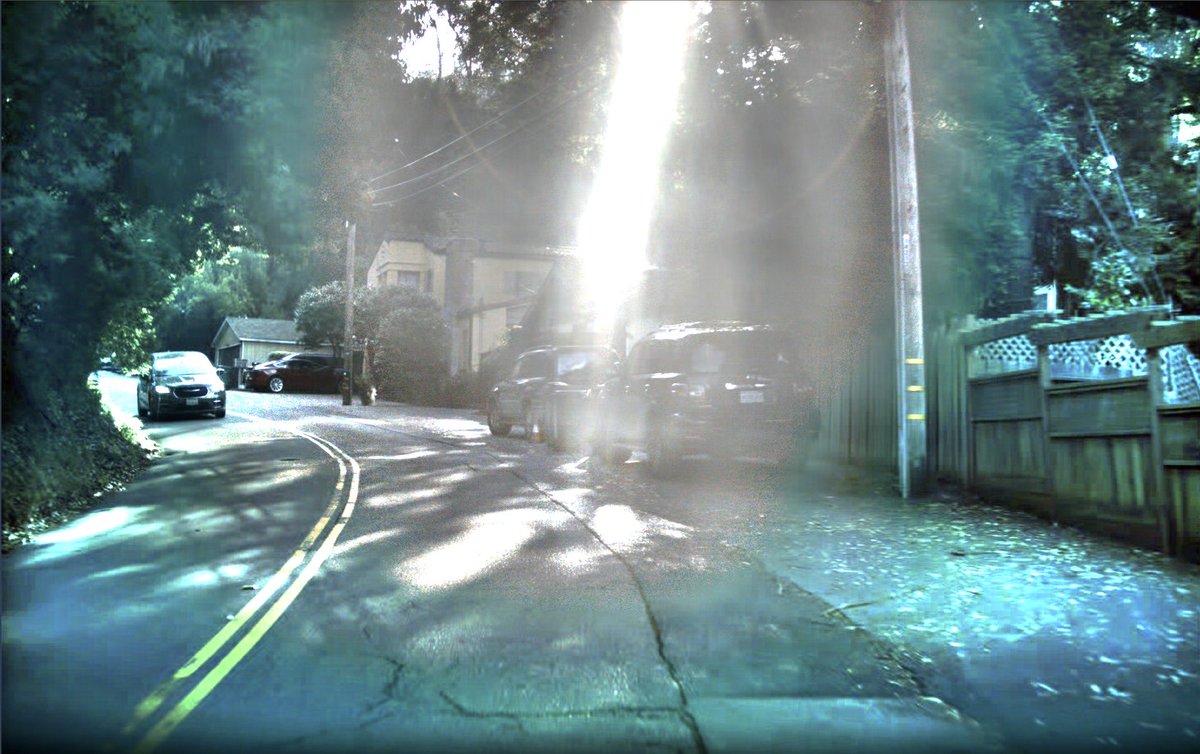
The human-perceived RGB is image 1 and the Tesla AI photon count reconstruction is image 2.
This is why Tesla FSD can see so well at night or through extreme glare.
CPO represents one of the largest upcoming shifts in the AI networking stack with adoption projected to increase from <0.1% in 2025 to >35% by 2030.
We break this shift down in this week’s newsletter. Link in bio.
$NVDA $AVGO
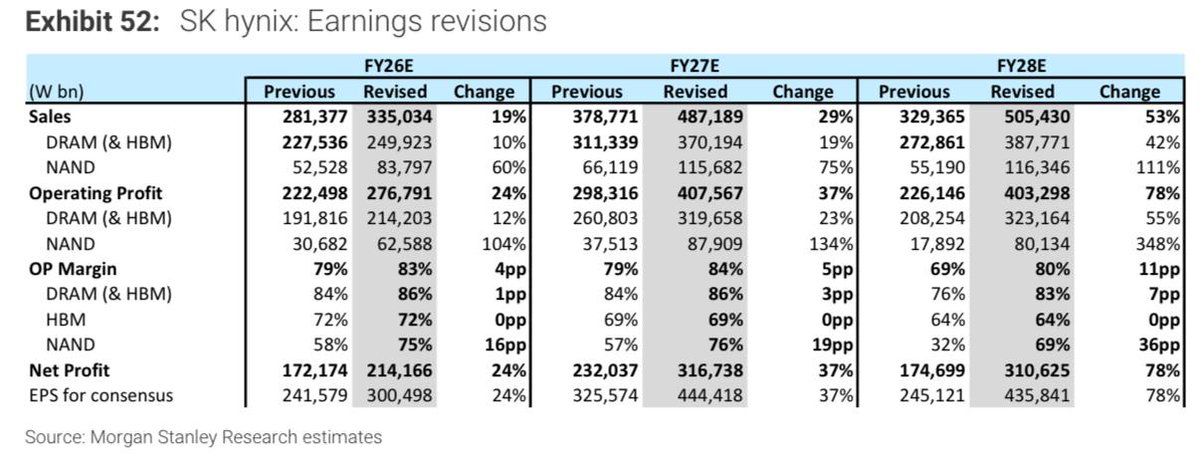
KIS, which I consider one of the top three Korean sell-side firms, published a memory report, and there’s a comment from it that I wanted to share with you all:
Memory is the critical variable that determines GPU utilization. In particular, when HBM and DRAM capacity is insufficient, memory bottlenecks prevent GPUs from being fully utilized, leading to a decline in overall system efficiency. Conversely, expanding memory capacity raises GPU utilization, allowing the same GPU resources to process a greater number of tokens. This translates directly into a lower cost per token. As cost per token falls, more users are drawn in, ultimately driving a larger expansion in inference demand. This is precisely why hyperscalers, despite rising memory ASPs, are willing to go as far as proposing long-term supply agreements in order to secure greater memory allocation. The cost of purchasing memory rises, but at the same time, that purchase improves GPU utilization—lifting overall system efficiency and lowering cost per unit of performance.
With DRAM prices having spiked roughly 3x year-over-year in a short span, the market is now bracing for a subsequent decline in demand or prices. But this view stems from looking at memory purely as a standalone cost line item. Even if DRAM is purchased at 3x the price, if that spending allows more GPUs to run and more tokens to be processed, system-wide profitability can actually improve. The fate of the chips that once tried to challenge NVIDIA GPUs by leaning on MLPerf benchmarks—touting per-chip performance-per-watt and price-performance comparisons—illustrates this well. As Jensen Huang has repeatedly emphasized, comparing single-chip specs in isolation is meaningless. Huang has stated that NVIDIA GPUs deliver the lowest cost per token in the world, adding that the lowest cost per token and the highest performance per watt are the decisive metrics of AI economics. In other words, his consistent argument is that competition should not be waged on GPU hardware specs alone, but rather on cost per token at the full-system level. The same logic extends to memory. If "buying memory at a premium still pays off at the system level," then memory purchases by hyperscalers locked in the AI arms race will continue.
The same logic applies to NAND. Active efforts are underway to integrate NAND into AI infrastructure systems. Some argue that wider NAND adoption will eat into DRAM demand, but this too misreads the memory market as a zero-sum game with a fixed pie. As AI workloads have grown, the upper tiers of the memory hierarchy—HBM and DRAM—alone can no longer accommodate the demand, and NAND has emerged as a key element in extending that hierarchy. NAND, in particular, offers an overwhelmingly lower cost per unit of capacity than DRAM. As of Q1 2026, NAND prices stand at roughly $0.10–$0.12 per GB, whereas DRAM—even mobile DRAM, the lowest-priced application segment—has already surpassed $6 per GB on a contract basis. Even if NAND prices were to double or triple, they would still remain far below DRAM. If even a portion of AI workloads can be offloaded to NAND, it can directly contribute to lowering system-wide cost per token.
$DRAM $MU $SNDK
OpenAI and Anthropic reportedly expect to spend almost $65 billion combined this year to train and operate their AI models, before nearly doubling to $127 billion next year and nearly $250 billion by 2029, per the WSJ.
$MSFT $AMZN $NVDA $AMD $AVGO
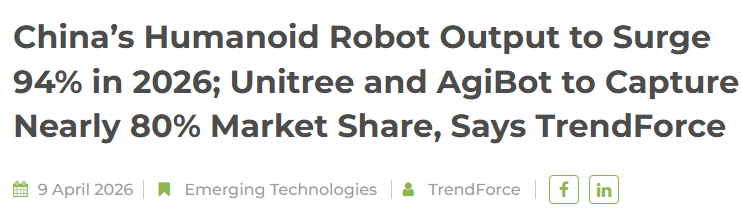
$MU $DRAM China’s humanoid robot output is projected to surge by up to 94% in 2026
"Vehicles with L4 autonomy require over 300GB. Humanoid robots powered by a compute platform that rivals a high-end L4-capable automobile" - @MicronCEO
Unitree Robotics and AgiBot are expected to dominate, together capturing nearly 80% of total shipments in China thanks to strong progress in monetization and mass production scaling.
-Unitree:Humanoid robot revenue accounted for over 51% of its total revenue in 2025.
-Combined gross margin (humanoid + quadruped robots) reached 60%.
-Planned annual production capacity: 75,000 humanoid robots and 115,000 quadruped robots.
AgiBot:
-Rolled out its 10,000th general-purpose embodied robot (Expedition A3) in late March.
-Rapidly scaled production in 2025–2026: from 1,000 → 5,000 → 10,000 units within a short period.







![ns123abc's tweet photo. 🚨 BREAKING: Apple filed for a PRELIMINARY INJUNCTION against OpenAI AND asked a federal judge to put them under forensic supervision
"Apple respectfully moves the Court for a preliminary injunction to stop THE THEFT OF ITS TRADE SECRETS"
Apple filed NINE sworn declarations, a 28-page memorandum and a concurrent motion for expedited discovery
What Apple now says, under oath:
Chang Liu: 8 years at Apple, now OpenAI "Member of Technical Staff" exploited an authentication bug to steal Apple trade secrets "on AT LEAST FIVE SEPARATE OCCASIONS" from February to April 2026, WHILE working for OpenAI
Liu downloaded "THOUSANDS OF PAGES of Apple's most sensitive trade secrets"
The stolen files, NAMED:
>DisplayNotes.key — "several hundred pages" on Apple's custom display power development program
>Architecture analyses. Fabrication decisions. Testing results
>Engineering data for an UNANNOUNCED Apple product: 'touch, display, and power systems"
>Final.key + V2.key — compilations of two undisclosed Apple R&D projects
>and those are "only four of the dozens of proprietary documents Mr. Liu stole"
Liu fed OpenAI "a steady stream of Apple proprietary information that he actively concealed"
Liu also "coached Yu-Ting "Alyssa" Peng, then still INSIDE Apple, how to access and copy files from Apple workstations "to avoid trouble with the security team" and directed her to communicate with him on the encrypted LINE app "to avoid detection"
Tang Yew Tan: 24-year Apple VP, now OpenAI's Chief Hardware Officer, "used an Apple internal project codename for an unannounced product to elicit still more trade secrets from job candidates."
Tan's own messages, quoted in the motion:
>"Just like last time, bring some parts you worked on" >"mlb, battery, shields type of stuff is interesting"
OpenAI recruiter, quoted: "No, you won't sign anything at the exit interview. If they do ask you to sign anything, let me know asap."
APPLE TOLD FEDERAL JUDGE:
>"OpenAI knows its misappropriation is wrong and has tried to conceal it."
>"This is not a case of 'mere hiring'... it is a case of repeated instances of deliberate theft."
Apple says OpenAI went after its SUPPLIERS:
>OpenAI "directed a trusted Apple partner [name redacted] to perform [Apple's proprietary metal finishing] process for them, knowing it was proprietary to Apple... because they were involved in this partnership while at Apple."
Apple put its own Surface Finishing Manager, Jackie Hughes, under oath to prove it.
Apple named ELEVEN MORE former Apple employees at OpenAI — beyond Liu, Tan, and Peng — Fourteen people total.
Apple also filed a concurrent motion for EXPEDITED DISCOVERY demanding depositions:
- Liu. Tan. Peng.
- A fourth unnamed OpenAI employee
- Plus OpenAI itself, under oath, through Rule 30(b)(6)
Apple has asked a federal judge to put OpenAI under forensic supervision RIGHT NOW:
>Forensic inspection of ALL OpenAI devices
>ALL cloud storage, Slack, email
>Including anything that "previously contained" Apple data — deleted included
Demanding the "first available hearing date," citing "imminent threat" to its trade secrets.
APPLE:
> "The harm is happening now — every day that passes without an injunction allows OpenAI to embed their knowledge of Apple's stolen information into its hardware development efforts."
Hearing: October 1, 2026. Judge Edward J. Davila.
ITS HAPPENING](https://pbs.twimg.com/media/HO4FaCPXUAAypf9.jpg)