We are facing a catastrophe because these incompetent fools (aided and abetted by the Greens, Teals and piss weak Liberals) prioritised the virtue-signalling renewable energy target over the 90 day IEA oil reserve target.
The renewable energy target is a meaningless feel-good virtue signalling target.
The 90 day minimum IEA target is a matter of national survival.
I remember Australian politics was divided by economic policy.
Now we've got a PM who justifies crushing free speech because his voter base has an ideology that justifies killing Aussies at the beach.
So it's easier to blame us,than deal with the truth.
I loathe this grub.
🚨 BREAKING 🚨
Australian Democracy has been SUSPENDED! We are now living under a totalitarian regime.
The Australian Labor Party can now dictate:
- what we can say;
- if we can meet;
- if we can distribute political ideas in written form;
- who can form political parties;
- what these political parties are allowed to advocate for; and
- how we can defend ourselves.
Essentially all forms of political resistance are now illegal.
These powers are also arbitrary! The ALP has complete discretion to now prosecute their political enemies!
This is literally Australia’s DARKEST HOUR since 1942!
Albanese’s going after the Christian pastors.
Under his proposed legislation, if you are a radical Islamist, referencing phrases from the Koran t,o espouse violence and death - Albanese’s "Hate Speech" legislation gives you a free pass.
But if you are a Christian pastor saying that individuals that hold such abhorrent views should be deported because their beliefs are incompatible with Australia being a Christian nation - under Part 3 of this abomination of a Bill, Albanese wants not only to put you in jail, but single you out for special treatment with imprisonment for 12 years. https://t.co/Qr49DSfXL8
And this is Albanese’s response to an Islamic terrorist atrocity - legislation which will have the effect of signalling out Christian pastors for special punishment.
Truth and Trust – Key for Our Future
As a new year begins, global attention gravitates toward elections, geopolitical tensions, economic uncertainty, and the accelerating advance of AI. Yet beneath these visible developments lie two deeper forces that will shape our shared future far more profoundly: truth and trust.
These are not abstract virtues. They are the basic conditions that allow complex societies to function in an era defined by rapid technological change, economic interdependence, and growing social fragmentation. And today, both truth and trust are under mounting pressure.
For most of the modern era, societies operated with the assumption that, although citizens may disagree on priorities or ideology, they broadly shared a common factual basis. That assumption is dissolving. Digital technology fragments information flows into personalized realities; synthetic content blurs the difference between the genuine and the fabricated; and algorithms reward the provocative rather than the accurate. The consequence is not simply misinformation—this is a broader social fragility, a weakening of the common foundations on which societies rely to decide what is reliable and what is not. When different groups inhabit incompatible versions of reality, public reasoning falters, consensus becomes elusive, and even the most basic collective decisions can stall.
At the same time, trust in institutions, leaders, media and even in fellow citizens has eroded. Trust is often described as a sentiment, but in modern society it is a structural asset: the invisible infrastructure that allows cooperation in markets, in democratic institutions, and in daily civic life. When trust is present, societies manage uncertainty with confidence and legitimacy. When trust declines, even competent institutions struggle to act, information loses persuasive power, and polarization thrives. Businesses increasingly recognize stakeholder trust as a strategic resource; governments and global organizations, too, are discovering that their legitimacy rests less on formal authority and more on the confidence they inspire.
The challenges of the intelligent age intensify these dynamics. Artificial intelligence now mediates large portions of human communication, decision-making and knowledge formation. As systems become more autonomous and opaque, their impact on public understanding grows. A society that already struggles to determine what is true will find it even harder when confronted with content that is effortless to fabricate and difficult to verify. A society that already doubts its institutions will hesitate to adopt technologies that require confidence in their design and governance. Progress will not come from innovation alone, but from the social capacity to interpret, trust, and integrate innovation.
Looking to the year ahead, the most consequential questions are not technological forecasts or geopolitical predictions. They are simpler and more fundamental: Can societies still agree on basic facts? Do citizens retain enough trust in their institutions to navigate uncertainty? And can we expect stability or progress in a world where truth is unstable and trust increasingly fragile?
Truth and trust are not nostalgic ideals. They are the operating foundations of any functioning society, and the decisive variables of the intelligent age. Whether the coming years bring fragmentation or renewal will depend less on the sophistication of our technologies than on the coherence of the truths we share and the strength of the trust that binds us.
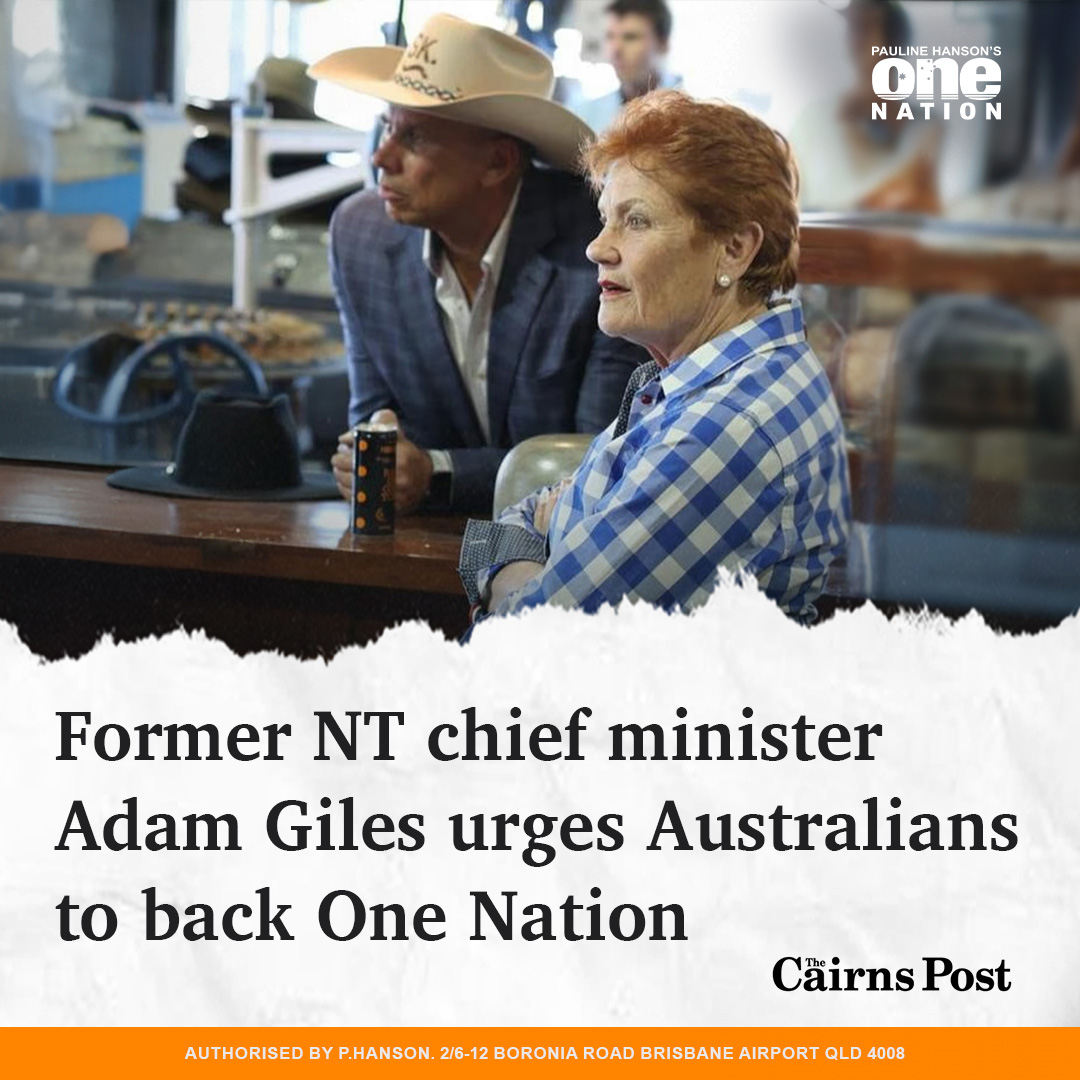
Adam Giles, Australia’s first leader of Aboriginal heritage, has thrown his support behind One Nation, urging others to back the party through donations and active support.
Mr Giles said Pauline Hanson and One Nation are the only ones providing the leadership needed on immigration and net zero to “save our country”.
Mr Giles led the Country Liberal Party government in the Northern Territory from 2013 to 2016 and is now Chief Executive of Hancock Agriculture and S. Kidman and Co.
“Australians have been suffering, and will suffer even more, under left-leaning net zero policies,” Mr Giles said. “We’ve been living under an immigration Ponzi scheme to prop up the economy instead of fixing the real problems. Excessive red tape, over-regulation, high taxes and wasteful government spending are crippling the country.” https://t.co/RmIoAoZXst
“Let me take a moment to send the love and prayers [of] our entire nation to the people of Australia... All nations must stand together against the evil forces of radical Islamic terrorism.” @POTUS