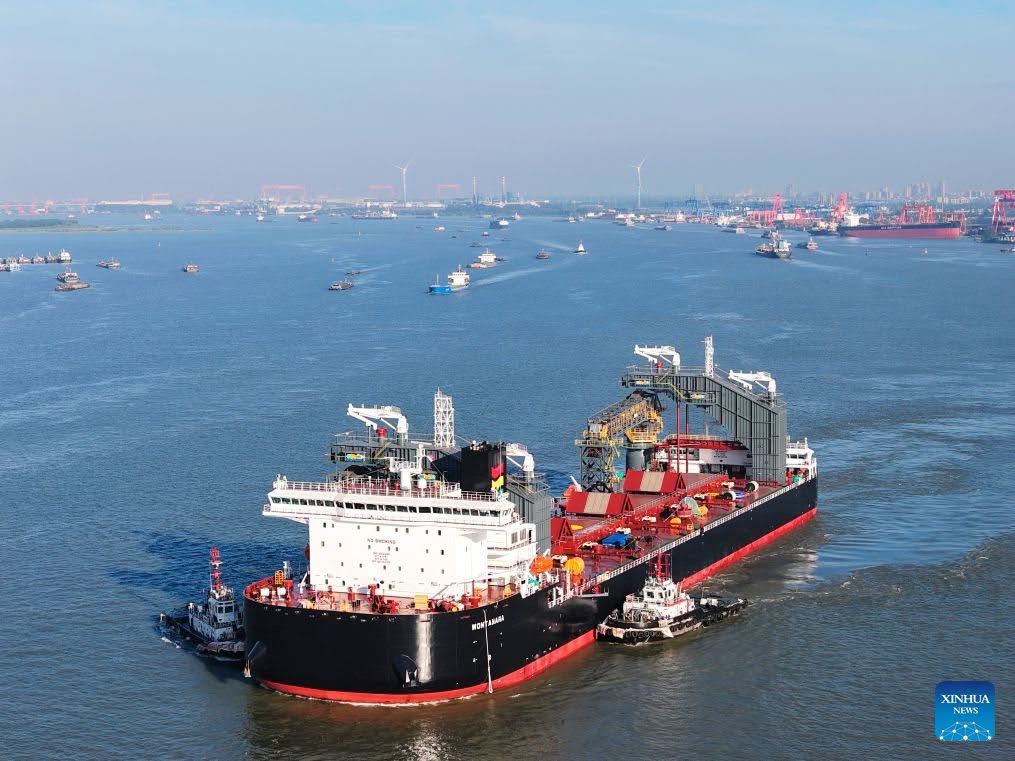
The China-developed world's first 41,800-tonne bidirectional sailing self-unloader set sail from Yangzhou, east China's Jiangsu Province, on Wednesday, and will be put into operation on international routes.
The vessel, measuring 215 meters in length, 42 meters in beam and 14.5 meters in moulded depth, has a cargo hold capacity of 29,000 cubic meters. It is also the world's largest shallow-water transshipment self-unloader by deadweight and the fastest self-unloading vessel of its kind, with a maximum unloading capacity of 12,000 tonnes per hour.
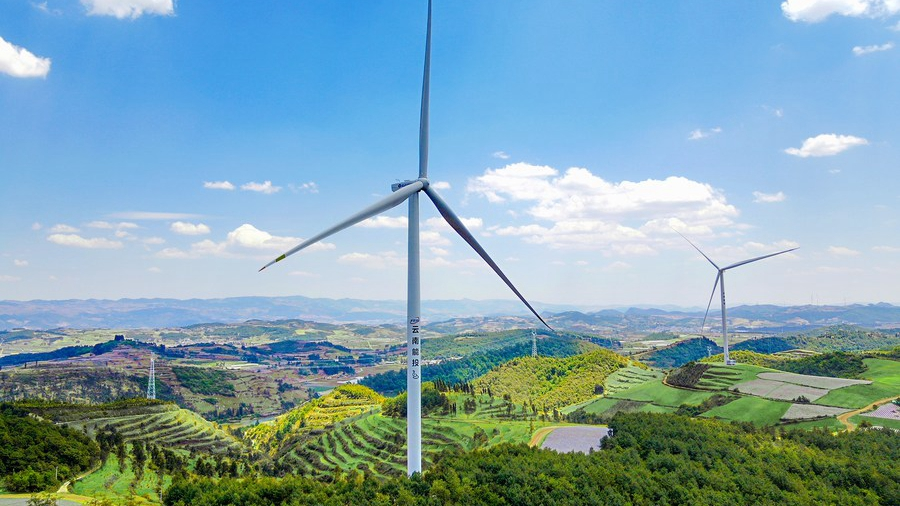
China aims to reduce CO2 emissions per unit of GDP by 17% from the 2025 levels by 2030, and develop the capacity to cut total emissions by 30 million tonnes of CO2 equivalent in the same period, according to a national climate change plan made public on Wednesday.
🇨🇳Cada vez más hijos de élites occidentales eligen estudiar en universidades chinas en lugar de las tradicionales de EE.UU. o Europa.
El motivo no es ideológico. Es práctico: China concentra gran parte de la producción tecnológica, la automatización industrial, la investigación aplicada y los proyectos de infraestructura a gran escala.
Estudiar allí permite contacto directo con el ecosistema que actualmente lidera en manufactura avanzada, robótica, vehículos eléctricos y cadenas de suministro.
Mientras algunos medios minimizan este cambio, las decisiones educativas de quienes tienen acceso a información privilegiada revelan dónde perciben el futuro del conocimiento aplicado.
¿Crees que este desplazamiento educativo es temporal o marca una tendencia estructural?
Outro ângulo do impacto de um drone russo contra um prédio residencial na Romênia, deixando dois feridos. É um dos ataques mais graves da Rússia contra a OTAN, após mais de 20 drones terem invadido o espa��o aéreo da Polônia em 2025.
#hojenomundomilitar
Mais uma lancha do narcotráfico foi destruída esta noite pelos EUA. A ação decorreu no Pacífico e resultou na morte dos 3 terroristas que seguiam a bordo.
Drones ucranianos de longo alcance atingiram 23 alvos russos esta noite, incluindo navios de carga ligados à "frota sombra" de Putin.
#hojenomundomilitar
Vídeo captado a longa distância mostrando a explosão da New Glenn, da Blue Origin, durante um teste estático em Cabo Canaveral, na Flórida. Ninguém se feriu na explosão.
China is the first major economy that has a #zerotariff policy for ALL African countries having diplomatic ties with China.
Since May 1, more African goods have entered China tariff-free, including:
✅ 🇿🇦 South African wine & apples 🍷🍎
✅ 🇰🇪 Kenyan avocados 🥑
✅ 🇪🇬 Egyptian citrus 🍊
✅ 🇳🇬 Nigerian bovine bone chips 🦴
✅ 🇲🇦 Moroccan gypsum
China’s zero-tariff policy comes with a package of supporting measures to ease the import process:
✅ “green lanes” for African agro and food imports
✅ streamlined quarantine clearance procedures
✅ a tiered risk-based management
��� HOW LONG WOULD IT REALLY TAKE TO VISIT EVERY PLANET?
Dreaming of hopping from planet to planet?
The Moon is closest at just three days away, but even nearby planets demand patience: Venus takes roughly 3–5 months, Mars 6–9 months, and Mercury’s tricky orbit around the Sun stretches missions like BepiColombo to 5–7 years.
The outer planets require true endurance: Jupiter 5–7 years, Saturn 7 years, Uranus 9 years, Neptune 12 years, and Pluto about 9.5 years with New Horizons’ record-setting trip. These journeys rely on clever mission design, orbital alignments, and gravity assists, proving that exploring our Solar System is as much about patience as engineering brilliance.
Sources: NASA mission archives
Scientists have made an exciting discovery that could change the future of human space exploration. An Earth sized planet, located 40 light years away from our own, has been identified as a potential candidate for supporting life. This discovery adds to the growing list of exoplanets that share characteristics with Earth, sparking questions about the possibility of life beyond our solar system. With advancements in space technology, researchers are increasingly confident that finding planets with conditions similar to Earth is within our reach.
The planet, nicknamed "New Earth," shares many of the same qualities as our planet, including its size and distance from its star. Just like Earth, it orbits within the habitable zone of its star, where conditions are just right for liquid water to exist. This discovery raises the tantalizing possibility that this planet could have the ingredients needed to support life, making it an exciting target for future space missions.
What's even more thrilling about this discovery is the fact that scientists have been able to study the planet from afar, using powerful telescopes and advanced technology. This breakthrough not only strengthens our understanding of how Earth like planets form but also opens up new opportunities for space exploration. As we continue to discover planets like New Earth, we get closer to answering one of humanity's biggest questions: Are we alone in the universe?
For many, the discovery of New Earth feels like a reminder that the search for life beyond our planet is far from over. With ongoing advancements in space exploration, scientists are continually uncovering new information that brings us closer to understanding the universe around us. The possibilities are endless, and New Earth could be just the beginning of a new era in space exploration.
As we continue to look toward the stars, the potential of discovering more habitable planets is inspiring. Whether or not New Earth can support life remains to be seen, but the discovery has reignited the conversation about our place in the cosmos. It has also fueled excitement for future space missions aimed at exploring these distant worlds.
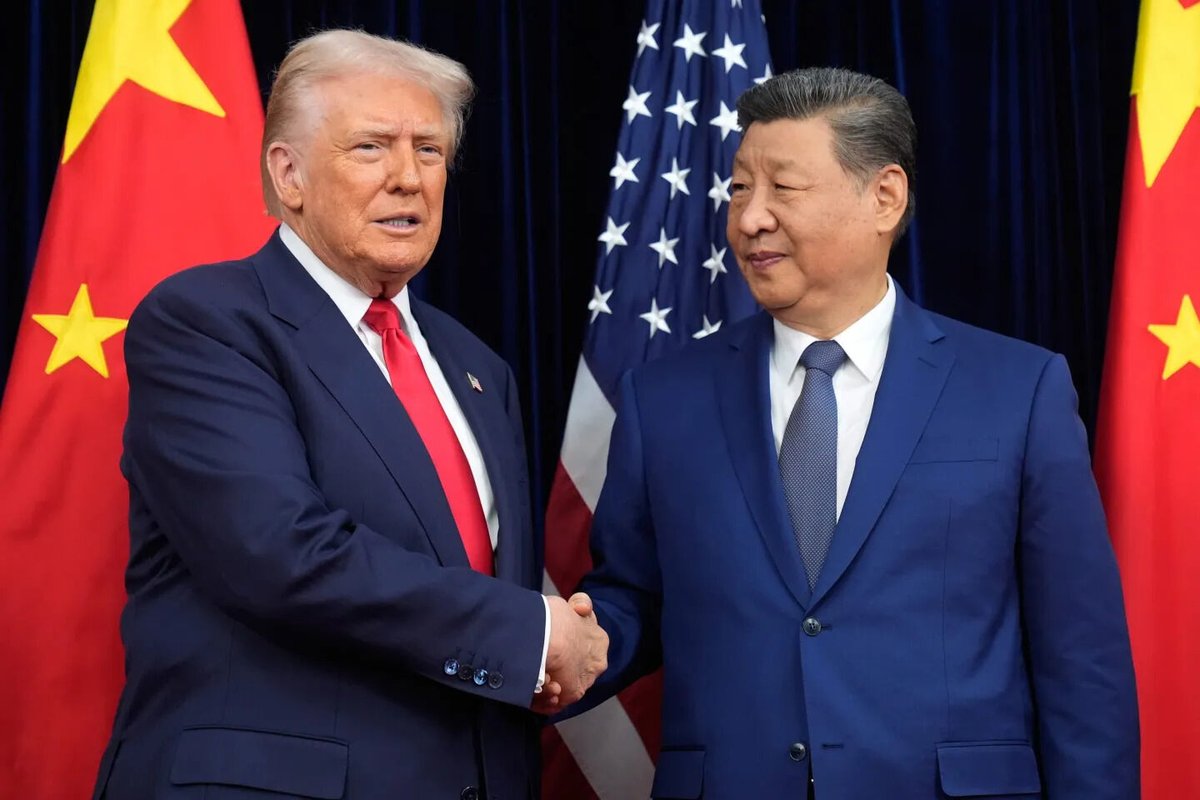
🚨 stop scrolling.. do you understand what this CEO delegation actually means in dollar terms..
because most people are only thinking about the handshakes..
these 12 companies have a combined market cap above $10 trillion..
every single CEO on that plane needs something specific from Beijing..
Musk needs China to keep building Teslas without a 100% tariff eating the margin..
Huang needs chip export licenses that let Nvidia sell into the world's largest AI market..
Cook needs Apple's $70 billion China supply chain to stay intact..
Fink and Solomon need Chinese financial markets to open so Wall Street can actually operate there..
Boeing needs China to unfreeze $50 billion in plane orders sitting in a backlog since 2019..
and here's what nobody wants to say out loud..
every one of those CEOs is on that plane because they already calculated that staying home costs more than the flight..
the combined revenue exposure to China across those 12 companies is over $300 billion a year..
that's not a diplomatic trip.. that's a $300 billion ask dressed up as a state visit..
if Xi says yes to even half of it.. the trade war framework changes overnight..
if Xi says no.. 12 of the most powerful CEOs in the world flew to Beijing for a photo op..
and markets will price that answer in real time.
if you're not following me you're finding out about this 48 hours late from someone who read my post..
The 2,000-Year-Old Door That Still Opens Every Day 😳🚪
In the heart of ancient Rome stands a silent giant that has watched empires rise and fall, wars begin and civilizations disappear… yet it still works as if it was built yesterday.
The massive bronze doors of the Pantheon are among the oldest surviving bronze doors on Earth. These incredible doors have been opening and closing for nearly 2,000 years, making them the oldest gate still in daily use in Rome. And here’s the part that feels almost impossible: despite their enormous weight, a single person can still push them open with ease.
No modern motors. No hidden machinery. Just ancient engineering so advanced that it continues to function after twenty centuries.
Even more mysterious is the lock itself. Experts believe the Pantheon holds one of only two known doors in the world whose original 2,000-year-old locking system is still operating today. Think about that for a moment — while modern locks rust, jam, or break within years, this ancient mechanism has survived floods, invasions, fires, and the collapse of an empire.
Many visitors walk past these doors without realizing they are touching a living piece of history. These same handles may have been touched by Roman emperors, soldiers, philosophers, and travelers from worlds long gone.
What secrets have these doors witnessed in the shadows of the ancient city? No one truly knows. But every time they slowly swing open, it feels less like entering a building… and more like stepping through a doorway into another age.
Forget Terminator and RoboCop scripts. This is now a reality in southern China’s Shenzhen, this year’s #APEC host city.
During the May Day holiday, humanoid robots hit the streets alongside police officers for patrol duty, turning sci-fi vision into real-world scene.