In Greek:
Peter = Petros (πέτρος) → a movable stone, small rock
Rock = Petra (πέτρα) → a massive immovable foundation
Jesus does not say: "You are Petra, and upon this Petra…" He says: “You are Petros, and upon this Petra I will build my church."
They are not the same word. The "rock" is not Peter, but something else. Petra in Scripture always refers to God/Christ, never a human.
"The Lord is my rock (petra)" (Psalm 18:2)
"That Rock (petra) was Christ." (1 Corinthians 10:4)
Christ is the Petra, the foundation.
Peter is only a petros, a stone.
Jesus had already identified the "rock." The context explains it: Peter’s confession: "You are the Christ, the Son of the living God." (v.16)
THAT is the "rock" Jesus refers to, not Peter himself.
Protestants didn’t invent this: Nearly every early Church Father understood the rock as Christ or Peter’s confession.
FEMA has measured hurricanes with a waffle.
It is called the Waffle House Index and it is real. Craig Fugate, who ran FEMA, made it famous. The scale has three colors.
Green. The Waffle House is open, full menu. The community is fine.
Yellow. The Waffle House is open but serving the limited storm menu. That means the power is probably out and they are cooking on generators. Trouble.
Red. The Waffle House is closed.
Waffle House does not close. The chain runs 24 hours a day, 365 days a year, roughly 2,000 locations concentrated in exactly the part of America that hurricanes aim for. So if one of them has gone dark, the town around it has been hit hard enough that federal help should already be rolling. Fugate put it plainly. If you get there and the Waffle House is closed? That's really bad.
Here is why the index works.
After Katrina destroyed seven of its restaurants and shut more than a hundred, the company rebuilt itself around disasters. It wrote a storm menu that can be cooked with no power. It created jump teams, crews from untouched states who roll toward the storm with generators and fuel, staged before landfall, ready to reopen a wrecked restaurant the moment it is safe. During one hurricane the CEO was personally positioned in Charleston.
During the Joplin tornado in 2011, 158 people died and a third of the city was torn apart. Both Waffle Houses in Joplin stayed open.
A company spokesman once explained the reason, and it had nothing to do with revenue. People need a place to gather after a storm, eat some eggs, and check on their neighbors.
A federal agency with a $30 billion budget looks for the glow of a waffle sign.
The waffle sign is usually on. 🧇
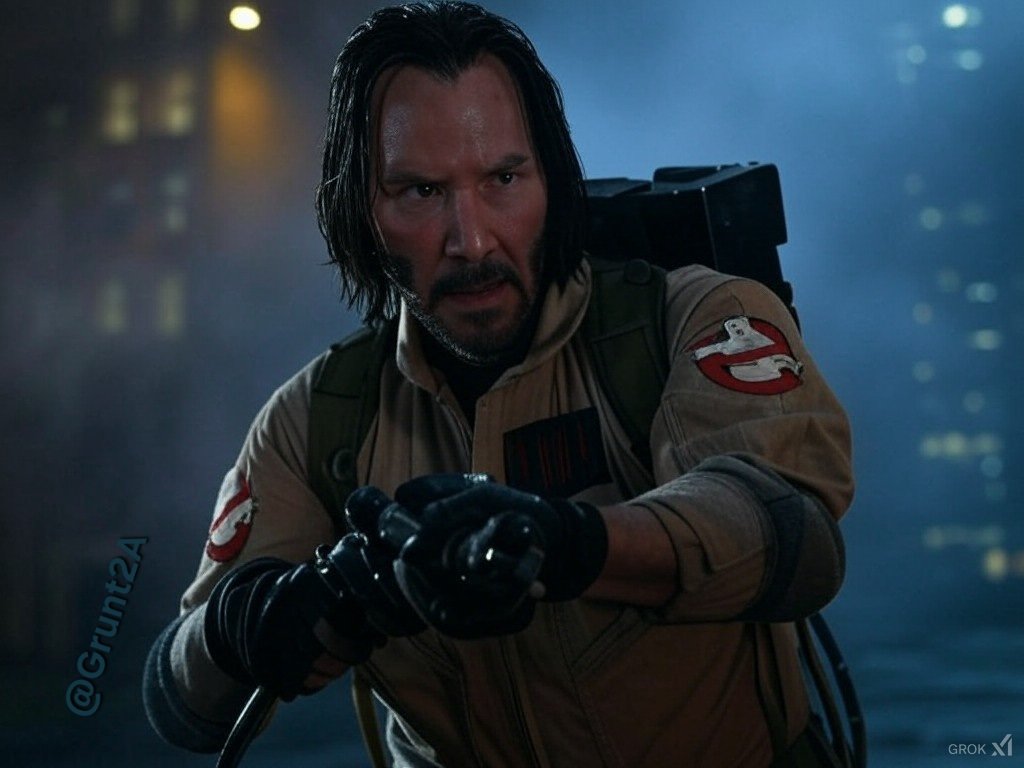
I would watch a movie where John Wick joins the Ghostbusters so he can hunt down all the ghosts of the people he killed for hurting his dog and kill them again
I was eating dinner at a diner in Pennsylvania.
Near the bathroom, there was a glowing screen mounted to the wall called "TouchTunes."
A man could insert one dollar and select music for the entire hall.
I wanted something quiet and respectful.
I selected a gentle-sounding song named "Sweet Caroline."
I returned to my booth to eat my potatoes in peace.
The horns began to play.
The melody was innocent.
Then the chorus arrived.
Suddenly, six truck drivers in the corner dropped their forks, slammed both fists onto their table, and screamed at the ceiling:
"BA! BA! BA!"
The waitress holding a pot of decaf yelled:
"SO GOOD! SO GOOD!"
The cook kicked open the kitchen doors, pointed a tongs at me, and roared:
"GOOD TIMES NEVER SEEMED SO GOOD!"
I grabbed my butter knife and stood on my seat.
Clearly, the tavern had come under ambush and the war horn had sounded.
A samurai does not abandon his allies during a raid.
I raised my knife to the sky and bellowed:
"I'VE BEEN INCLINED TO BELIEVE THEY NEVER WOULD!"
The entire diner erupted in cheers.
A guy named Big Mike sent a basket of onion rings directly to my table.
The bartender leaned over the counter and wiped a tear from his eye.
"You picked the right hymn, brother."
My grammar textbook taught me how to ask for the train station.
Neil Diamond gave me forty armed brothers in Pennsylvania.
I stand with Neil.
In December, a woman at my son's school asked if I would help "lay wreaths," and I said yes, because I pictured a craft fair.
I want to be honest about how wrong I was.
I told my son we were going to make decorations.
He brought a glue stick.
He is eight. He was very proud of the glue stick, and I did not have the heart to stop him, mostly because I did not yet know myself.
On the appointed morning we stood at the veterans' cemetery at eight a.m., in sleet, with what I estimated as four thousand people and what my son estimated as "a million." The truth was somewhere between us. I am bad at counting crowds.
A man with a microphone explained the rule. You take a wreath. You find a headstone. You place it. And before you walk away, you say the name on the stone out loud.
That is the whole rule. Say the name.
I asked the woman next to me why, and she said, "A man dies twice. Once when his heart stops. Once when nobody says his name anymore."
I have been to funerals in two countries, and I have never heard grief explained so efficiently.
So we walked the rows in the sleet, and we placed wreaths, and we said names. I said the name of a private who died in 1944 at the age of eighteen.
I said the name of a nurse. My son, carrying his useless glue stick in his coat pocket like a sidearm, said six names, carefully, the way he reads out loud in class, and at the fourth one his voice did something, and he pretended it had not.
Around us the cemetery sounded like low rain. Thousands of names, spoken once each, into cold air, gone the moment they were said.
In my country we carve the names of the dead into stone, so that they endure. Here, once a year, they are spoken aloud, and vanish. I asked an old woman which way was better.
She was placing a wreath on a stone that had her own last name on it. I did not ask whose stone it was. I still do not know, and I think about it.
She said, "Stone is for the dead, honey. The saying is for the living."
On the drive home my son asked if we could come back next year.
We will come back every year.
Here is what I did not expect. I have started saying the names on war memorials when I pass them.
Quietly, so no one hears.
My son does it too now. He believes it is a custom of our family, something we brought with us from Japan.
I have decided to let him believe that.
The Bible was written on three continents.
Asia.
Africa.
Europe.
In three languages.
Hebrew.
Aramaic.
Greek.
By over 40 different men:
Shepherds.
Kings.
Prophets.
Fishermen.
A tax collector.
A doctor.
A tentmaker.
Written in palaces and prisons.
In deserts and cities.
In freedom and in exile.
Across roughly 1,500 years.
66 books.
One continuous story:
Creation.
Fall.
Redemption.
Christ.
Most of these writers never met.
No committee planned it.
No editor stitched it together.
Yet it opens in a garden with the Tree of Life
and closes in a garden with the Tree of Life.
Different writers.
Different centuries.
Different cultures.
One voice.
Because behind the human hands was a divine Author.
Men held the pens.
But God wrote the story.
If your theological convictions are not actively making you more gracious, humble, and repentant than your beliefs are not being shaped by Jesus they’re motivated by a desire to be argumentatively “right.”
If your heroine-driven movie fails, it's because you presented a weak character and subpar story that simply couldn't garner interest. It's not the audience's fault. Don't tell us that Supergirl bombed because men aren't ready for a powerful woman. History has proven otherwise.