We’re now accepting applications for the third year of our research internship program taking place summer ’27 in NYC!
Past interns have worked directly with Category Labs researchers on problems spanning consensus, cryptography, and mechanism design resulting in academic publications and new protocol features.
For full consideration, please submit applications by December 7, 2026: https://t.co/DYdcByaSDM
Last month, we introduced Monad Private Settlement. Today, we're publishing the technical white paper.
It details private execution domains, shared sequencing on Monad, cross-domain messaging, and configurable access controls.
Read the research: https://t.co/oK16NeoPll
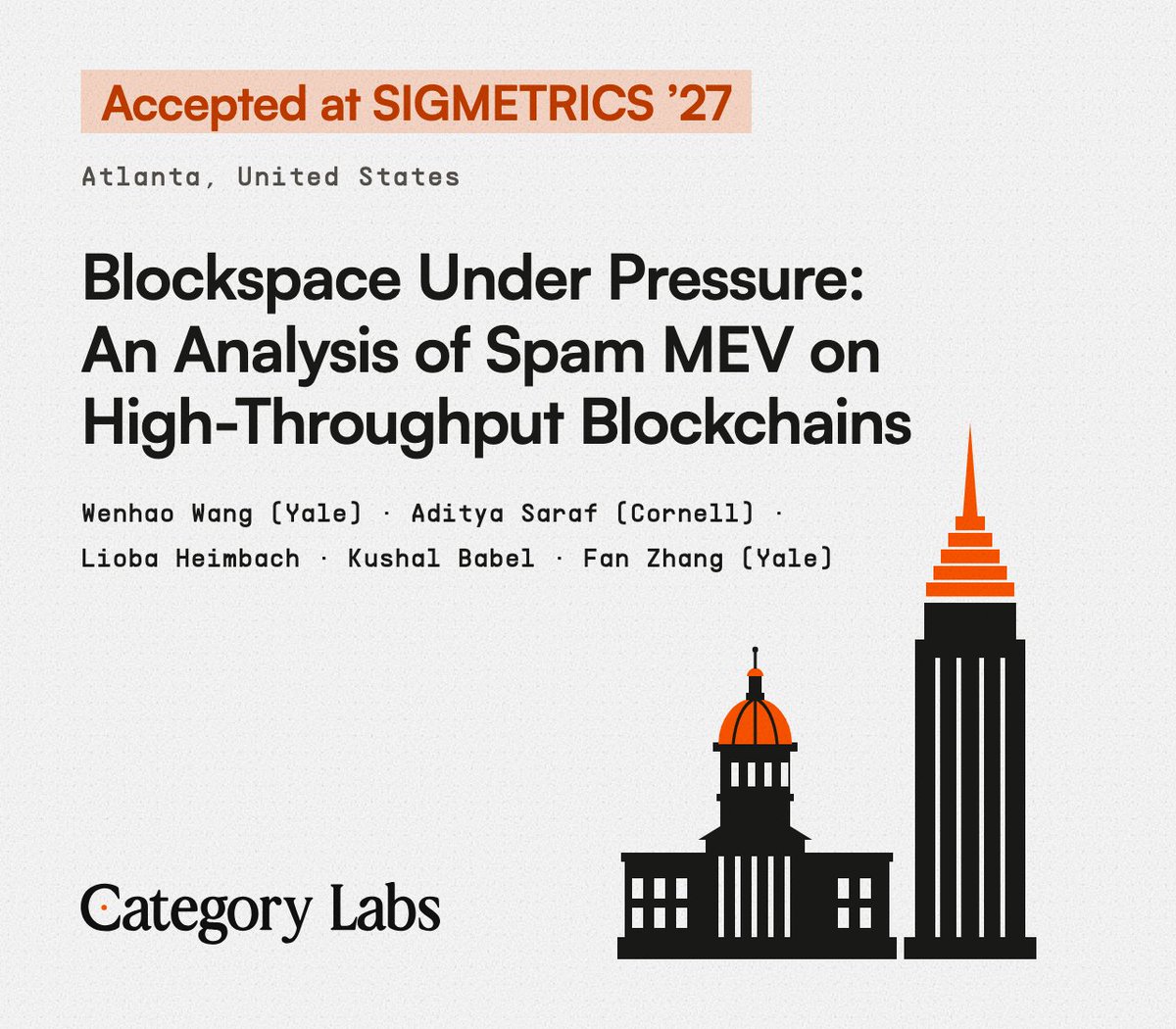
Blockspace Under Pressure was accepted at SIGMETRICS '27 in Atlanta. Spam MEV occupies a significant proportion of blockspace on high-throughput blockchains. Our analysis reveals why it emerges and how to mitigate it.
Work on this project began during the 2025 research internship of @0xWenhaoWang and Aditya Saraf!
Today we are releasing Quantum Cadence, a post-quantum version of Cadence, our consensus protocol with multiple concurrent proposers. Quantum Cadence uses no quorum certificates, and its safety and liveness do not depend on signatures.
Most modern consensus protocols, Cadence included, rely heavily on signatures and quorum certificates, which a large-scale quantum computer could forge. Simply replacing today's signatures with post-quantum ones would make certificates too large for every validator to send around in a high-performance blockchain. Quantum Cadence instead draws on Forget-IT, a recent signature-free consensus protocol co-developed by researchers at Category Labs.
Quantum Cadence still keeps the overall architecture and core guarantees of Cadence, so our Cadence prototype was easy to carry over: an AI was able to adapt it to Quantum Cadence in a few hours, and an early prototype now runs on an internal test network.
We designed Quantum Cadence to be practical for a high-performance blockchain. In our simulations, its latency is similar to Cadence's, and it scales better with the number of proposers.
Interactive explainer: https://t.co/tKVbnkhkBY.
Full paper: https://t.co/6xdk5Y3ime.
Joint work by @MohammadMJalal1, @TobiasKlenze, and @komasito55
Dolev–Strong is arguably the best-known consensus protocol, and for roughly 45 years, no deterministic protocol improved on its O(n³) communication.
A new paper by @komasito55, Yuval Efron and Ling Ren improves that bound to O(n² log⁴ n) for Byzantine Broadcast, tolerating t < n faults in O(t) rounds.
After thinking about the problem on and off for years, they started leveraging AI models. The paper is the result of a month of human experts digesting and simplifying the discourse with AI.