#CryptoReserve#DigitalAssets#Treasury
Trump signs an executive order establishing a Strategic Bitcoin Reserve (and broader digital asset stockpile) using forfeited crypto no new buying planned
Translation: US markets sold off sharply in early August as weak jobs data, new tariffs, and underwhelming tech earnings triggered widespread investor panic and volatility
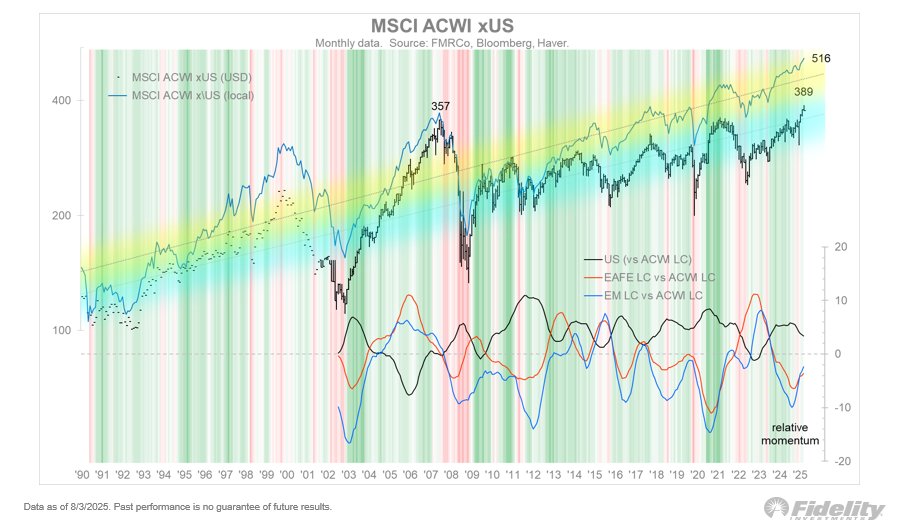
The long-term uptrend for international equities remains intact as well, both in USD and local currency terms. The momentum curves continue to converge, suggesting that the mean-reversion could continue. The leadership inside the US may be narrow, but there is a global bull market going on.
If the US is going to grow its way out of debt, it will need either a growing labor force or a productivity boom to lift up the speed limit for the economy (potential GDP). With immigration policy under pressure, it will have to come down to productivity. Barring this (or regardless), borrowing costs will need to come down, which will put pressure on the Fed to look past its dual mandate of price stability and full employment and lower rates even when it might not be justified.
This is of course where the tension is coming from between the White House and the Fed. With Chair Powell’s term ending in less than 12 months, it will be interesting to see how independent the Fed will remain in 2026 and beyond.
The one “devil’s advocate” challenge to the otherwise unmistakably bullish narrative driving gold and Bitcoin is the question of how much of this fiscal dominance and de-dollarization playbook is already priced in. The combined value of above-ground gold and Bitcoin is now around $25 trillion, which is higher than the US money supply, and at levels that have previously marked tops. Like the valuation chart for equities, if the thesis is priced in, the trade may not be the slam dunk that it seems.
In my view, we are not even close to that point, in part because the global money supply is five times larger than the US money supply (and this is a global theme), and because the dollar is still at historically high levels while the term premium is still modest. So, I am guessing we are still in middle innings for the hard money trade.
Unless you were focused on Bitcoin’s ascend to new highs or the Mag 7 celebrating a $4 trillion milestone for NVDA, it was a quiet week for the markets. The 10-year yield continued to meander in its tight range, and the S&P 500 barely moved despite a new barrage of tariff headlines, the likes of which would have alarmed markets just a few months ago.
The second half of July will get busier, not only with Q2 earnings season and economic data but also the approach of the August 1 tariff deadline. We will also soon get the much-anticipated quarterly refunding announcement, where we will see what tricks the Treasury Secretary has up his sleeve with regards to financing the $5 trillion One Big Beautiful Bill (OBBB). More Bills, less bonds, as was done under the previous Treasury leadership?
After July, we get into the weakest seasonal period of the year, spanning from August through the first half of October. The market has lurched from a post-election right tail to a tariff-induced left tail, and now back to the OBBB-induced right tail. Where next?
Read more in this edition of the Weekly Asset Allocation Review.
https://t.co/O3r3zTJhPN
Trump in Scotland for golf & politics—met PM Starmer but no King meet. Protest expected. Is this a smart move or a political misstep? Comment below! #Trump#UKNews
If the dollar does lose some of its supremacy premium, while global earnings are converging on US earnings and non-US valuations are lower than in the US, it should provide a good backdrop for a prolonged period of mean reversion between US and non-US equities.
The two charts below show just how important the currency component can be for investing globally. That’s especially the case for emerging markets, where the USD-based EM index (solid blue) has vastly outperformed the local currency index (dotted line) over the past 25 years. In local currency terms, the MSCI EM index is where the S&P 500 was in the year 2000.
For EAFE (non-US developed), that currency difference is much less. For me, that makes EAFE an easier region to say yes to than EM. Either way, the momentum curves in both charts suggest that the long-awaited mean reversion is upon us.
🧠 AI-generated deepfakes now influencing local U.S. elections—confirmed in Pennsylvania.
Regulation is needed, fast.
Should AI content be labeled by law?
#AIethics#Deepfake#Elections2025