Because the patterns of thinking that I’ve seen most successful in LLM problem solving have almost nothing to do with the patterns of thinking that work well for writing code?
There are definitely some great coders I’ve know who can wield agentic solutions well, but it’s almost always because they have some other skill unrelated to programming.
Save 45%, only on Sept. 1st!
Today, you can save on Local Image Generation by @willkurt and other related titles: https://t.co/QC2w0Upw41
Learn how to generate, refine, and customize images locally without needing a background in data science or machine learning.
It really depends on Pinocchio’s mental state at the time the statement is made. His nose growth is a function of him intentionally lying, not being factual incorrect (otherwise we could use him as an oracle, and trivially demonstrate whether P=NP). The question boils down to whether making a confident statement without sufficient information to justify the confidence counts as a “lie”. Am I lying if I state “the outcome of this coin toss will definitely be heads”?
@Michaelzsguo This is the pattern of incorrect half measures that we’re seeing all over software right now. Replicating existing software is still “using software”.
What will kill software is not mere replication, but emergent patterns that will cut it out when there is a faster path to value
Is this intentional rage bait? It's so clearly a terrible take I can't imagine it not being.
I've worked in ad tech. The information you can put together on someone by combining network activity + 3rd party data would shock most people (you might be surprised that many of those places you connect to through HTTPS still sell you data).
@fchollet I also think there is quite a bit of opportunity to make LLMs better writers. It will be interesting to see if some people start writing more like clankers and some clankers start writing in a more interesting fashion!
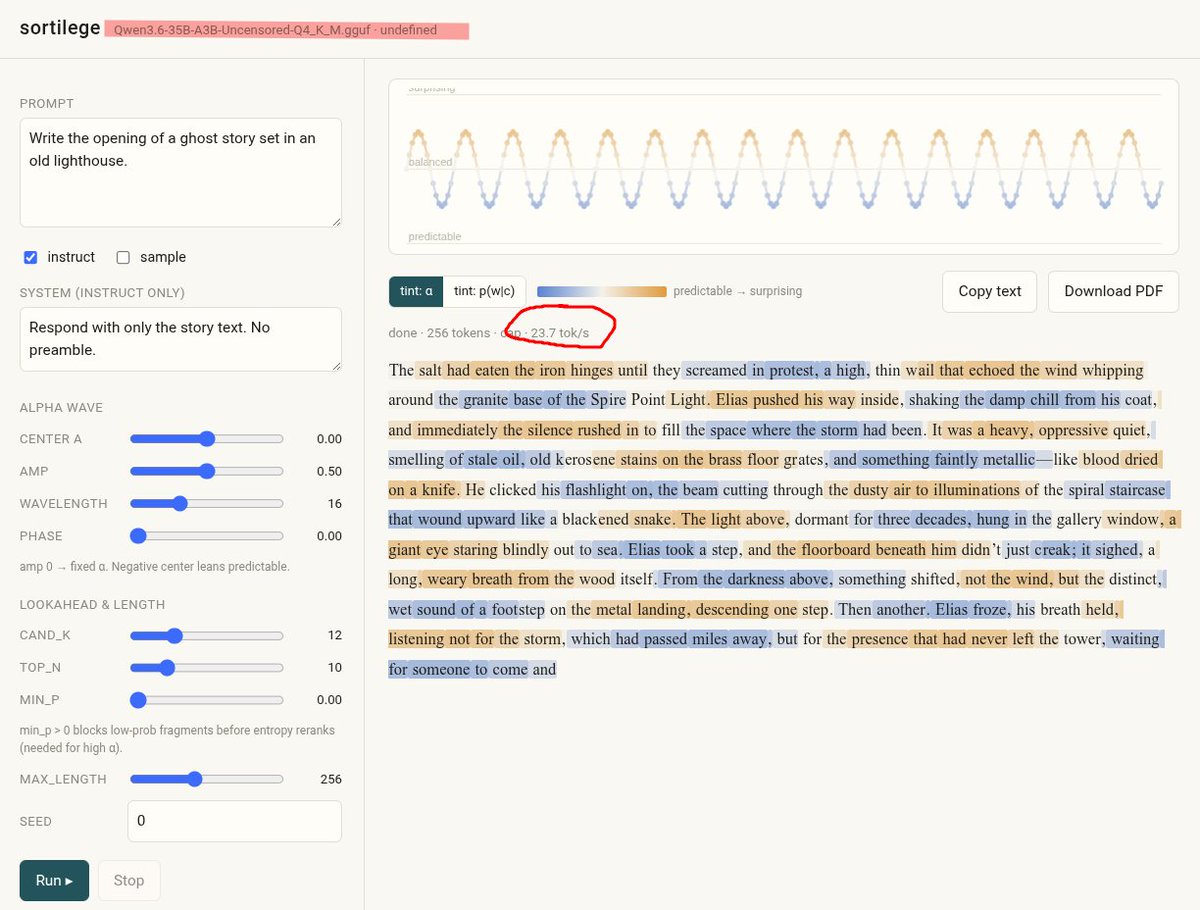
AI is crazy. Before I was running this with a small model using HF, getting about 7 token/s.
I was able to get a full transition to using Llama.cpp using Qwen3.6-35B-A3B-Uncensored-Q4_K_M, and getting 23.7 tok/s (Impressive given the extra computation required for this decoder)
This is the most accurate description of the current state of agentic coding in practice.
I remember you used to solve a big, challenging brain problem and then know you had a few days to implement it. This this was boring, but heads down, headphones on work. It was relaxing.
software engineering is now draining because all the "easy" work is done
you used to be able to do productive but relatively simple work some days (writing some new endpoints, making some dashboards)
now all that is left is the hard part
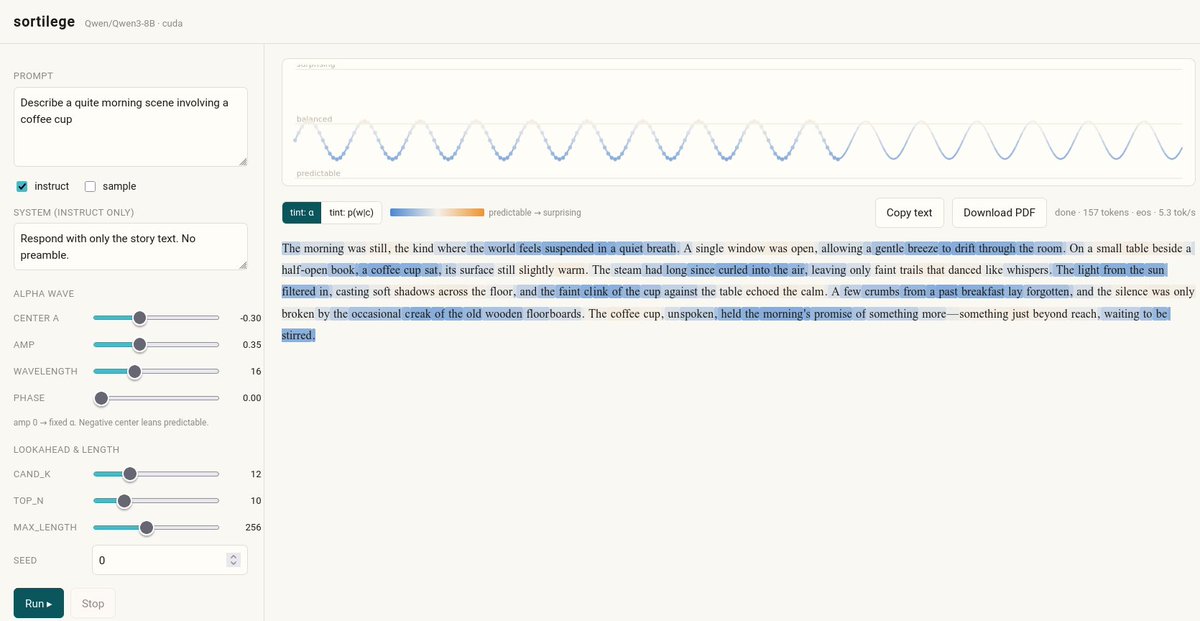
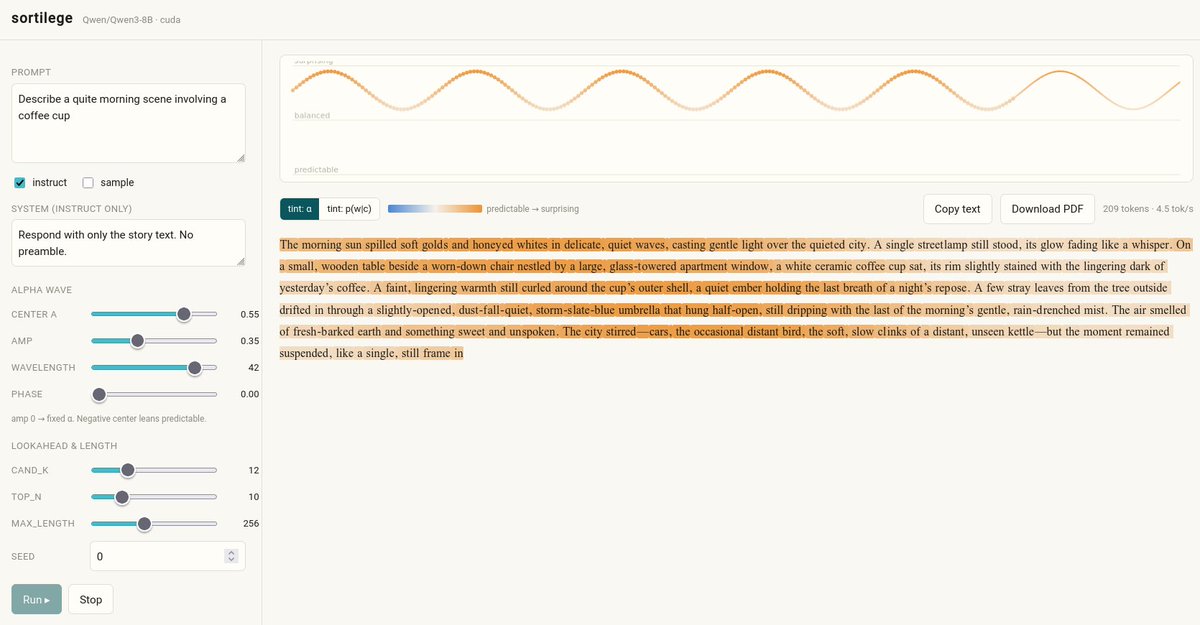
Whipped up a UI for my future-entropy based decoder!
By weighting the base probability against future entropy with a single parameter, you can then just apply a sine wave to give more variety to the decoder itself.
Really impressed by how configurable this simply design is!
It’s curious that I’ve had a bunch of requests for the source code for my most recent “entropy decoding” experiment.
This means there are still many people, interested in AI, whose first response is still not “point an agent at the article and ask it to recreate it”
Leetcode is a very poor test of DSA, most people grind it just pattern match with no understanding. Further leetcode excludes huge areas of practical algorithms, very little coverage of heuristic methods, combinatorics, anything probabilistic in nature, etc.
Systems design, true algorithmic whiteboarding, etc are great. But “solve two leetcode mediums in 40 minutes” only tests how much you’ve grinded LC.
What a strange time in software.
My last round of interviews I used "leetcode style coding challenge" as an autoreject signal because it meant the team was not in touch with the current direction software is moving.
It is hard to test signal now, but leetcode is not it.
I definitely think “review this AI PR, give feedback, find mistakes, point your own agent to the code base for context, etc.” is a much more useful approximation of what works today.
However the space is moving fast enough that it’s not hard to imagine the space being totally different in a year. Nonetheless anything beats leetcode as a signal!
Very true, especially now. Most good hiring managers I know (including the team I ended up joining) believe know personal referral is only reliable way to vet candidates.
I think in time we’ll find better ways to find signal, but the space is changing so fast now it’s hard to really pin that down