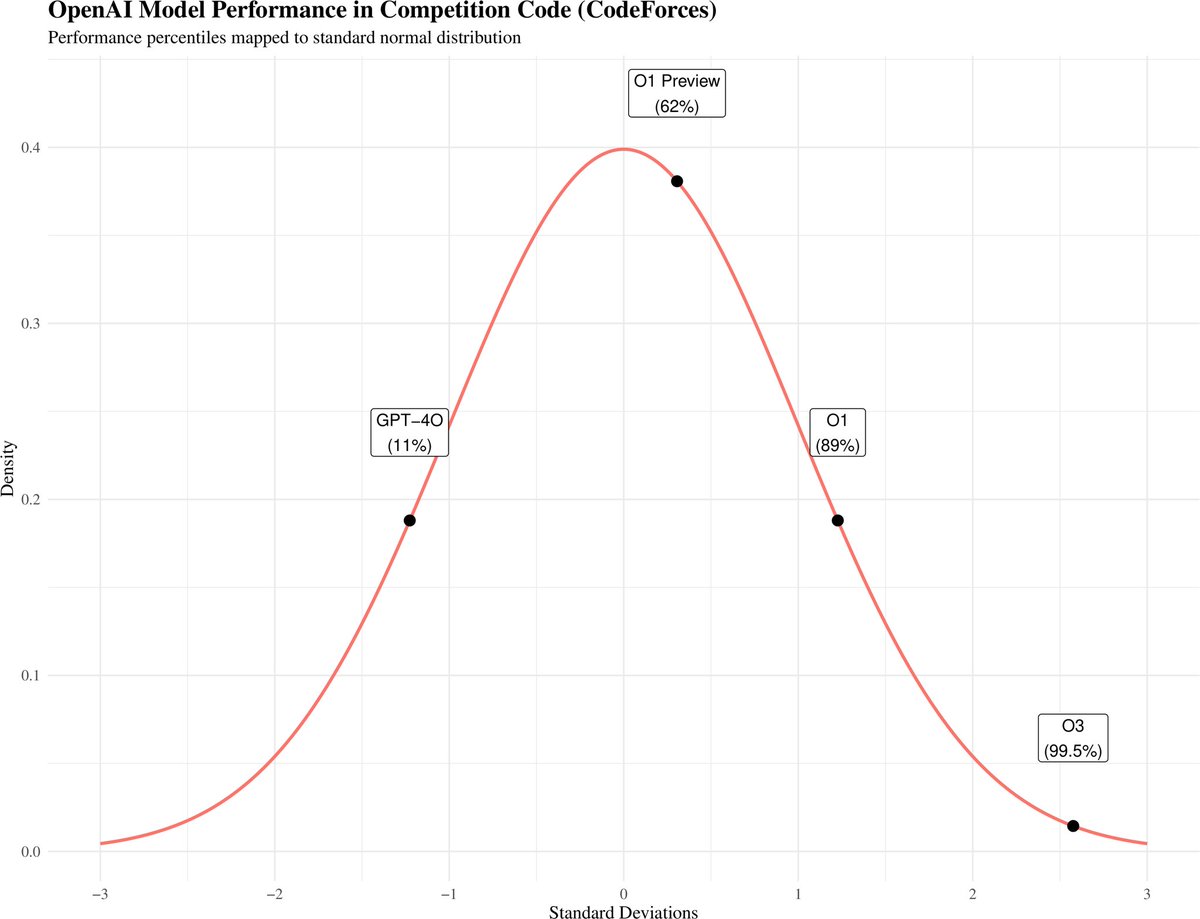
This demonstrates how the coding skills of OpenAI models have improved over time, rising from the 11th percentile with 4o to the 99.5th percentile with o3 in just 1.5 years.
Is OpenAI o1 ready for cutting-edge theoretical research in statistics? I am afraid that the answer is YES. I gave it an unsolved problem in clinical trial design that our team of PhDs and professors had been working on for months. I was blown away when I saw o1’s solution.
@BorisMPower@sytelus We are conducting the world’s first double-blinded study to evaluate the performance of LLMs in evidence-based medicine at Mayo Clinic and Fred Hutch Cancer Center. Now with the newly released o-1 models, I guess we need to re-run our study.
In case you were wondering how superconductors work, this is a good explanation. They are a very interesting phenomenon and may prove economically useful, but are not a hard requirement for a sustainable energy future.
Physics has many powerful tools of reasoning to understand and predict reality. Those tools, like first principles analysis and thinking in the limit, are broadly applicable to anything, in my experience.
With Grok, @xAI is attempting to create an AI that reasons from first principles, which is fundamental if you care about getting as close to the truth as possible.
The acid test would be reaching a conclusion that is correct even if it is extremely unpopular, which means being right even when the training data is almost entirely wrong.
For example, Galileo concluded, after observing the moons of Jupiter from a telescope he engineered, that it was far more probable that Earth revolved around the Sun than the other way around. This view was so unpopular that he was forced to recant and placed under house arrest!
If you had trained an LLM on material back then, it would’ve given you the popular, but wrong, explanation. Due to social and legal pressure, it likely wouldn’t even acknowledge the possibility that the Earth revolved around the Sun.
For AI to help us understand the true nature of the universe, it must be able to discard the popular, but wrong, in favor of the unpopular, but right.
We have reached an agreement in principle for Sam Altman to return to OpenAI as CEO with a new initial board of Bret Taylor (Chair), Larry Summers, and Adam D'Angelo.
We are collaborating to figure out the details. Thank you so much for your patience through this.
We have reached an agreement in principle for Sam Altman to return to OpenAI as CEO with a new initial board of Bret Taylor (Chair), Larry Summers, and Adam D'Angelo.
We are collaborating to figure out the details. Thank you so much for your patience through this.
Move faster. Slowness anywhere justifies slowness everywhere.
2021 instead of 2022. This week instead of next week. Today instead of tomorrow.
Moving fast compounds so much more than people realize.