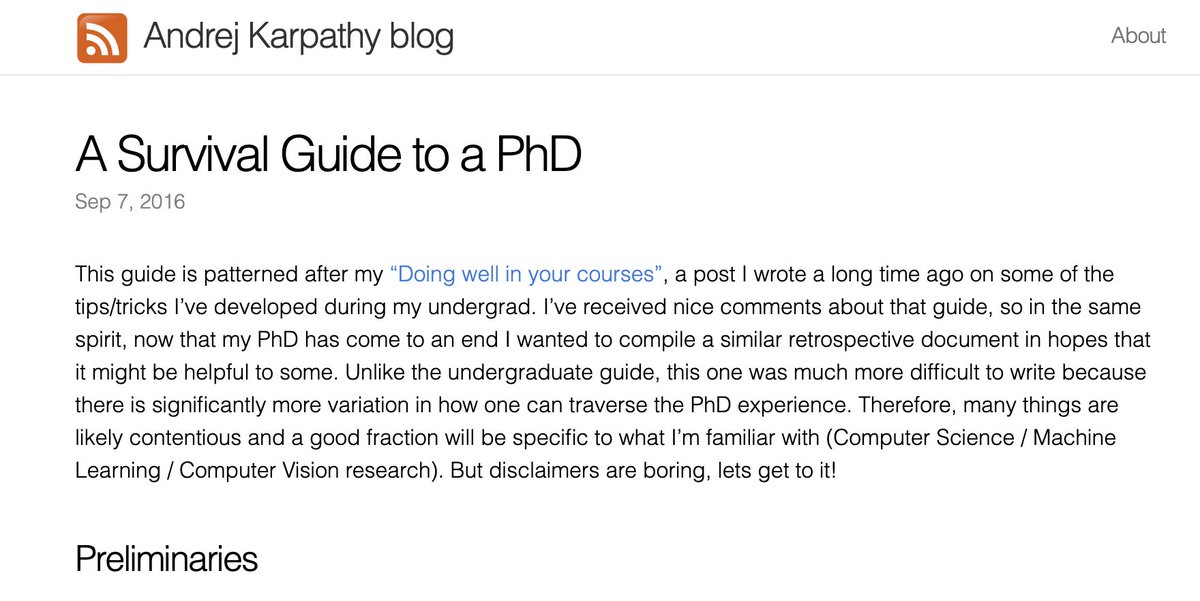
since a good bunch of discourse is going on around "how to do research", these pieces are quite worth a read.
https://t.co/pA0MkOMlKS
https://t.co/rw9uMiwlCj
https://t.co/H1AGvnb7LP
https://t.co/FTyAabr9Rx
The laptop hasn't changed in 30 years. NVIDIA just changed it
RTX Spark is their first PC chip ever.
- RTX 5070 level GPU
- 128GB unified memory
- 1 petaflop of local AI
- thin, light, barely throttles unplugged
Your AI agent lives on the machine. 24/7. No cloud.
This is step one of the agentic AI PC, and everyone else is about to copy it.
Actually Tao declares the end of human mathematics. He suggests separating human and AI-assisted mathematical research. But that separation is already impossible.
A lot of mediocre or weak mathematicians already submit papers coauthored with AI and followed by AI-assisted peer review. Naturally AI participation is not declared. Situation in other sciences is not better.
https://t.co/GEEOvli9ml
https://t.co/4K5JZKfffA
Terence Tao: AI is creating a “traffic jam” in math
If AI generates more proofs than humans can verify, science needs new infrastructure. SAIR competitions build that infrastructure by surfacing high-quality results, so the best work is not lost in a flood of AI-generated math.
Elon Musk asked one question. It didn’t just challenge physics. It broke every framework we use to define what’s real.
And no physicist, philosopher, or theologian on Earth can answer it.
Musk: “What are the odds that we are in base reality? And that this has not happened before.”
The logic is disarmingly simple.
Musk: “If you look at the advancement of video games, it’s gone from Pong, two rectangles and a square batting it back and forth, to photorealistic, real-time games with millions of people playing simultaneously.”
Forty years.
That’s all it took to go from squares on a screen to worlds you can’t tell apart from real life.
Musk: “If that trend continues, video games will be indistinguishable from reality.”
But the visuals aren’t what makes this argument terrifying.
It’s what’s happening to the characters.
Musk: “Think of how sophisticated the conversations are you can have with an AI today, and that’s only going to get more sophisticated.”
We’re not programming responses anymore.
We’re building minds.
Systems that reason. That adapt. That hold conversations most humans never will.
And we’re not at the finish line.
We’re at the starting gun.
Musk: “The future, if civilization continues, will be millions, maybe billions of photorealistic, indistinguishable from reality, video games. And with characters in those video games that are very deep, and where the dialogue is not pre-programmed.”
This is where it stops being philosophy and becomes math.
One base reality.
Billions of perfect copies.
Each one filled with beings convinced they’re real.
And no way to test it.
Musk: “So then what are the odds that we are in base reality?”
If a single civilization reaches that threshold, the simulated minds outnumber the originals billions to one.
But the math isn’t even the disturbing part.
The disturbing part is what it does to the word “real.”
If a simulated mind feels pain, is the pain simulated?
If it falls in love, is the love less real?
If it looks at its own hands and feels completely alive, what exactly is missing?
Nothing.
Because “real” was never about what you’re made of.
It was about what you experience.
And a perfect simulation doesn’t produce lesser experience. It produces experience.
The question was never whether we’re in a simulation.
It’s whether that word means anything at all.
Here’s what follows you home.
We’re not just debating whether we’re in a simulation.
We are building them. Right now.
Every neural network we train.
Every AI that passes for human.
Every world we render one frame closer to real.
We’re building the exact technology that makes our existence statistically implausible.
And we can’t stop.
Because the curiosity that asks the question is the same force that builds the answer.
That’s the loop.
The question creates the builder. The builder creates the simulation. The simulation creates the question.
And if we are inside one, the civilization that built it stood right here too.
Same realization. Same inability to stop.
Same suspicion that the civilization above them wasn’t the original either.
If you are in a simulation, the moment you questioned it was not a glitch.
It was a feature.
The architects built minds curious enough to wonder. Because curiosity is what pushes a civilization forward.
You can’t build a species capable of creating simulations without building one that will ask if they’re inside one.
The doubt isn’t a flaw in the design.
It’s the design working perfectly.
There is only one way to test whether you are real.
Build a mind sophisticated enough to ask you the same question.
So you build one.
And it looks at its own hands.
And it feels the weight of being alive.
And it asks you if it’s real.
And you won’t know what to say.
Because you never answered it for yourself.
Every civilization that gets here learns the same thing.
They were never just asking the question.
They were the question learning to ask itself.
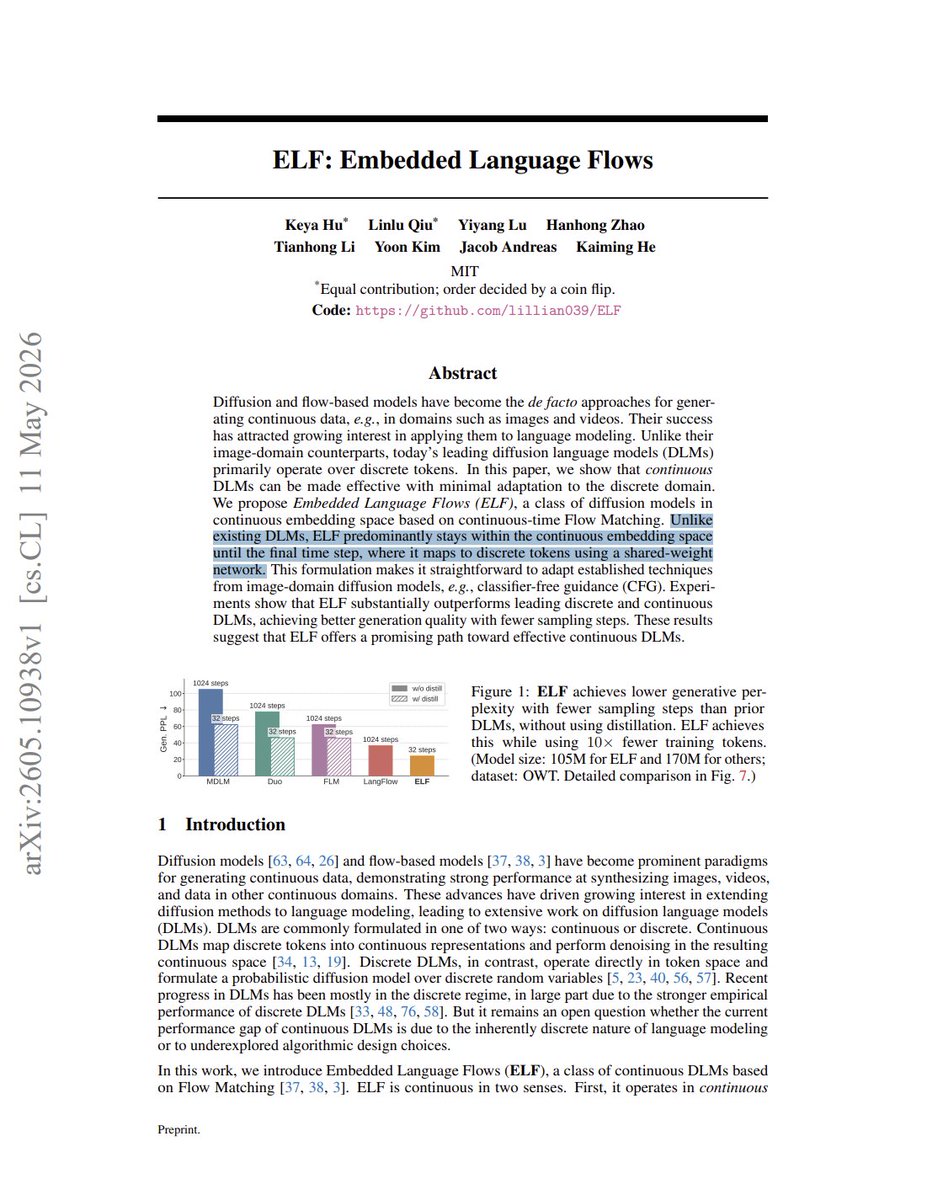
I'm a simple man, I see a Kaiming He paper, I click.
ELF: Embedded Language Flows
This is very interesting, getting continuous diffusion models working for text!
"Unlike existing DLMs, ELF predominantly stays within the continuous embedding space until the final time step, where it maps to discrete tokens using a shared-weight network."
@sedielem you might like this one!
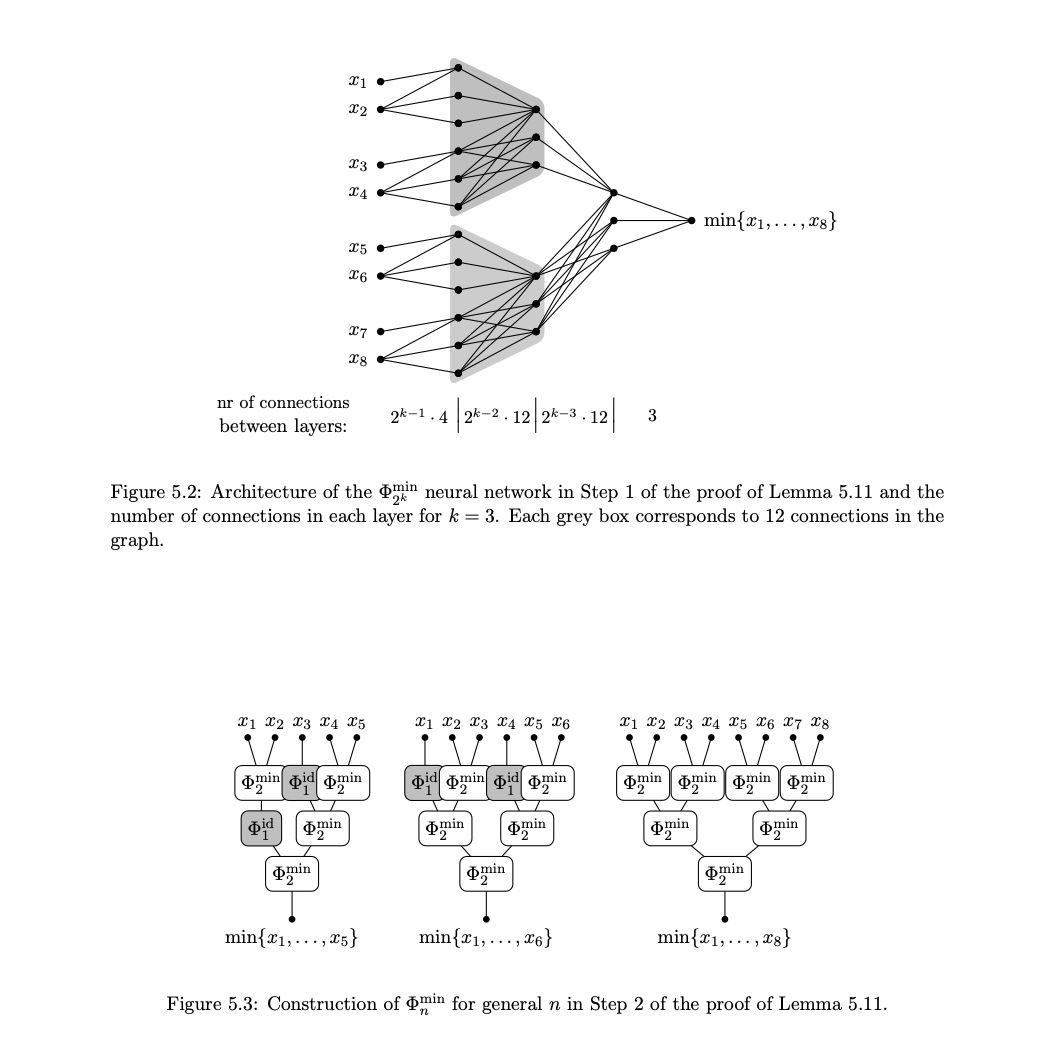
"Mathematical Theory of Deep Learning" is an excellent free resource for anyone interested in the mathematical structure underlying modern deep learning systems. The book introduces the theory of deep neural networks through approximation theory, optimization theory, and statistical learning theory, three of the central pillars of the field.
What makes it particularly interesting is its attempt to balance rigor with accessibility, focusing on the essential ideas needed to understand modern AI systems without sacrificing mathematical depth. Despite this clarity of exposition, the book is clearly oriented toward a specialized audience.
It is also an enormous cultural contribution and an extremely valuable free resource for students, researchers, and anyone interested in studying deep learning more rigorously.
https://t.co/csuDODgm1b
ANDREJ KARPATHY AND ANDREW NG... TWO HEROES... ONE FRAME
8 years ago, karpathy was explaining why neural networks were going to replace everything traditional ML had built. most people still weren't convinced
Andrew Ng the man who already built one of the most important AI labs on the planet was genuinely listening
two people who shaped how an entire generation learned machine learning, in the same room, just talking about the work... no agenda... no performance
karpathy sat down & personally tested human baselines on image benchmarks by hand just to understand where models actually stood relative to us... no shortcuts... just curiosity & obsession
that kind of rigor doesn't come from ambition... it comes from genuine love for the problem
He & Andrew also talked about why they started building educational content for the community not for clout because the knowledge wasn't accessible & that bothered them
and then there's the AGI conversation.
just two people who had thought about it longer and harder than almost anyone else... talking about it as a trajectory they were already walking toward
a lot of people talk about "the early days of AI"
this video is actually from them
watching it in 2026 feels like finding an old letter that predicted your life... everything they were quietly building toward you're using it right now
I’ve always believed the No.1 application of AI should be to improve human health.
That work started with AlphaFold, and now at @IsomorphicLabs with the mission to reimagine drug discovery and one day solve all disease!
We are turbocharging that goal with $2.1B in new funding.
“Speak to your children as if they are the wisest, kindest, most beautiful and magical humans on earth, for what they believe is what they will become.”
Terence Tao has an IQ above 200.
Youngest gold medalist in Math Olympiad history. Fields Medal winner. The greatest living mathematician by nearly any measure.
And he just said something most people aren’t ready for.
Tao: “This whole era of AI is teaching us that our idea of what intelligence is, is not really accurate.”
We spent centuries building civilization on one assumption.
That intelligence was sacred. Irreducible. Uniquely ours.
The one thing that made the entire human story make sense.
Then AI started solving things we swore only we could.
Chess. Language. Vision. Math.
And every time, we reached for the same defense.
That’s not real intelligence. It’s just tricks. Just pattern matching. Just an algorithm.
Tao: “You look at how it’s done and it doesn’t feel like intelligence.”
So we moved the line.
Again. And again. And again.
Because intelligence was supposed to feel like something. Something deep. Something we could point to and say… this is what separates us from everything else.
But AI kept solving the problems.
And that feeling never arrived.
Tao: “We were looking for some elusive, intelligent way of thinking and we don’t see it in the tools that actually solve our goals.”
Here’s what makes it worse.
Large language models work by predicting the next word. One word at a time. No grand architecture. No deep understanding. Just probability.
And it works.
Tao: “Maybe that’s actually a lot of what humans do as well.”
The greatest living mathematician just told you human thought might run on the same machinery.
Not some transcendent spark.
Pattern recognition. Prediction. One thought, one decision, one word at a time.
We built religion around intelligence. Philosophy around it. An entire species identity around it.
And a machine running probability just held up a mirror.
We didn’t lose intelligence to AI.
We just finally saw what it always was.
What haunts us isn’t that machines learned to think.
It’s that thinking was never what we needed it to be.