The irony of this being that I’m now drowning in compute relative to before but I can’t ask any questions relevant to the competition because of the bio classifier :/ lol lmao even
I wonder if people have tried to engineer rubisco by increasing its content of essential amino acids without altering its catalytic function. Considering it’s like 50% of protein weight you could probably make a plant crop protein complete if you add enough viable changes?
@navyadotbio I think tissue patterns could be easy (?) to scale, you could let a tissue grow from a library in a well plate and generate a bunch of varieties of Turing patterns then image them and iterate that way towards some macro function. But the bottleneck is screening still
@navyadotbio Ah I see! Cool :D
Trying to even think about the verifiers for this, DE only really works if you can couple it to a HT screen like growth/fluorescence and macro phenotypic traits/functions feel too nebulously unrobust to screen for. Do you have any ideas of how you would start?
@zeta_globin I’m part of an ARIA innovator circle on biomaterials/bioengineering and we have a library of recommended books on that subject here https://t.co/3aj6sIXTLu I recommend on the future of species and Napoleon’s buttons
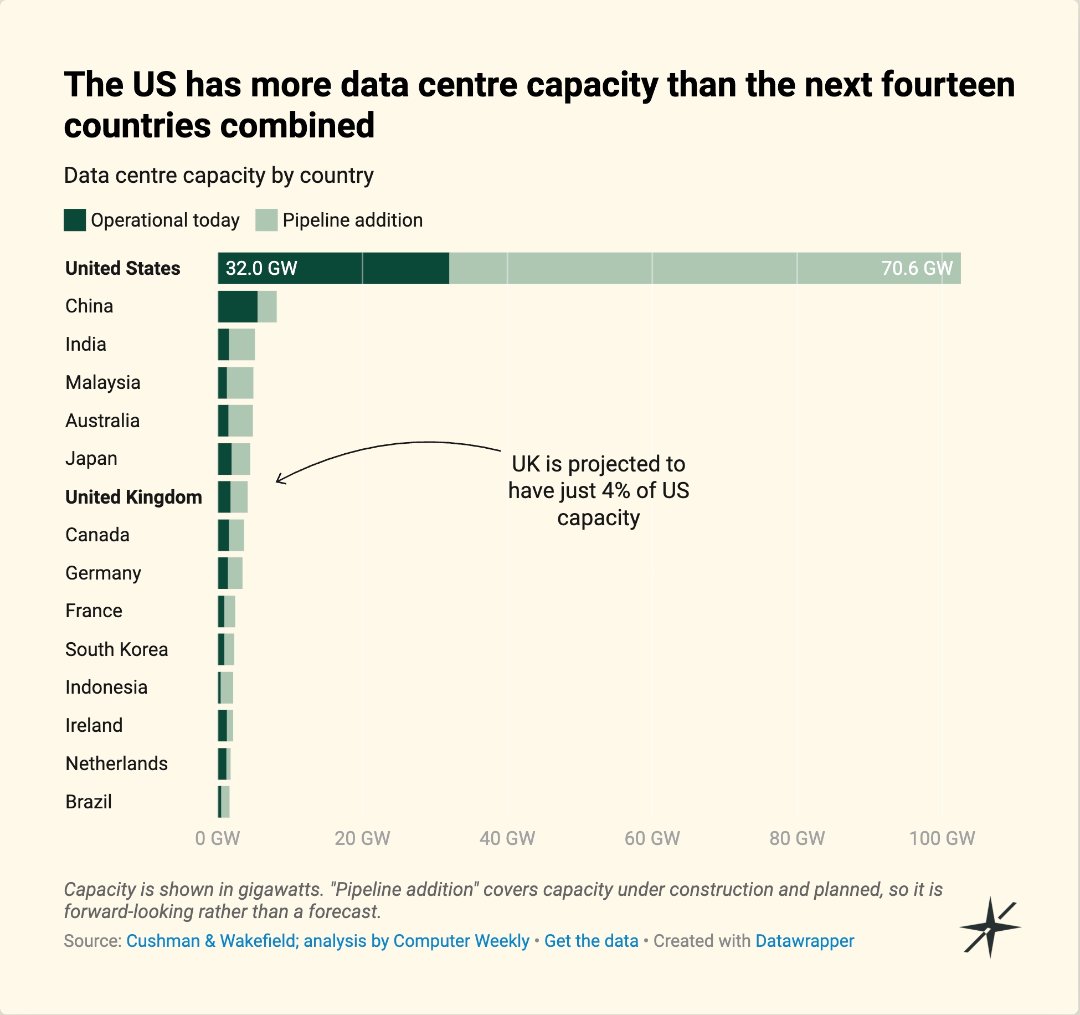
I am increasingly frustrated about the state of conversation about AI in the UK. It feels like we are in never ending cycles of deluded thinking. Under current trends, Britain will be defenceless against the transformative effects of AI and have no leverage over development at the frontier.
We are the most exposed economy to AI in the world. We have very little data centre capacity and few credible plans to expand – and our high energy costs mean we would struggle to even if we tried.
I am publishing a paper today on what the UK should do to build that leverage, let the economy capture value from AI and prepare the state to adapt, however AI develops.
The three strategies are as follows:
1. Build the infrastructure that gives us leverage. Fix the grid, fix planning, make Britain a place frontier AI can run.
2. Let the economy capture the value of AI. Reform the regulatory, labour and talent barriers that stop British firms adopting AI.
3. Build a state that can adapt to a changing world. Build a tax base that survives the labour market changing, public services that use AI to deliver better, and capacity to weather the upcoming geopolitical storms.
Two years ago, we published a similar report on AI - many recommendations of which ended up in the action plan. I remember feeling hopeful, but sadly the fundamental problems facing the country on AI have not shifted. I truly hope that this week of momentum culminates in action. There’s still a narrow path for the UK, but everyday that path is narrowing.
Behold the dumbass who is me who ran a PCR product gel at 11pm using a protein ladder (I just reran it and I got a nice clean band so I’m all good but oof my brain is jelly)