An amazing moment at Iso as we close our Series C funding round! We founded Iso on the conviction that AI can transform biology into a programmable science. We are clearly seeing this play out internally with our models’ capabilities translating into new potential medicines for patients. This funding will supercharge our efforts, so we can push even deeper into the hard problems of understanding disease biology, engineering the most exquisite molecules possible, and bringing new drugs to patients who need them. Lots more to come!
🆕 cuPotential
A CUDA-X library for computing nonbonded interactions in molecular dynamics. The OpenMM plugin replaces the nonbonded force, integrator, and barostat.
In NPT benchmarks on systems from 24K to 400K atoms, it ran over 3x faster than OpenMM on RTX PRO 6000 Blackwell and about 2x faster on B200, H100, A100, L40S, A10, L4, and T4.
Accuracy holds up too, with a few hundred times less energy drift than default PME.
💻 Github https://t.co/zl2fmghUhi
📄 Technical Blog https://t.co/TbOm4zchvx
📍 Find us at #SC26 👇
Proud to share our preprint on de novo designed enzymes for C-H hydroxylation - one of the most valuable chemical reactions. P450's we're coming for you!
This is the result of a great collaboration with @Shilong_Gao, Jihun, @UWproteindesign, @GreenGroupMIB
https://t.co/0pyHXpNX1D
People do not realize this, which is not an insult. You can spend $1 billion at Gingko or Adaptyv and you will still be at hit-to-lead (the very first step of drug development if you’re doing conventional AI drug development).
Automated labs only offer certain services.
There’s not end-to-end automation except at specific big pharma or biotech companies.
There are not CROs that are completely automated until animal studies. It’s not possible; there are thousands of types of assays for different R&D.
@lucas_nivon@cyrusbiotech Thanks Lucas! Erik's work on BINDI was super cool and intracellular is tough (which is still an open question for us), would love to work on further
this was one of my first projects in @try_litefold, and i was super nervous. really grateful to the team and @adaptyv for making this happen. proud of what we built together.
and this is just the beginning
@BiologyAIDaily It's unusual that to compare the different metrics (ipSAE and ipTM, max and min) they picked models that had highest iptm(Ab -> Ag) (align Ab, score Ag) and then on those models calculated Spearman ρ w/ Dockq, rather than picking the highest scoring model by each metric, then ρ.
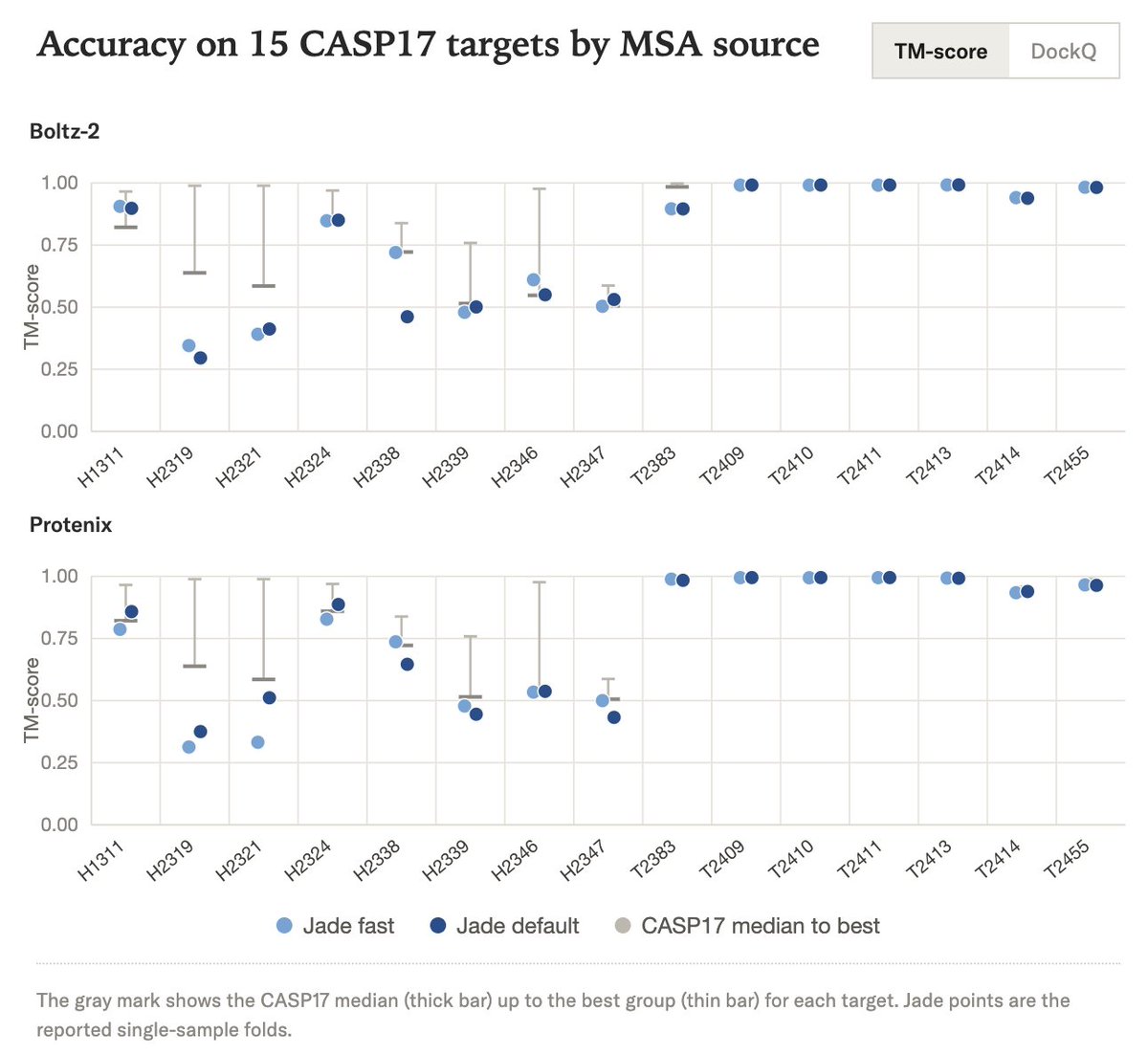
Introducing Jade, our lightweight, GPU-accelerated homology search engine for proteins, DNA, and RNA.
Modern protein structure prediction depends heavily on evolutionary information from MSAs. But generating them at scale can require enormous databases, memory, and preprocessing infrastructure.
Jade builds is built on top of DIAMOND. It adds two very important thing custom CUDA kernels, nucleotide search, and direct A3M generation for co-folding models like Boltz-2 and Protenix, without requiring a prebuilt search index.
Some benchmark highlights:
> 26× faster than BLASTN at near-matched recall on simulated divergent DNA sequences.
> 10–11× faster protein search on an A100 compared with our 64-thread CPU baseline, with unchanged sensitivity.
> 49 seconds to prepare all 32 MSAs across 15 CASP17 targets, with MSA preparation accounting for only ~3–5% of end-to-end co-folding time.
Our goal is simple: make homology search fast and lightweight enough to become a routine step in continuous biomolecular engineering.
Jade is already integrated into the LiteFold platform, with standalone API and SDK access coming soon.
Links in the comments
Excited to share one of our first milestones!
We recently sent 19 peptides designed using LiteMol-1 to Adaptyv Bio for experimental validation against BHRF1, a protein associated with Epstein–Barr virus.
9 out of 19 peptides showed binding. Two even achieved lower apparent KD values than Bim, the natural binding partner.
Here are some numbers:
> 47.4% experimental hit rate among our selected candidates.
> 37.6 nM and 49.9 nM apparent KD for our two best peptides.
> 75.6 nM apparent KD for the natural Bim control.
Report link in the comments!