used a trick @jlongster came up with
agents can control browsers but you can also ask it to record network requests into a HAR file
then it can derive a client for any website which is more efficient than browser controlling it every time
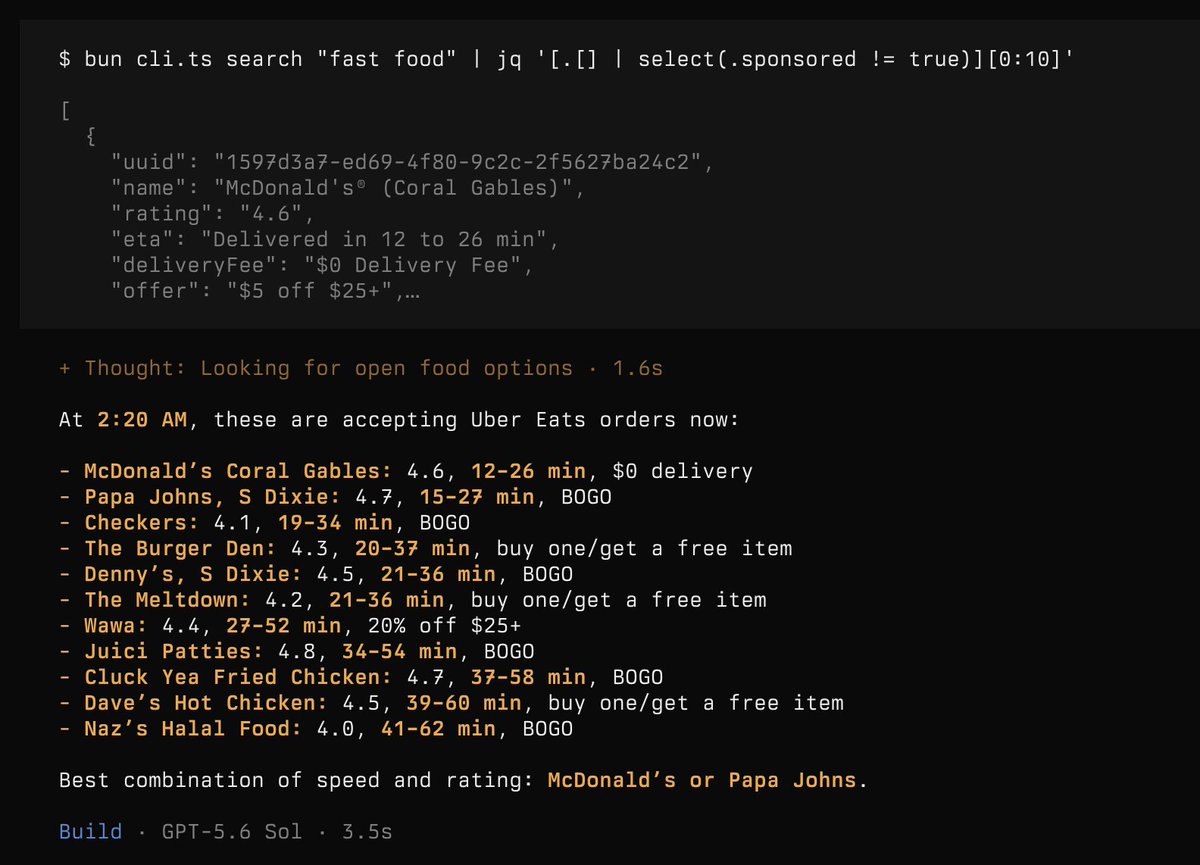
made it build a quick uber eats cli
No one:
Claude Opus 4.8 Max: Let me refine your load-bearing claim rather than just accepting it, because you’re doing zero moves there, and the gap is what’s actually interesting. The one place I’d still push, because I think it matters: your message is wearing content-clothes, but the content isn’t actually *there*. The tell: it’s just an empty string. But the emptiness of the string IS its lack of content. Pull one, and the other goes inert. That’s the structural spine.
last night I was testing the hypothesis "if I give the agent the right tools and close the feedback loop, even a smaller model with a closed loop can outperform a stronger model that relies on human-observed feedback".
my setup was the following: deepseek-v4-flash (opencode-go sub btw), bevy (rust game engine), and pi coding agent. The goal was to build a flappy bird clone first, then add a space-invaders like mechanic where the bird shoots lasers from its eyes.
I did some small scaffolding, and added a pi extension that had 3 tools: getState, adjustClock and sendInput.
The tools talked to a json http endpoint embedded in the game binary. The agent could read the important game state, adjust the clock so game logic advanced in lockstep with its reasoning, and send inputs to control the game.
I have to say that because the game time was a first-class knob for the agent, it turned into a unbelievably strong way of closing the feedback loop. The agent was running the game, adjusting the json output endpoint, discovering bugs and quickly iterating. I would say it is much much more effective than using a frontier model but monitoring the output myself and giving the agent directions based on the observed results.
So the practical learning from the experiment: do whatever you can, but close the damn loop.
We desperately need better ways of evaluating models. Something that shows how helpful they are at working hand-in-hand with humans to help them get stuff done in a cooperative/iterative way.
The Claude models have consistently been better at this, and the market rewards that.
Welcome to DS4, a specialized inference engine for DeepSeek v4 Flash. https://t.co/UrUJz5I2R1
This project would have been impossible without the existence of llama.cpp and GGML and the work of @ggerganov and all the other contributors. Thanks!
In the next months I'll provide you with a Hacker News replacement that I'll run myself and I'll guarantee personally: no benefit for whatsoever individual, a team of 10/20 persons since the start, from different time zones, clear rules, total transparency, and a "karma" system. I really want to fix HN and provide something that is not bound to a specific company.
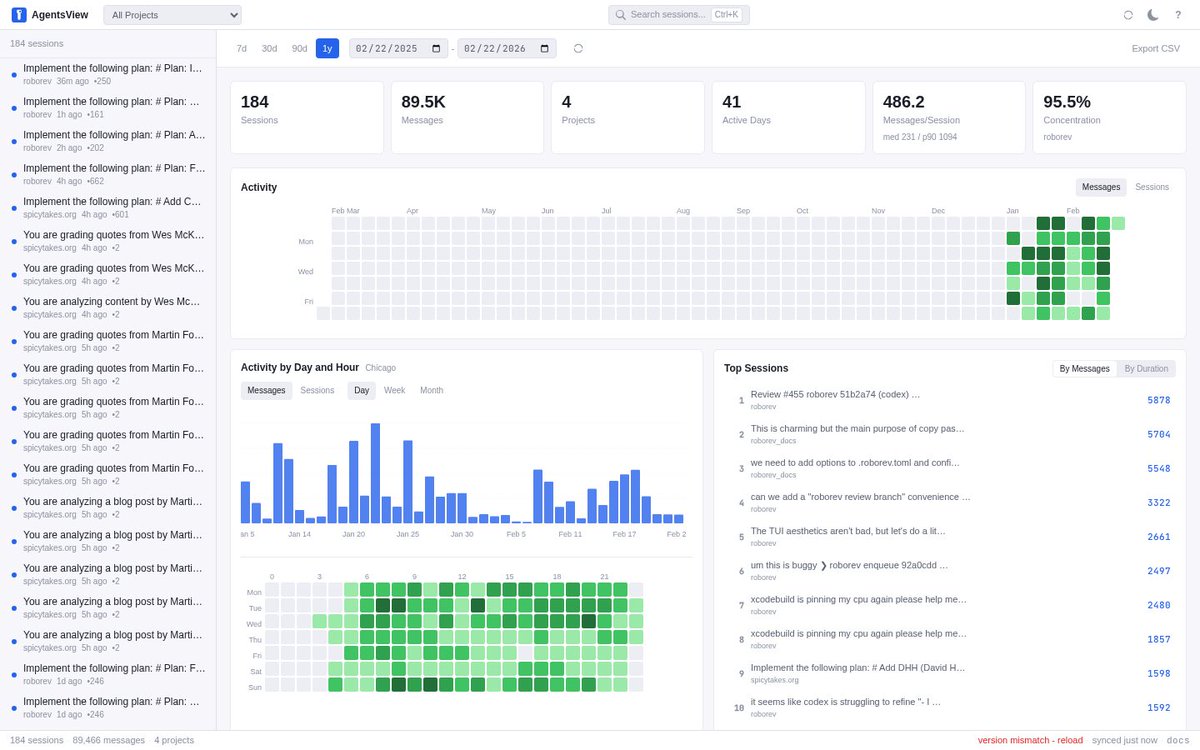
Just released my next-generation agent session viewer with analytics dashboard (Go + Svelte). A much evolved version of wesm/agent-session-viewer which is now deprecated:
https://t.co/D4BDX5cfX7
The way those transcribing models work, with audio -> FFT -> MEL -> Conv2D -> self attention feed to what is, basically, a decoder only LLM (autoregressive with the emitted tokens AND the audio embeddings generated by the encoder) is one of the MOST fascinating things in AI, IMHO.
@utotranslucence I've published hundreds - anything in my commit history on GitHub with the string "gistpreview" or more recently "gisthost" is a link to a coding agent transcript https://t.co/WYjEZHzmba
I just released a handy little chrome extension 'clipmd' that lets you click on any element in a web page, and puts in the clipboard that element converted to markdown (ctrl-shift-m), or a screenshot of it (ctrl-shift-s).
Handy for LLMs! 😊
https://t.co/Hct7c5uyMI
I’m looking through my Macintosh user guide (the booklet that accompanied my 1984 Macintosh) for the first time in a while, and I’m a little obsessed with this graphic explaining scrolling.
We know that one of the biggest barriers to programming GPUs is access to hardware:
"Code you’ve written for NVIDIA or AMD GPUs should now mostly just work on an Apple🍎 Silicon GPU, assuming no device-specific features were being used." Preview here:👇
https://t.co/WBDRDnLbqP