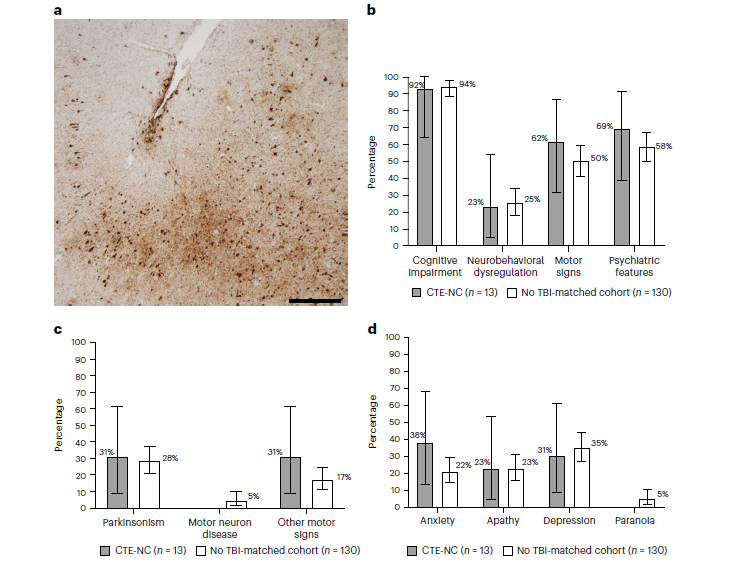
New @PennNSG research finds that most people who met proposed chronic traumatic encephalopathy (CTE) criteria in life did not show the hallmark brain changes of the disease at autopsy. https://t.co/Xaa52fDw82
The proposed clinical features of #Traumatic Encephalopathy Syndrome have low predictive value for #CTE pathology, raising concerns for incorrect #diagnoses of #neurodegeneration in former athletes. #TBI@JohnDArenaMD
https://t.co/MGxckHtM8z
@ChrisNowinski1@PennNSG@Penn Your chosen analysis just underlines what we show in published paper - current TES criteria not fit for purpose as almost entirely driven by risk factor (RHI sport) rather than clinical symptomatology.
Again, we seem to agree there's long way to go to define valid TES criteria
75% of those meeting proposed clinical criteria identifying chronic traumatic encephalopathy (#CTE) during life do not have the pathology at autopsy.
Raises serious concern re consequences of incorrect diagnoses in at risk groups
@PennNSG@Penn
https://t.co/mWWNAQAWwi
@mvianin@WillStewNeuro There is strong evidence that neither the mental state aspects or the anger supposedly associated with cte occur at any higher rates- the first thing to do is to drop these from criteria. Second thing is to add specific rider not better explained by functional cognitive disorder
@ChrisNowinski1@PennNSG@Penn I think we both know there is no material issue in our case ascertainment via TES criteria
But there is a serious and demonstrable risk of inappropriate misdiagnosis, which we show current criteria are prone to
I am sure we both agree on that too
@ChrisNowinski1@PennNSG@Penn Thanks Chris
It's exactly what we show it to be and detail in the data and discussion, as you acknowledge
#TES criteria are not fit for prime time and should not be used that way
CTE cannot be diagnosed during life. Our work published today in @NatureMedicine demonstrates that most individuals meeting proposed clinical criteria do not have evidence of #CTE neuropathology at autopsy (1/5)
https://t.co/5euKrqf8vq
@PennNSG@PennMedCSO@WillStewNeuro
"Guidance for managing #concussion in grassroots sports"
While there's been great progress with grassroots sports concussion guidance internationally the past decade or so, in some regions it is still a mess.
Hard to believe this is published in 2026
https://t.co/UkyjDTImUD
@amironburgundy@HACKETTREF Unfortunately, you are incorrect.
My pinned post in profile lists some of our work showing this.
In parallel, multiple other studies in multiple other regions from other authors have confirmed same findings.