This image vividly translates Elon Musk’s five-step engineering process into a visual metaphor using a modular fluid control system. The entire device uses "fluid flow" to represent a work process—showing how raw, chaotic inputs are refined into a high-speed, automated output.
Here is how each section of the image corresponds to the specific steps outlined in the provided text:
Core Metaphor: The Linear Flow
The device is arranged linearly from left to right, enforcing the principle that the steps must be followed "in order". The fluid (the process) physically travels through each stage, illustrating that you cannot skip ahead without causing system failure.
1. Requirements: Pressure Reduced
Visual: The first module features a pressure regulator knob and a gauge pointing to a green "SAFE" zone, labeled "PRESSURE REDUCED."
The Principle: This represents the first step: "Make requirements less rigid or eliminate them".
Interpretation: Just as high pressure makes a hydraulic system dangerous and prone to leaks, rigid requirements create unnecessary constraints. By "turning down the pressure" at the intake, the system visualizes the need to question and remove dumb requirements before designing anything.
2. Delete: Bypass Active
Visual: The second module shows a large orange valve handle set to "BYPASS." The fluid is diverted away from a complex, empty maze structure and sent through a direct shortcut channel.
The Principle: This illustrates the second step: "Delete parts or processes".
Interpretation: The complex maze represents unnecessary complexity or bureaucratic waste. The visual of physically bypassing the maze emphasizes that the goal is "deletion is prioritized over optimization". You don't optimize the flow through the maze; you cut the maze out entirely.
3. Simplify: Laminar Flow
Visual: The third module uses a clear glass window to show the fluid transitioning from bubbly turbulence on the left to straight, smooth lines on the right, labeled "LAMINAR FLOW."
The Principle: This corresponds to the third step: "Simplify and optimize".
Interpretation: Even after deleting the "maze" (Step 2), the process (fluid) might still be messy or turbulent. This stage represents smoothing out the remaining necessary steps. The image visually argues that "optimizing a system prior to removal" is a mistake; you must delete the maze first, then smooth the remaining flow.
4. Accelerate: Max Flow Rate
Visual: The fourth module contains a high-speed turbo pump with a spinning impeller (motion blurred), labeled "MAX FLOW RATE."
The Principle: This represents the fourth step: "Accelerate cycle time".
Interpretation: The pump is placed after the flow has been smoothed. This illustrates why you wait to accelerate: if you placed this high-speed pump at the beginning (before the maze or the turbulence), the system would likely explode or clog. Speed is only safe once the path is clear and simple.
5. Automate: Self-Regulating
Visual: The final module is an electronic solenoid valve with a blue status light and wiring, labeled "AUTOMATE."
The Principle: This is the final step: "Automate".
Interpretation: The electronics are attached at the very end. This aligns with Musk's warning that "automating an inefficient or flawed process amplifies errors". The visual placement confirms that "smart" automation should only be applied to a system that has already been rigorously simplified and accelerated mechanically.
Summary
The image serves as a visual proof of order dependency. It demonstrates that "Automation" (Step 5) is effectively useless without the "Bypass" (Step 2) and "Laminar Flow" (Step 3) preceding it.
description:
1. 🏛 The Central Capital: Type System & Semantics Core
Visual: A circular, dense metropolitan city located at the very center of the map.
Why this design: The prompt explicitly rejects the idea of a flat API list. Instead, the Type System is positioned as the "Gravity Center" of the Swift universe. Just as all roads lead to Rome, all Swift code revolves around how you define data (Type, Protocol, Generic) and how that data behaves (Value vs Reference).
Key Elements:
City Hall: Represents the "Worldview Generator" where the rules of Optional, Result, and Error handling are legislated.
2. 🧱 Southern Plains: Basic Constructs & Control Flow
Visual: Agricultural farmland and open plains with structured road networks.
Why this design: This area represents the "grammar farmland". These are the daily staples of coding—if, switch, loops, and functions.
Design Logic: It is placed at the bottom (South) because it is the foundational "flat land" where most developers start their journey. It’s accessible, necessary, and utilitarian, like farming.
3. 🏗 Eastern Industrial Zone: Memory & Lifetime
Visual: A power plant and resource recycling facility (cooling towers, grids).
Why this design: Memory management (ARC) is the energy system that keeps the application running. The metaphor here is "Power Plant + Resource Loop".
Key Elements:
The Grid: Represents strong, weak, and unowned references holding the structures together.
Recycling Center: Visualizes deinit and Cow (Copy-on-Write) as mechanisms to efficiently manage and recycle resources so the city doesn't crash.
4. 🏭 Northeast Industrial Belt: Concurrency & Effects
Visual: A complex factory complex with conveyor belts, distinct processing units, and isolation walls.
Why this design: Concurrency in Swift (async/await, Actors) is about managing work in parallel without collisions. The factory metaphor highlights "Factories + Conveyor Belts + Isolation Walls".
Key Elements:
Isolation Walls: Represent Actor and MainActor ensuring thread safety.
Pipelines: Represent Task and TaskGroup moving data through asynchronous workflows.
5. 🧬 Northern Highlands: Abstraction & Composition
Visual: High mountain peaks and elevated terrain.
Why this design: This represents the "Mathematical Highlands" or "Abstraction Mountains".
Design Logic: As you master Swift, you "climb" into higher levels of abstraction using Protocol-Oriented Programming and Generics. The air is thinner (pure code), and the view is wider (composition). The terrain is difficult but powerful.
6. 🌊 Southwest Coast: Interop & ABI Harbor
Visual: A shipping harbor with docks, cranes, and customs checkpoints facing the ocean.
Why this design: This is the interface with the "Foreign World" (C and Objective-C). The Harbor represents the "Customs System" where data is marshaled (shipped) back and forth.
Key Elements:
The Ships: Represent legacy C/ObjC code arriving at the port.
Customs: Represents Bridging and @objc attributes ensuring compatibility.
7. 📦 Western Archipelago: Modules & Packages
Visual: A group of distinct islands connected by bridges.
Why this design: Modules are encapsulated units of code. The archipelago metaphor represents distinct "Trade Zones" separated by water (access control levels like public, internal, fileprivate).
8. 🛠 The Underground: Compiler & SIL
Visual: A cutaway view revealing the subterranean engine room beneath the crust.
Why this design: This is the hidden "Underground Furnace" that powers the surface. Normal citizens (developers) don't always see it, but it drives everything.
Key Elements:
The Core: Represents LLVM and SIL (Swift Intermediate Language), where high-level code is melted down and optimized.
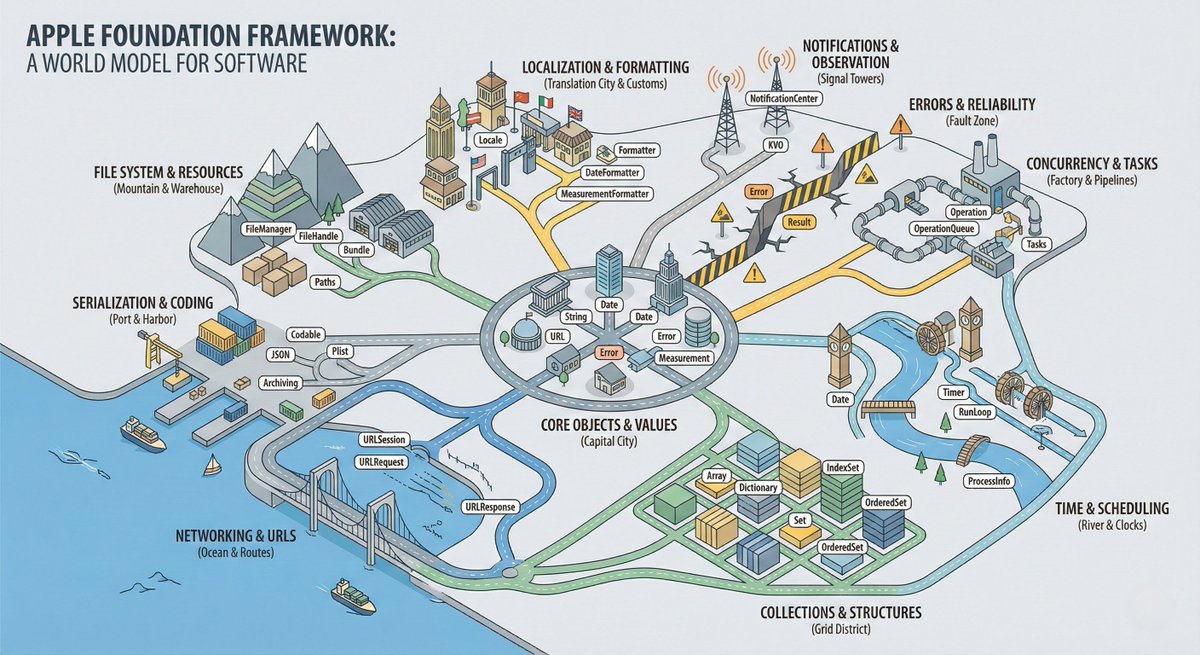
This image reimagines the Foundation framework not as a list of APIs, but as a functional continent. The core design intent is to show that Foundation is "how software interacts with reality". The layout follows a "Hub and Spoke" model, where primitive values sit at the center, and functional capabilities radiate outward like distinct geographical regions.
1. The Center: Core Objects & Values (The Capital City)
Visual Element: Located in the exact center, depicted as a dense, modern "Capital City" or central hub.
Key Components: String, Data, Date, URL, Error, Measurement.
Design Thought: This is the "Zero Point" of the framework. Just as all roads lead to Rome, all complex systems (Network, File System, UI) ultimately resolve down to these primitive objects. They are the currency and the citizens of this world.
2. The Surrounding Regions (The Provinces)
A. Collections & Structures (The Grid District)
Visual Element: A structured, grid-like urban area, resembling organized warehouses or city blocks.
Software Concept: Array, Dictionary, Set.
Design Thought: This region represents Order. It visualizes how we organize complexity. It is placed near the capital because structure is the immediate container for raw values.
B. Serialization & Coding (The Port & Harbor)
Visual Element: A shipping port with containers, cranes, and docks facing the water.
Software Concept: Codable, JSON, Plist.
Design Thought: Serialization is about Transport. Just as a port prepares goods for shipping, Codable packages objects to be sent across time (disk) or space (network). It is the gateway between the internal memory "land" and the external "sea".
C. File System & Resources (The Mountain Range)
Visual Element: A mountainous region with mines, storage bunkers, or heavy bedrock.
Software Concept: FileManager, Bundle, Paths.
Design Thought: This represents Persistence. Files are heavy, static, and "hard" like rock. This is where data goes to rest permanently, distinct from the fluidity of memory.
D. Time & Scheduling (The River & Clock Towers)
Visual Element: A flowing river winding through the map, punctuated by clock towers or water wheels.
Software Concept: Date, Timer, RunLoop.
Design Thought: Time is a Flow. The river metaphor captures the continuous nature of the RunLoop and the passage of time (Date), connecting different parts of the land (the system) together.
E. Concurrency & Tasks (The Industrial Factory)
Visual Element: A complex of factories, pipelines, and multi-lane highways.
Software Concept: OperationQueue, Tasks, Async/Await.
Design Thought: This represents Throughput and Parallelism. It visualizes the "work" of the CPU. The pipelines show how data is processed in parallel streams, distinct from the static storage of the mountains.
F. Networking & URLs (The Ocean & Bridges)
Visual Element: The vast ocean surrounding the continent, connected by long bridges and shipping routes.
Software Concept: URLSession, URLRequest.
Design Thought: This represents the Unknown External World. The ocean separates "My Device" (the land) from "The Server" (somewhere across the sea). Networking is the bridge over this chasm.
G. Errors & Reliability (The Fault Zone)
Visual Element: Warning signs, cracked earth, or fault lines running through the terrain.
Software Concept: Error, Result, Do/Catch.
Design Thought: Errors are Structural Risks. They are not a separate "module" but a fracture that can happen anywhere. Visualizing them as a fault zone emphasizes that failure is a geological reality of the software landscape.
H. Localization & Formatting (The International Zone)
Visual Element: A district with diverse architectural styles, flags, or customs houses.
Software Concept: Locale, Formatter.
Design Thought: This represents Culture. It shows that the same raw data (from the Capital) looks different depending on which "cultural lens" (Locale) you view it through.
I. Notifications & Observation (The Signal Towers)
Visual Element: Radio towers, radar dishes, or broadcast stations.
Software Concept: NotificationCenter, KVO.
Design Thought: This represents Awareness. These towers "listen" to the environment and broadcast signals across the entire map without direct physical connections (decoupling).
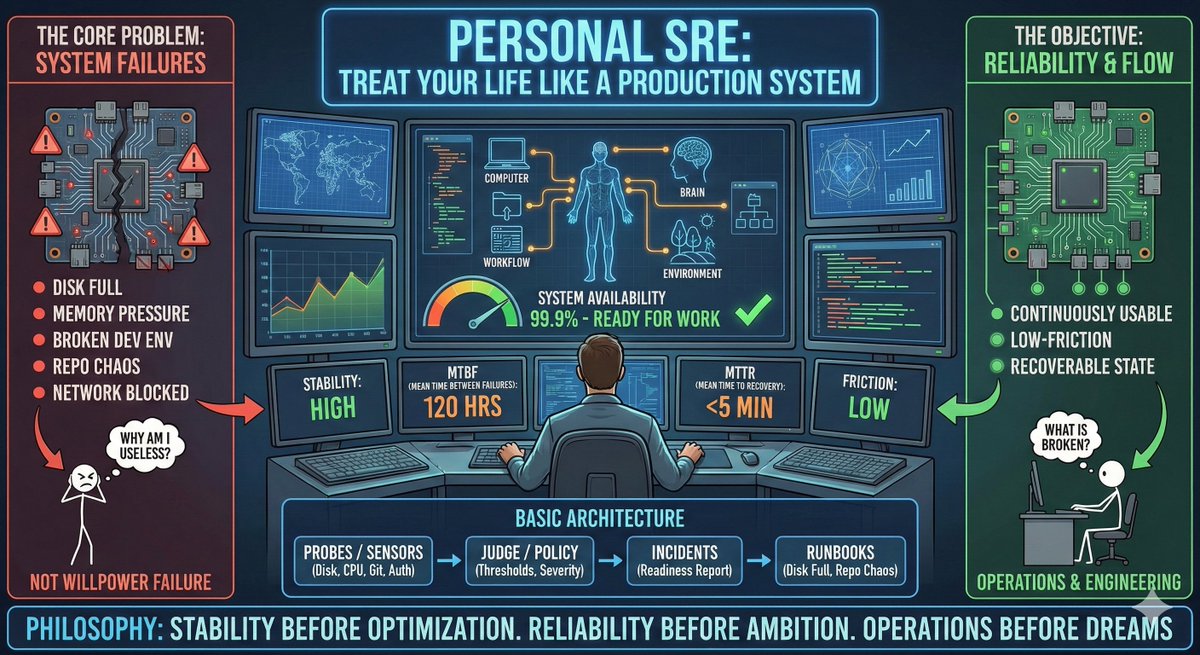
A paradigm shift:
We used to think “personal productivity” is about motivation, habits, and discipline.
But a modern personal work system is already:
as complex as a small internet company in 2005.
The real problem is not psychology.
It’s reliability engineering.
Maybe it’s time to introduce:
Personal SRE —
operating your personal system like a production system.
Has anyone seen or built something like this?
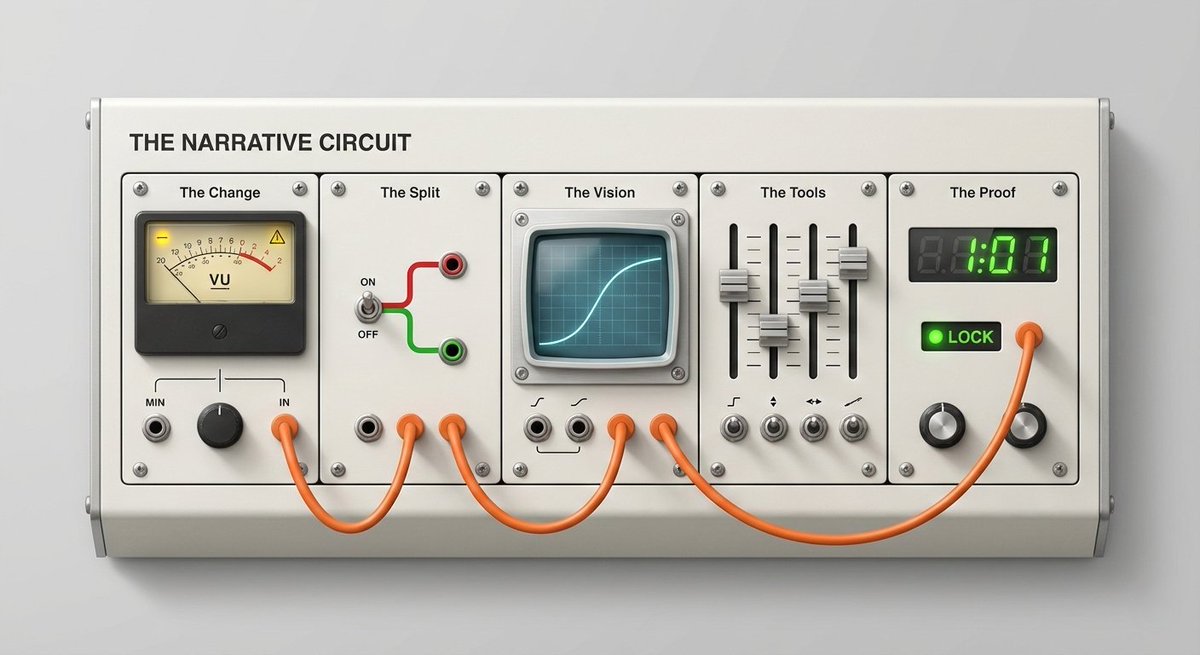
The Narrative Circuit
Conceptual illustration, 2026
This work presents persuasion not as speech, but as a machine.
Arranged like a piece of laboratory equipment, The Narrative Circuit depicts a five-stage system—The Change, The Split, The Vision, The Tools, and The Proof—wired into a single closed loop. Each module performs a distinct cognitive function, but only together do they form a working circuit: one that converts uncertainty into conviction.
Rather than a sequence of arguments, the connected modules form a continuous cognitive process. Once the circuit is closed, the question is no longer whether the story is true, but whether the system is internally consistent and operational.
The image suggests that modern narratives function less like stories and more like machines for producing belief—designed pathways that move the mind from one world model to another, and then seal the passage behind it.
Conceptual editorial illustration for it
Digital print
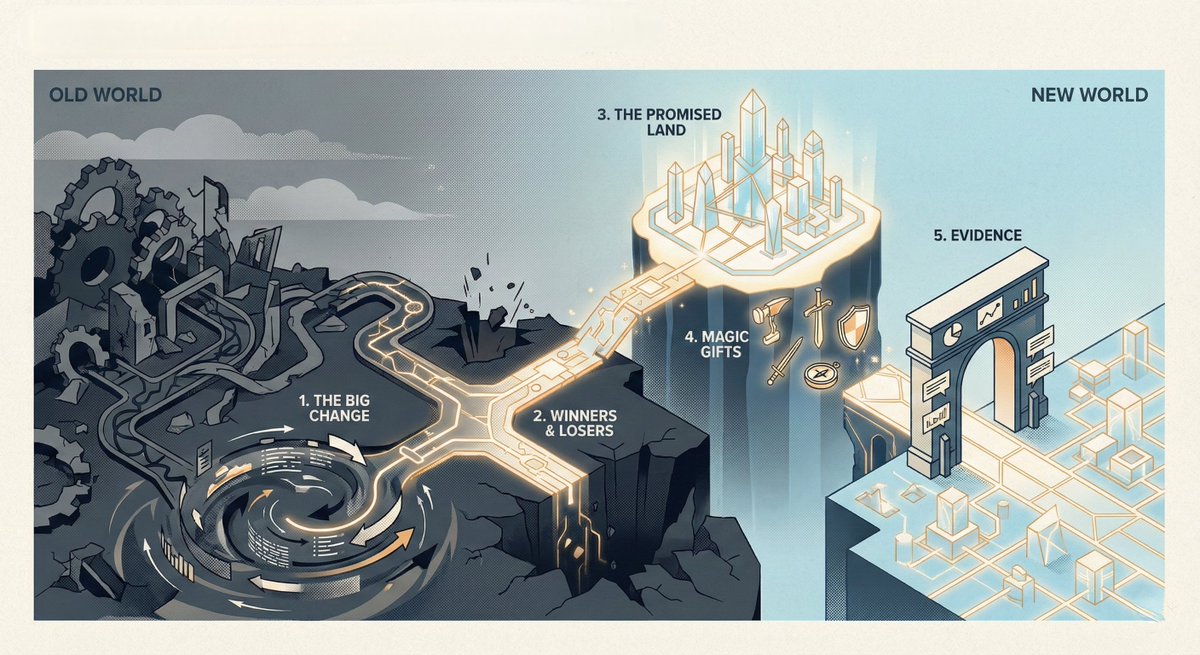
This work visualizes a five-stage cognitive journey from an Old World to a New World—not a physical migration, but a migration of the model of reality through which decisions are made.
On the left, the Old World is depicted as a closed, mechanical landscape: broken gears, circular currents, and self-reinforcing loops. It is a world that still functions, but only by repeating itself. The first two stages—The Big Change and Winners & Losers—introduce instability and pressure. The viewer is shown not merely that the environment has changed, but that staying means falling behind.
The central bridge marks the point of no return. Above it rises the Promised Land—not a solution, but a vision: a coherent, higher-order future in which the rules of the world are different. Beneath that vision hang the Magic Gifts: tools, methods, or systems that make the crossing possible. They are not the goal; they are the means.
On the right, the New World appears as a clean, structured city. The final gate, Evidence, is not decorative—it is the psychological anchor that stabilizes belief by proving that this new world is already inhabited and operational.
The image is not a story about persuasion. It is a diagram of worldview replacement: how humans do not change by accepting new facts, but by crossing into a new reality in which different facts, goals, and identities make sense. The path shown here is irreversible—not because of force, but because once the new world is seen as real, the old one can no longer fully contain experience.
In this sense, the work is less a map of territory than a map of belief migration.
Vibe Coding Protocol
This is not a machine for building.
It is a machine for steering.
At the center, a knob replaces the blueprint.
You do not construct the future — you feel your way into it.
Each turn is small.
Each run is a question.
Each result is an answer from reality.
You listen.
You decide.
You keep, or you revert.
Progress here is not forward motion,
but the quiet art of staying in control while moving through the unknown.
The Order of Babel
Medium: Digital Illustration
Description:
This artwork visualizes the sum of human knowledge as a self-sustaining vertical city. The structure is organized hierarchically, moving from material foundations to abstract thought.
I. The Foundation (Physical Reality) The tower is anchored deep within the bedrock of Geography and places, rooted in the physical world. Its energy source is a massive reactor core representing Natural and physical sciences, surrounded by a network of vital fluids symbolizing Health and fitness that sustains the structure.
II. The Runtime (Human Civilization) The central industrial layers are supported by the steel framework of Technology and applied sciences. Within this machinery, hexagonal living modules house People and self, connected by the complex walkways and bridges of Society and social sciences. This area is alive with motion, depicting the constant flow of Human activities.
III. The Kernel (Abstract Thought) Suspended in the quiet upper center is the rational core: a floating crystal mechanism representing Mathematics and logic. Directly above it sits a pristine, mirror-walled observatory dedicated to Philosophy and thinking.
IV. The Interface (Expression & Belief) The summit blossoms into open-air hanging gardens, representing Culture and the arts. The tower culminates in a spire that dissolves into ethereal light, symbolizing Religion and belief systems reaching toward the sky.
V. The Context (Time & Data) The tower's outer shell is carved with ancient reliefs recording History and events. Encircling the entire structure is a holographic data ring, serving as the General reference index that binds all layers together.
反推得到的 prompt,觉得效果如呢?
核心是:用极简高对比配色与复古印刷质感,把“古典具象人物”放入“现代隐喻场景”,构成强概念、强象征、强中心构图的观念海报式插画。
Prompt: "A conceptual editorial illustration with a classical statue or archetypal human figure as the central subject, in a stage-like composition, using a 2–3 color high-contrast silkscreen poster palette, halftone print texture, flat background, strong symbolic metaphor, minimal but bold color fields, retro print grain, surreal but readable narrative scene."
Test on https://t.co/sUaT9BVMgQ