Wemby bails out defenses far too often by settling on the perimeter. With his historic length, he should be absolutely punishing teams in the post instead of wasting possessions on lower-percentage jumpers.
It’s a glaring symptom of an era that forces 3-point volume onto big guys before they ever develop a polished back-to-the-basket game.
I can’t stand how chaotic the game has become. Players are flying into each other at full speed with zero control. Brunson is already paying the price for how reckless this has gotten.
John Havlicek on the Boston Celtics’ smothering, pressure defense in the 1974 NBA Finals:
“The pressure defense is the difference. Obviously we can't play like this for 82 games during the regular season or we'd be worn out after two weeks. We would need 40 guys."
(May 4, 1974)
After taking an accidental hit to the face from Em Bryant in Game 5, Wilt Chamberlain practiced in dark glasses to protect a bruised eye during the 1969 NBA Finals.
(May. 3, 1969)
Washington Bullets guard Larry Wright wins Game 1 of the 1979 NBA Finals at the free-throw line with no time left on the clock.
It is the only game in NBA Finals history to be decided by free throws at the buzzer.
A premier matchup in the 1967 NBA Finals: Nate Thurmond vs. Wilt Chamberlain.
Ahead of the series, Thurmond gave an assessment of Wilt’s evolution as a player:
“I’ve had a couple of good games against him this year. But, overall, Wilt probably has the edge over me. Wilt’s a lot tougher this year. The fact that he is passing more makes him a double threat.”
Los Angeles Lakers vs. New York Knicks 1972 NBA Finals Preview.
“Wilt Chamberlain — 7-2 center. Somehow managed to contain Bucks’ Kareem Jabbar in last series, will have less direct challenges in this one.”
(Apr. 25, 1972)
@PeterVecsey1@samnewkirk64@NycRoundball This injury happened during the 9th game of the regular season. November 7, 1969, during a home game against the Phoenix Suns. Wilt had already been battling with chronic arthritis in his knees.
Wilt Chamberlain getting ready for the 1970 NBA Finals against the New York Knicks.
In one of the greatest medical comebacks in sports history, Wilt returned from a total patellar tendon rupture in just four months to lead the Lakers back to the NBA Finals.
(Apr. 24, 1970)
@WiltStats@NycRoundball Everyone, and I mean everyone, knocks Wilt to this day for not dominating G7 v injured Willis (27 minutes, two baskets at the outset). Jerry West told me shortly before he died he was amazed Wilt played 18 playoff games after playing but 12 in regular season due to surgery.
Wilt wore a heavy, restrictive knee brace. It allowed him to run up and down the floor in a straight line, but heavily compromised his side-to-side (lateral) movement. The Knicks actively tried to exploit this by pulling him away from the basket.
His right knee routinely filled with fluid and swelled up significantly after games. He required constant icing and doctors had to drain the fluid to keep him mobile enough to play.
Because of how quickly he returned to action, the muscles supporting his right knee—specifically his quadriceps—had not fully rebuilt or regained their pre-injury strength.
Wilt acknowledged that he had permanently lost his explosive, vertical leap after the injury, forcing him to adapt his game to rely more heavily on positioning, passing, and rebounding.
Wilt wore a heavy, restrictive knee brace. It allowed him to run up and down the floor in a straight line, but heavily compromised his side-to-side (lateral) movement. The Knicks actively tried to exploit this by pulling him away from the basket.
His right knee routinely filled with fluid and swelled up significantly after games. He required constant icing and doctors had to drain the fluid to keep him mobile enough to play.
Because of how quickly he returned to action, the muscles supporting his right knee—specifically his quadriceps—had not fully rebuilt or regained their pre-injury strength.
Wilt acknowledged that he had permanently lost his explosive, vertical leap after the injury, forcing him to adapt his game to rely more heavily on positioning, passing, and rebounding.
Jerry West in the locker room after Game 6 of the 1970 NBA Finals, where his 31 points and 13 assists alongside Wilt’s dominance forced a Game 7 against the Knicks.
Wilt Chamberlain in the locker room after Game 6 of the 1970 NBA Finals, where his historic 45 points and 27 rebounds kept the Lakers alive to force Game 7 against the Knicks.
Yes, In past eras, the rules protected players better. The game was either much slower—meaning they covered less ground, reducing soft-tissue wear and tear—or, when the pace was quick in the 60s through the 80s, strict enforcement of dribbling and offensive foul rules naturally limited the explosive, erratic movements that cause injuries today.
The era of repeat champions is likely over because today's chaotic style of play and loosened rules are simply too injury-prone—just look at Jalen Williams and Ajay Mitchell.
If any past dynasty, from the 60s Celtics to the 90s Bulls, lost their #2 player, they would've fallen short too. It was just much less common back then because the style of play actually accommodated the players.
That’s just the reality of the game today.
Yeah, looking at the Spurs, Wemby is heralded as the future of the league, but his physical profile already puts him at a heightened risk for injuries. Combine that with the grueling, wide-open perimeter style of the modern NBA, it’s hard not to worry about his longevity.
This is exactly why the modern NBA concerns me. The current style of play is a threat to player longevity, and we’re going to miss out on a lot of greatness because guys are breaking down too much.
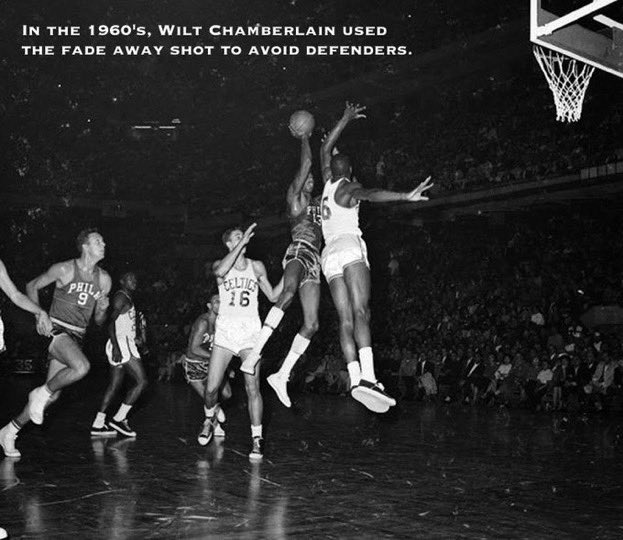
Hall of Fame Lakers legend Jim Pollard—then coaching the Chicago Packers—was among the first to foresee Wilt Chamberlain’s legendary 100-point game.
On January 15, 1962, Pollard pointed to Wilt’s evolving fadeaway shot, predicting: “He will score 100 points in an NBA game. His fadeaway jump shot is a lot better.”