This is a notice I originally posted in my Telegram group, but since I never shared it on X, I wanted to post it here as well.
----------------------------------------------
This might sound a bit negative toward memecoins, but I just wanted to share my personal thoughts.
I believe memecoins are ultimately closer to speculative, Ponzi-like assets driven by hope.
Most memecoins have no intrinsic value or sustainable cash flow. Their prices are built on the expectation that more people will become interested in the future, and that someone else will eventually be willing to buy at a higher price.
People enter hoping for a 10x or even 100x return, while those who got in earlier often realize profits using the liquidity provided by later participants.
In the end, it's not a structure where everyone can make money.
That doesn't mean I think memecoins are inherently bad.
People naturally pay for hope and possibility. They buy lottery tickets, bet on sports, and invest in startups that haven't proven anything yet.
I see memecoins as the market where that aspect of human psychology is expressed in its fastest and most extreme form.
The important thing is not to fool yourself into believing this is a stable investment.
Always ask yourself what you're actually buying, why you believe the price could rise, and who will eventually be willing to buy your bags at a higher price.
A strong narrative, a growing community, attention from influential people, or new liquidity entering the market can all send prices much higher.
But the moment that collective belief disappears, things can collapse much faster than most people expect.
I trade memecoins myself, but I never fall in love with a coin or believe it will go up forever.
To me, success in this market isn't about holding onto hope. It's about understanding what kind of hope people are buying before everyone else does.
At the end of the day, memecoins are a market that sells dreams.
The only question is when people will wake up from those dreams.
That's why I don't judge a coin simply by whether the meme is funny or entertaining.
I pay attention to who's behind it, who is creating attention around it, and what kind of track record those people have.
I also try to understand why people become emotionally attached to a meme, what narrative is forming, and what events could make even more people want to buy into it.
Ultimately, I don't place my faith in the coin itself.
I place my attention on how expectations are created, spread, and sustained.
The real challenge is judging how long those expectations can survive, whether they can continue attracting new participants, and when it's time to exit before that belief begins to fade.
Because of this structure, I completely understand why many people have a negative view of memecoins.
Honestly, I think that perspective is perfectly reasonable.
So even if I talk about different coins while trading on DEXs, I hope people don't interpret that as a recommendation to blindly buy them.
The narratives I see could be wrong.
Unexpected events can happen.
Most of the coins I buy may ultimately disappear.
I'm just another degen who can be wrong at any time.
Rather than buying something simply because I mentioned it, I'd rather people do their own research and make decisions within the level of risk they can personally afford.
At the end of the day, both profits and losses belong to each individual.
I'll continue sharing the narratives I find interesting and the observations I make while actively trading, but I can never guarantee the outcome.
If you want to survive in this giant Ponzi-like casino for the long run, I believe the most important thing isn't finding someone to follow.
It's developing your own framework for making decisions.
It is statistically safer to store coins on exchanges than to self custody. 👇
A few thoughts:
Assuming the data is correct, my impression is Willy has always been a strong supporter for self custody.
Hack data is easier to collect on the CEX side, usually major news. It is harder on the self-custody side, where hacks, lost coins, etc are often not reported.
On the exchange side, some deceased exchanges drag down the data. Binance (and a few other exchanges) have always covered users for any CEX side hacks.
Not saying one is better than another. Different approaches have different risk profiles (and product offerings), and may be better suited for different people. A balanced approach is probably best.
Going to address some posts I am seeing on the timeline
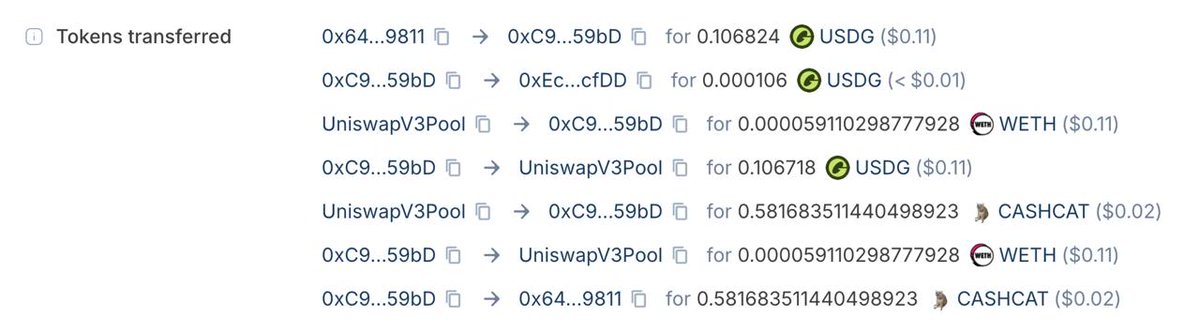
What you see below is a $10 USDG buy on https://t.co/GfT48aIfeD to check whether our integration of Varo tokens worked on Rialto.
The events of yesterday:
- We tested the site on staging (https://t.co/UzyyChXECO), but did not realise our domains were being tracked. At this stage, we were testing the product out, making sure it was ready for launch.
- People found the site and launched 8-10 tokens over a short period of time. After we realized, we immediately took down the site. We were originally going to deploy a fresh contract, however, deploying a new one would have wiped out the money people put in, so we kept the existing contract.
- Initially the site used Uniswap, but our goal was to integrate the Rialto router for swapping to enable any input token and into any output token.
- To do this, we had to whitelist Varo tokens on the Rialto router. Following integration, I bought $10 of PLTS to test to make sure the Rialto router integration was working before we went live.
- Since the staging site was leaked, we worked overtime to get the site out the same day and restore trading for anyone who had purchased tokens during the short period of time the staging site had leaked.
I’ve attached screenshots from that same wallet of buys/sells executed for various other tokens, before we integrated tokens of that type into the router. These include Uni v4 tokens (which we just launched support for yesterday) and CASHCAT etc. when we launched trading for all Uni v3 tokens.
We are a doxxed team and we spent nearly a year building @rialto_xyz. Our goal is to build the best trading suite onchain for the EVM: aggregator, propAMM, launchpad, and more to come.
For my first post, I’m sharing a letter @NVIDIA signed on why open models matter.
AI will transform every industry, power every company, and be built by every country.
Open models strengthen safety and cybersecurity, accelerate innovation and diffusion, and enable sovereignty.
The world needs both frontier closed models and frontier open models.
https://t.co/AUKzoQ5Ikb
Viral police body cam video appears to show a self-described transgender student freaking out on a campus police officer for “misgendering” him — and then being hauled away in cuffs. https://t.co/AAIQURpd9k