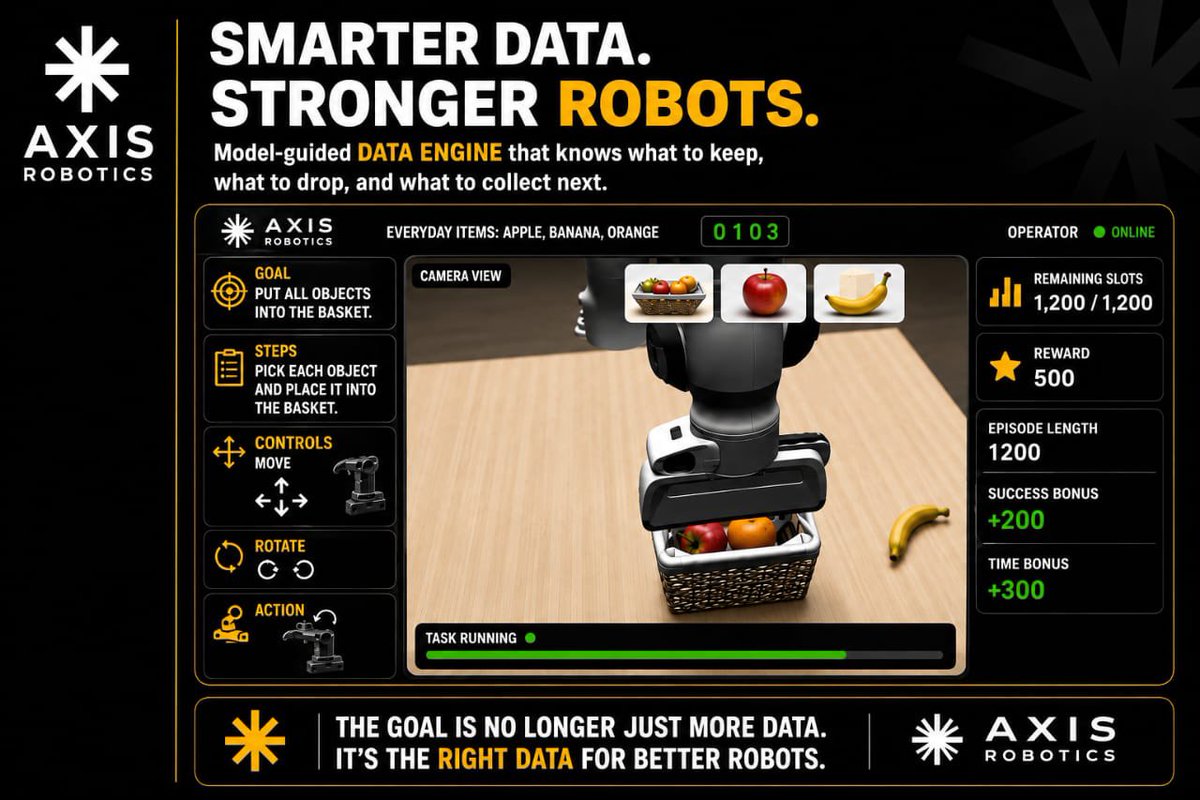
The next phase of robot learning is not just collecting more data. It is knowing which data the model actually needs. @axisrobotics
After nearly a year of building its data flywheel, Axis is moving toward a model-guided data engine that uses model performance to decide what to keep, what to drop, and where the next batch should be collected.
A few key developments:
• Real2Sim2Real: Real objects and scenes are being brought into simulation, with hardware validation to ensure simulated data improves real-world performance.
• Active curation: Instead of relying mainly on human, VLM, or scripted checks, data selection is increasingly tied to what the current model still struggles with.
• Online post-training: Repeated rollout failures become targets for new data collection, while distillation helps add new skills without losing existing ones.
• Stronger verification: Full action replay and manual cross-review are being used to combat cheating, with bots and cheating operators banned.
• Dual-arm robotics: ARX5 support is now live, alongside new put-in and take-out basket tasks and multiple task descriptions within the same scene.
The interesting part is the shift from “collect more data” to “collect the right data.”
If this works at scale, the data flywheel becomes much more efficient continuously identifying what robots cannot do yet and feeding those exact gaps back into training.
Link here: https://t.co/Y1oKNFcCfZ
250 in 5 days 🌟🍓🦋
RF @Wanted_Network
——––––––––––
Ad,NFA,DYOR
You don’t always need a new plan. Sometimes you just need to stay consistent with the one you already made.