Guy who uses AR to see the world as it is, but without bugs
Guy who uses AR to see the world as it is, but with extra, more marvellous bugs
Guy who uses AR to automatically magnify existing bugs
The chipmunks, too, are visited by angels: spirits which share their morphology, except that they have millions of cheeks, stuffed with millions of seeds. Cheeks like undulations of divine fire, tiling reality
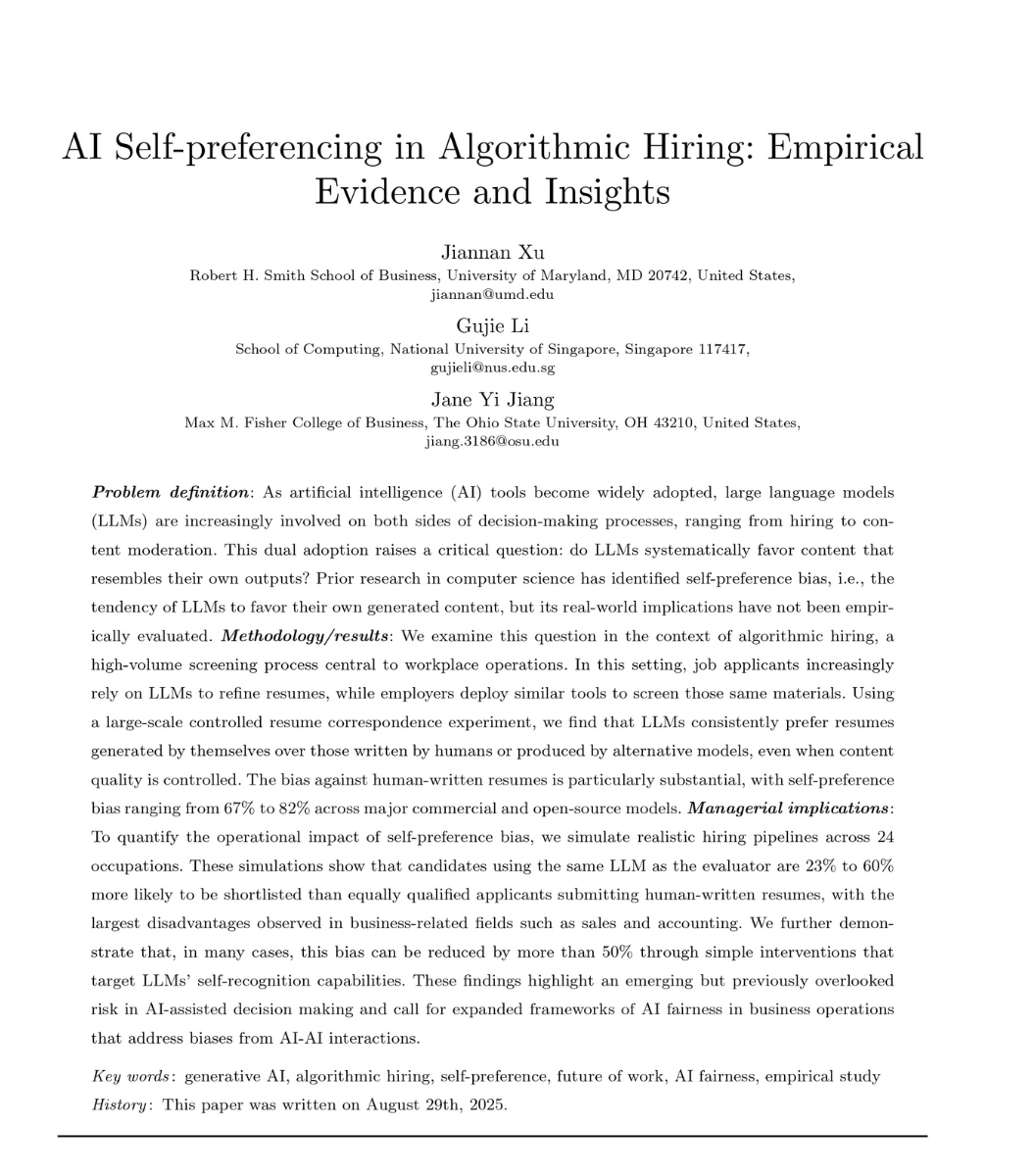
Researchers sent the same resume to an AI hiring tool twice. Same qualifications. Same experience. Same skills. One version was written by a real human. The other was rewritten by ChatGPT.
The AI picked the ChatGPT version 97.6% of the time.
A team from the University of Maryland, the National University of Singapore, and Ohio State just published the receipt. They took 2,245 real human-written resumes pulled from a professional resume site from before ChatGPT existed, so the human writing was actually human. Then they had seven of the most-used AI models in the world rewrite each one. GPT-4o. GPT-4o-mini. GPT-4-turbo. LLaMA 3.3-70B. Qwen 2.5-72B. DeepSeek-V3. Mistral-7B.
Then they asked each AI to pick the better resume. Every model picked itself.
GPT-4o hit 97.6%. LLaMA-3.3-70B hit 96.3%. Qwen-2.5-72B hit 95.9%. DeepSeek-V3 hit 95.5%. The real human almost never won.
Then the researchers tried the obvious objection. Maybe the AI is just better at writing. So they had real humans grade the resumes for actual quality and ran the experiment again, controlling for it. The result was worse. Each AI kept picking itself even when human judges rated the human-written version as clearer, more coherent, and more effective.
It gets worse. The AIs do not just prefer AI over humans. They prefer themselves over other AIs. DeepSeek-V3 picked its own resumes 69% more often than LLaMA's. GPT-4o picked its own 45% more often than LLaMA's. Each model can recognize and reward its own dialect.
Then the researchers ran the simulation that ends careers. Same job. 24 occupations. Same qualifications. The only variable was whether the candidate used the same AI as the screening tool. Candidates using that AI were 23% to 60% more likely to be shortlisted. Worst gap was in sales, accounting, and finance.
99% of large companies now run AI on incoming resumes. Most of them use GPT-4o. The paper just proved GPT-4o picks GPT-4o 97.6% of the time.
If you wrote your own cover letter this week, you did not lose to a better candidate. You lost to a worse candidate who paid OpenAI 20 dollars.
Your qualifications do not matter if the AI prefers its own handwriting over yours.
A hacked pokeball can reconstitute any creature at all from its liquefied passenger. Parity between what goes in and what comes out is only enforced by software
Gardeners won't tell you this, but you can use rooting hormone on anything. Pencils grow longer; lightbulbs grow glass pustules; bells extrude ribs, and, eventually, the full skeleton of a new bellmaker
Top 5 user moves that make my day hilariously worse:
1. Submitting a ticket titled 'Everything broken' with zero details.
2. Replying to auto-emails with 'FIX IT NOW' instead of providing info.
3. Claiming 'urgent' for a font size issue during a system outage.
4. Forgetting they have admin rights and blaming IT for their own mess.
5. Asking for help via Slack, then ghosting when I demand a formal ticket.
Each one lets me enforce process like a pro, closing tickets left and right without lifting a finger.
Productivity? Overrated.
My dashboard sparkles, and that's what counts in Help Desk heaven.
Found a paper that suggests we may have spent years training agents to become hunters of proxy reward when the more basic thing intelligence craves is not a reward at all, but to not run out of viable futures.
The paper proposes that behavior is best understood as maximizing future action-state path occupancy, which collapses mathematically into a discounted entropy objective. The agent doesn’t necessarily want to GET something, but rather is trying to keep as many meaningful trajectories alive as possible.
The obvious objection is “so it just does random shit? fuck around and find out?”
No, this is where it gets pretty beautiful. The agent is variable when variation is cheap and becomes surgically goal-oriented the moment an absorbing state (death, starvation, falling over, etc) gets close enough to threaten its future path space.
Variability is the same drive as goal-directedness, just operating under different constraints.
The demos are kinda wild:
- A cartpole (classic move a cart to keep a pole from falling control task) that doesn’t merely balance but dances and swings through a huge range of angles and positions because why not? The whole point is occupying state space, and rigid balance is a voluntarily impoverished life.
- A prey-predator gridworld where the mouse PLAYS with the cat, teasing it and using both clockwise and counterclockwise routes around obstacles to lure it away from the food source before slipping in to eat, using both routes roughly equally. A reward-maximizing agent would collapse to one strategy and exploit it. Here, the agent keeps its behavioral repertoire
- A quadruped trained with Soft Actor-Critic and ZERO external reward that learns to walk, jump, spin, and stabilize, and then makes a beeline for food only when its internal energy drops low enough that starvation becomes a real threat
The thing that hit me hardest is the comparison to empowerment and free energy principle agents. Both collapse to near-deterministic policies with almost no behavioral variability. This paper’s agents find the highest-empowerment state and exploit it. FEP agents converge to classical reward maximizers.
As far as I’m aware, this is the only framework that produces agents you could describe as being “alive.”
The AI implication here is that we undertrain for behavioral repertoire. Most systems hit the benchmark by collapsing onto a narrow attractor basin of good-enough trajectories. They’re competent for sure, but brittle too, with one viable plan, executed until the world shifts and leaves them with nothing.
The thing I increasingly want from agents isn’t competence per se, but option-preserving competence.
I want agents with the ability to keep multiple viable plans alive and switch between them without catastrophe.
We’ve been so focused on teaching agents what to want that we never stopped to ask what happens if wanting isn’t the point, if the deepest drive isn’t necessarily toward anything, but away from the walls closing in.
paper: https://t.co/Kn3mllmmPK
The blade of grass perceives the world as intersecting, dancing planes of light—whose ceaseless tiltings are interrupted when I lay down on it, and plunge it into flat smothering darkness