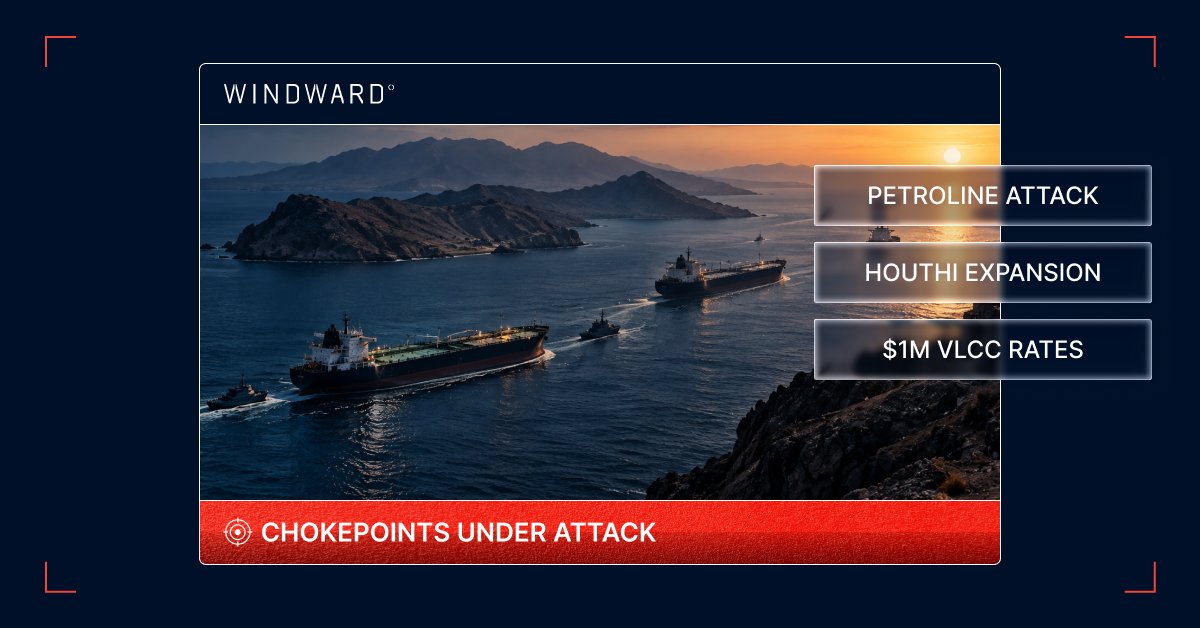
VLCC spot rates to transit Hormuz and load inside the Middle East Gulf were assessed at just over $1 million per day this week, equivalent to approximately $26 per barrel, or 25% of the price of a barrel of crude at $100.
The surge follows a week where Houthi forces seized Perim Island, effectively completing their hold on Bab el-Mandeb, and struck Saudi Arabia's Petroline pipeline, its main workaround for Hormuz.
Full story and other updates: https://t.co/fvO6TS1PGt
🇨🇳 South Korea detained two Chinese fishing vessels off Baengnyeong Island. Windward data shows the fishing grounds around the island keep drawing Chinese vessels regardless.
Windward all-source operational intelligence, 0–30 NM from the island, August 1 – September 18:
→ Five Chinese-flagged fishing vessels detected conducting dark activity.
→ Two showed AIS tracks consistent with fishing inside North Korea's EEZ, a potential UN sanctions violation.
Foreign vessels are barred from fishing in these waters. The low count likely reflects deliberate AIS suppression: the vessels that surface are a sample, not the fleet.
You might have seen the 1980s trend filling your feed this week. Here's our take on it.
In 1980, tracking a tanker meant a radio check-in, a paper plot, and however long it took to rewind a mixtape before the next update.
Windward fuses AIS, SAR, EO, RF, and vessel behavior into a single all-source operational picture, decision-ready and updated when and where you need it.
77 vessels blacklisted by Iran's Persian Gulf Strait Authority across three rounds since August, for using the unauthorized southern corridor or skipping tolls on the northern one.
Listing hasn't stopped them trading: 61% still broadcast AIS in September, and nearly all carry the P&I insurance Iran is telling insurers to drop. https://t.co/Dt2168Ld6Q
Join us at 2026 Intel Summit, hosted by @PotomacOfficers, September 24 in Falls Church, VA. Detect threats, anticipate risk, act faster.
Visit us at Booth 9 to see how we turn maritime data into all-source operational intelligence.
See you there. #POCIntel2026 https://t.co/7vbPTaxj4p
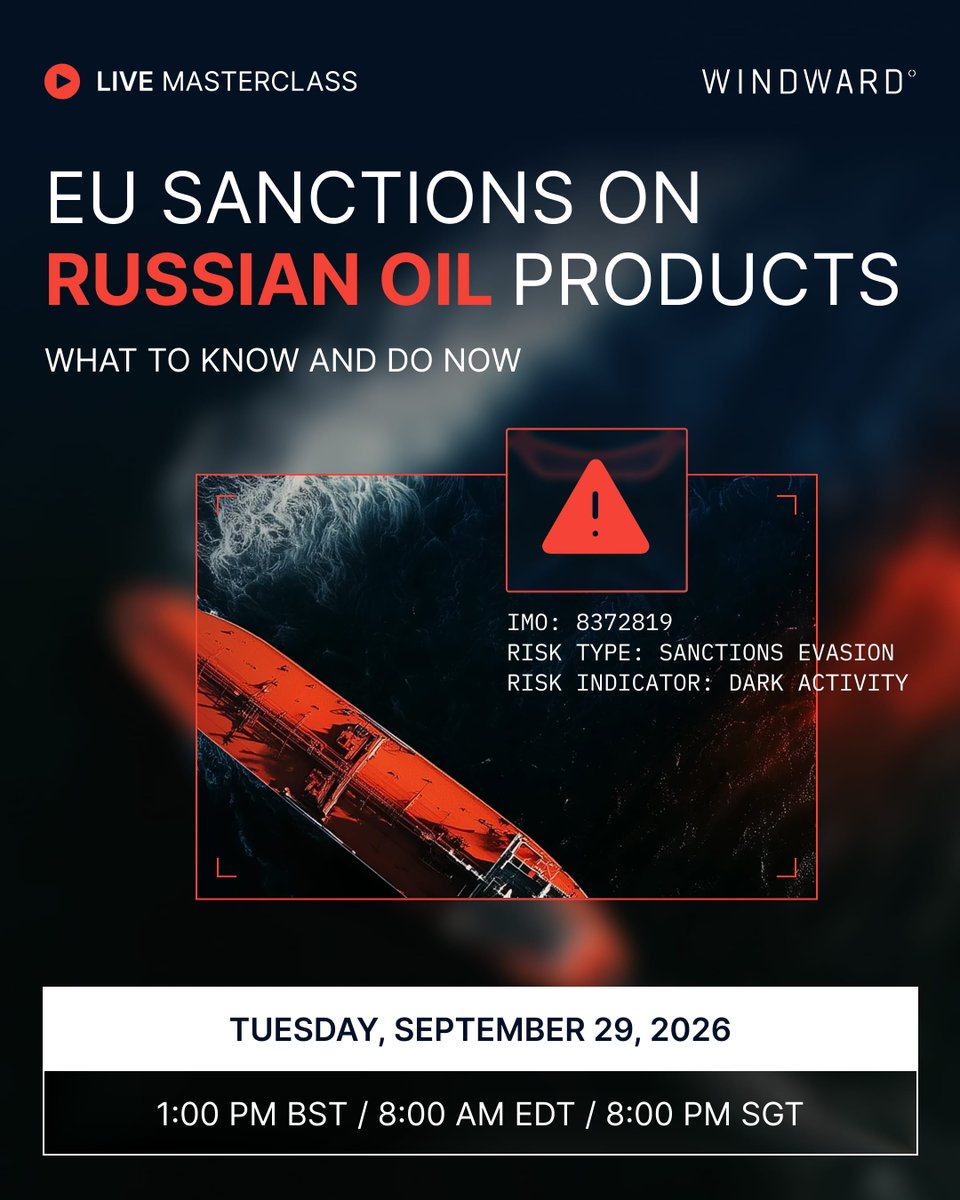
EU sanctions target refined products from Russian crude, even when refined in a third country. Windward's Michelle Wiese Bockmann (@Michellewb_) and Angela Freeth discuss what to do about it in a live masterclass, Sept 29.
Register. https://t.co/R9Sfio9oSv
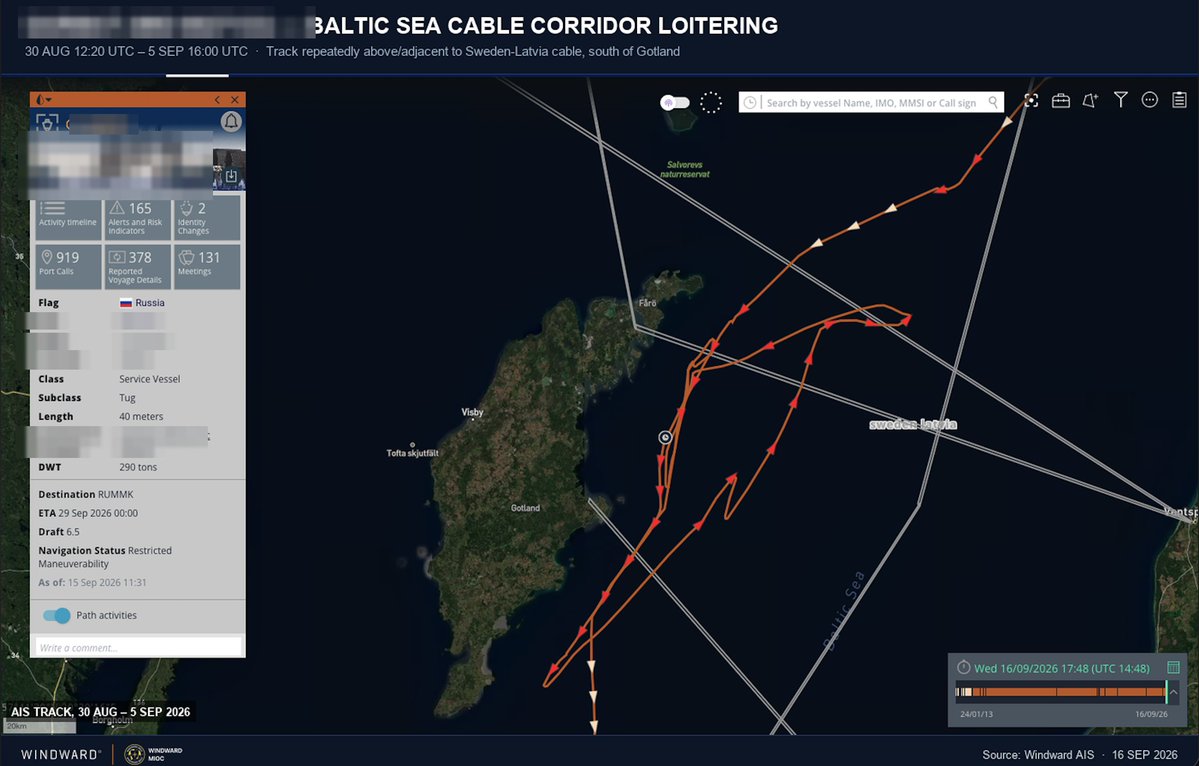
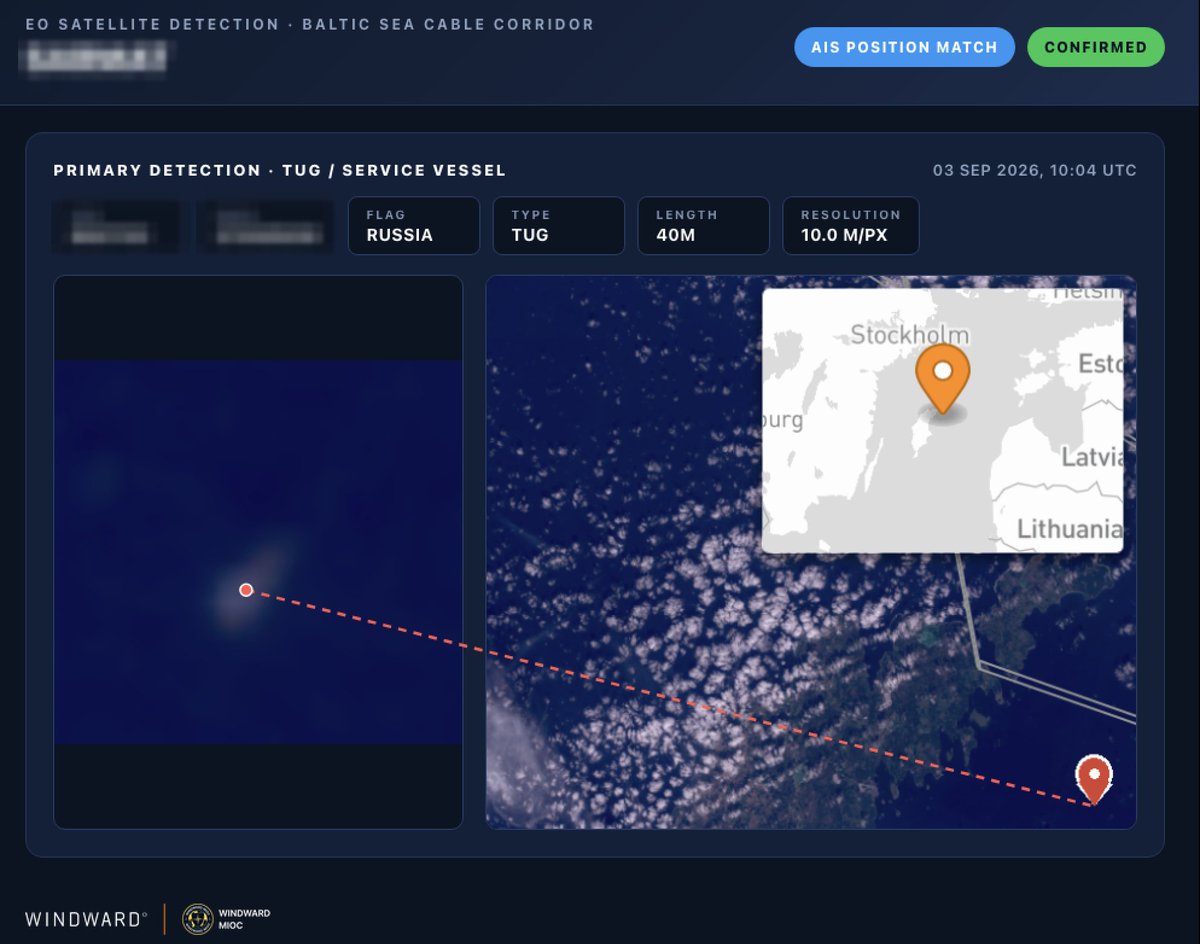
Windward's MIOC tracked a Russian-flagged tug spend 18 days shuttling between two undersea cable corridors with no commercial activity in between.
Seven days over three Baltic cables Sweden-Latvia, BCS East–West Interlink, and Latvia–Sweden 1 (the first two already damaged in 2024–2025), then four more days under 3 knots above Kattegat 1 and GlobalConnect 2, repeatedly looping back over both before heading south. Transmitted destination as Murmansk the entire time since leaving Ust-Luga.
Seabed depth is 28–80 meters, shallow enough for an anchor, a dragged grapple, or diver access. Same context behind confirmed cases like Eagle S.
Your sanctions audit trail now has to survive ten years, not five. OFAC extended its retention window in 2025. OFSI typically asks for six, and the EU currently sits at five, with room for extensions after 2027. For a program that answers to more than one of these regimes, the longest applicable clock governs.
Keeping the records is the easy part. Being able to explain them, years later, is the real test. https://t.co/qVND63QDeh
@johnkonrad@mercoglianos@johnkonrad, for what it’s worth, we’re just here to say how much we appreciate the incredible work you and your team at @gCaptain are doing to inform and educate the entire industry.
Tomorrow, Windward's MIOC analysts brief live on the Hormuz closure and the threat to Bab el-Mandeb, the Gulf's other exit.
On the agenda are anchorage tanker counts, dark STS activity, U.S. strikes on Iranian tankers, and Gulf crude diversion.
With Matthew Mueller and Michelle Wiese Bockmann (@Michellewb_).
8AM EDT / 1PM BST / 8PM SGT
Register: https://t.co/6PyWk1ApEw
Windward is tracking 14 Saudi-flagged vessels rerouting around the Cape of Good Hope instead of transiting the Bab el-Mandeb Strait, as Houthi attacks on Saudi-linked shipping in the Red Sea continue.
Since July 20, the diversions have added an estimated 140-195 extra vessel-days and $13-14M in voyage cost across the fleet, each transit running 10-14 days and roughly $0.9-1M longer than the direct route.
The willingness to absorb this scale of delay and cost reflects how seriously Saudi Arabia is taking the Houthi threat, rather than a routine commercial routing choice. Given its outsized share of global shipping and energy trade, that risk aversion is a signal worth watching beyond the Saudi fleet for what it implies about trade flows through the Red Sea corridor.
Live Red Sea and Bab el-Mandeb tracking: https://t.co/8DAi1YAeV0
On Thursday, I’ll be briefing live with my colleague @ Matt Mueller on both Gulf chokepoints: Hormuz, six months into the closure, and Bab el-Mandeb, where Houthi forces now hold strategic ports along the Yemeni coast and Perim Island.
We'll cover anchorage tanker counts and dark STS activity off Fujairah and Sohar, the U.S. strikes on Iranian tankers, daily transits vs. official claims, and where Gulf crude is being diverted.
45 minutes, then your questions.
Thursday, September 17 | 8:00 AM EDT | 1:00 PM BST | 8:00 PM SGT
Register: https://t.co/urvR4vG7BM
VLCC charter rates to transit the Strait of Hormuz were assessed at just over $1 million a day on Friday, the highest on record.
Rates were near $500,000 a day last month, climbing steadily since the U.S. military's "tanker-for-tanker" pledge saw 10 Iranian-trading tankers disabled or destroyed, with further vessels attacked by the IRGC on the route.
Freight normally runs 1-3% of the cost of moving oil. At $1 million a day, that's roughly $26 a barrel, about a quarter of the price of crude at $100/bbl, and the cost is spilling into routes that never touch Hormuz: Oman-China VLCC near $600,000/day, West Africa-China near $400,000, and an aframax shipping naphtha from the Middle East Gulf to Japan near $280,000.
Tonnage is scarce. The southern corridor now carries roughly 6.5 million barrels a day of crude, about 45% of pre-war levels excluding Iranian exports, and a five-year-old VLCC is now valued near $160 million, versus $130 million for a newbuilding. That's the premium immediately available ships can command as chokepoint vulnerability meets a need for asset security.
Live Hormuz tracking: https://t.co/u59JyYIjoQ
"These waters aren't safe," Windward's Michelle Wiese Bockmann (@Michellewb_) tells @nytimes. She calculates Gulf crude exports (excluding Iran) ran ~2/3 of prewar levels in August. U.S. forces disabled or destroyed at least eight Iranian tankers this week, as Iran hits vessels near Oman. https://t.co/U33cTqQGnQ
Six months into the Hormuz closure, the conflict has expanded to Fujairah and the Gulf of Oman. Now Houthi forces hold Perim Island and stretches of Yemen's coast at the heart of Bab el-Mandeb, the Gulf's other exit.
This Thursday, Windward's MIOC analysts brief live on anchorage tanker counts, dark STS activity, U.S. strikes on Iranian tankers, and Gulf crude diversion.
With Matthew Mueller and Michelle Wiese Bockmann (@Michellewb_).
Sept 17 | 8AM EDT / 1PM BST / 8PM SGT
Register: https://t.co/zOUnVTQhsN