Isreal IMMEDIATELY murdered 25-year-old Palestinian photojournalist Fatima Hassouna in Gaza,just one day after it was announced that her documentary,exposing what Isreal did in Gaza ,had been selected for screening at Cannes Film Festival, killing her and 20 of her family.
I had to read this over and over again to make sure I was understanding it correctly.
Israel killed three Palestinians working for World Central Kitchen today, Nov. 21, 2026.
No breaking news alerts, that’s how normalized Israel’s slaughter has become.
https://t.co/XH2S1j2r4s
Israel doesn't want you to see Palestinian faces, to hear their names, or to know that they had dreams and families who loved them.
Thank you @MahaGaza for always putting forth their faces, names, and stories.
A man who died 23 years ago may explain Palestine better than anyone on television today.
A new documentary has brought Edward Said back to life. And if you want to understand Palestine, the Western media, and why an entire people have spent generations fighting for the right to tell their own story, put this film on your must-watch list.
Edward Said: Between Worlds (2026), directed by Maiken Baird, is a 107-minute documentary unlike the usual parade of historians and experts telling us what to think.
For the first time, filmmakers were given full access to the Said family archives.
Decades of previously unseen home movies, private recordings, rare television interviews, public confrontations and lectures have been assembled into a film in which Said largely tells his own story.
It premiered at the Toronto International Film Festival, has travelled to festivals around the world and won a Special Jury Prize in São Paulo.
But who was Edward Said?
Born in Jerusalem in 1935, he became one of the twentieth century's most influential intellectuals, teaching at Columbia University and writing Orientalism, the 1978 book that exposed how the West had spent centuries inventing its own versions of Eastern peoples, describing them, classifying them and claiming intellectual authority over them.
A Palestinian telling the West that perhaps the people it had colonised understood their own existence better than their colonisers did.
And doing so with such intellectual brilliance that ignoring him became increasingly difficult.
One particularly devastating moment in the documentary takes us back to 1992.
Said returns to the Jerusalem house where he played as a little boy, captured in the family home movies his father had filmed.
The house is still there.
His childhood isn't.
And the building now houses an office of a Christian Zionist organisation.
He cannot bring himself to knock.
That single scene says more about exile than a hundred political speeches.
Said died in 2003.
He never lived to see what happened to Gaza after October 7, 2023. But he spent decades explaining how Palestinians were dispossessed not only of their land, but of the authority to describe what had happened to them.
And why their suffering so often had to be translated into language acceptable to Western audiences before it was considered worthy of attention.
That is what makes this documentary so urgently relevant.
In a world overflowing with people explaining Palestinians to everybody else, here is a Palestinian explaining himself.
No one can accuse Edward Said of having nothing to say.
The question is whether we are finally prepared to listen.
Edward Said: Between Worlds (2026). Remember the title. Watch it when you get the opportunity.
Myanmar found guilty of genocide for killing up to 10,000 Rohingyans and displacing around 700,000.
Israel has likely killed 300,000 Palestinians and displaced over 2 million. Remember that next time some idiot claims it's not genocide.
It does look like one of the NYT’s sources, the key one they relied on in their we-should-bomb-the-dams article, was scrolling Twitter or telegram and saw a map of US bombing sites in Iran and in his mind compared it to one he had made of Iran’s dams. And that was presented as evidence.
Responsible Twitter use for a journalist or expert would never allow you to even re-share a map like that if you didn’t make it or didn’t know how it was made or have any independent confidence in the source. It could just be some random kid or bot who posted a made-up map. Yet in this case the NYT wrote an entire article based on it, never shared the map itself nor discussed how they verified its accuracy, all while Trump is threatening to wipe Iranian civilization off the face of the earth.
Imagine if the NYT did something similar to Israel, suggesting that Israeli civilian infrastructure may also be used by the military and therefore is fair game for annihilation, and did so based on a random map posted by a Twitter user that they themselves didn’t even review. Just speculating.
There is a disturbing lust for violence that underpins this kind of reporting and blinds the paper, rendering it unable to even see the basic journalistic mistakes they keep making in pursuit of satisfying they lust.
Israel was forced this week to make public how much aid it has allowed into Gaza. It is resounding proof that it is committing the crime of genocide.
Since Israel agreed a ceasefire in Gaza just over a year ago, it has broken its commitment – month after month – to allow humanitarian supplies into the enclave.
A freedom of information request from the Haaretz newspaper shows that, since March, the aid trucks entering the enclave have never gotten close to the number Israel agreed was required to address the population’s basic needs.
According to the ceasefire’s terms, Israel was supposed to allow in 18,200 trucks a month, or 600 a day.
Last March, Israel let in only a quarter of that number: 4,779.
In April, only a few hundred more trucks entered. By May, half the agreed number were being allowed into Gaza. In the best month, September, Israel approved just over 13,000 trucks – 30 percent fewer shipments than it had committed to.
That did not mark a turning-point. Last month the figure fell back to just over 6,500, barely more than a third of the promised number.
Over the past eight months, there has been a shortfall of just over 74,000 trucks, representing more than half of the aid even Israel agreed a year ago was necessary to keep the population fed, sheltered and cared for.
The basic supplies the people of Gaza are being deprived of include food, fuel, medicines and medical equipment, as well as materials for building temporary shelters and repairing infrastructure.
Israel’s blockade has led to critical shortages of tents, medicines and disinfectants. Humanitarian organisations also lack the supplies needed to repair water pumps and sewage drainage systems, provide shelters and make safe damaged buildings. Even timber is refused.
The problem has become even more acute in recent weeks – just as Israel has again reduced the number of aid trucks – as winter storms have ripped across Gaza, damaging or washing away tents.
This month, some 40,000 tents, a flimsy shelter to 200,000 Palestinians, were flooded, often with waste water from overwhelmed sewage pits that is causing the further spread of disease for which there are no medicines.
According to the UN, some 150,000 tents – as well as hundreds of thousands of tarpaulins, blankets and mattresses – are stuck outside Gaza, with Israel refusing entry.
This is an extract from my latest article Under the West's watch, genocide apologism has become entirely respectable. Find a link to the rest in the reply post ⬇️
The purpose of Israel's 1954 Operation Susannah, which consisted of a covert bombing campaign against US and British targets in Egypt was not, as claimed below, to frame the Muslim Brotherhood. Rather, the objective was to implicate Egypt's new leadership, led by Gamal Abdel-Nasser.
There is convincing evidence that upon seizing power in 1952, Egypt's revolutionary leaders were not interested in confrontation with Israel and in fact sought to avoid conflict with it, because they intended to prioritise dealing with Egypt's domestic crises and to focus on the country's socio-economic development.
Israel for its part considered an Egypt that succeeded in the development of its state, economy, and society a long-term strategic threat, and therefore engaged in a program of provocations to ensure the eruption of a conflict that Cairo hoped to avoid. The objective was to divert Egypt from its domestic priorities and engage it in conflict while it was still comparatively weak.
At the time of Operation Susannah Egypt's leadership had not yet aligned with the Soviet Union and was seeking to strengthen relations with the West, and with the US in particular given the latter's economic primacy.
Operation Susannah was designed to sabotage such relations by demonstrating that Egyptians were fundamentally hostile to the West to the point of bombing US and British targets in Egypt.
The operation, for which Israel recruited Egyptian Jews rather than sending its own operatives, failed and was exposed. Needless to say Israel responded to Cairo's trials of the terrorists it arrested by launching an international campaign denouncing the prosecutions and resulting sentences as anti-Semitic Nazi blood libel bla bla bla etc etc etc by the Egyptian leadership.
Egypt's determination to hold the terrorists accountable was considered so beyond the pale that Abdel-Nasser was portrayed as "Hitler on the Nile".
Operation Susannah failed, but the provocations continued, most notably with a massive Israeli raid into the Egyptian-administered Gaza Strip on 28 February 1955 that killed nearly 40 Egyptian servicemen.
Cairo, which until then had been working to prevent Palestinian commando raids from Gaza into Israel with considerable success, succumbed to Egyptian and Palestinian popular pressure and began permitting and supporting such raids.
The writings of Israeli leaders such as Moshe Dayan make clear that the resulting conflict is precisely what Israel sought to achieve.
This culminated with the 1956 Suez Crisis, in which Israel, by its own admission, played the role of "prostitute" servicing Britain and France, and launched an invasion of Egypt and the Gaza Strip.
That gambit failed as well, and confronted with combined US and Soviet pressure, Israel was forced to withdraw from the territories it had occupied in 1957.
Israel never renounced its ambition of military confrontation with Egypt to undermine its leadership, and finally got its way in June 1967, when Israel administered a crushing defeat against the Egyptian military.
Was Egypt seeking war in 1967? Israelis such as then-military chief of staff Yitzhak Rabin are on record that Egypt had no intention of going to war, in no small part because tens of thousands of Cairo's most capable troops were at the time deployed in Yemen in support of its republican government.
It was only after the shock of the October 1973 War that Israel came to the realization that further conflict with Egypt was not in its interests, and eagerly embraced Anwar Sadat's offer of a separate peace that removed the most powerful Arab military from the regional equation.
That utterly preposterous CNN story on chemical weapons and dirty bombs, which scared Scott Bessent into a bunker, is revealed by the NYT to have been fed to us by Israel.
CNN must have known that but clearly left that detail out because it would have completely undermined the story. Everyone assumed it anyway.
Mike Johnson holding hands with Hakeem Jeffries and Chuck Schumer, chanting "We stand for Israel."
Look at this. It's the perfect picture of American politics.
All the partisan theater disappears the moment it's time to bend the knee to a foreign government. You vote for blue, you vote for red, you get AIPAC
🇵🇸 Britain, Canada, Australia and Italy acknowledge that 150,000 tents and vital supplies are being blocked from entering Gaza as winter floods devastate displaced Palestinians but offer no single measure to compel Israel to comply.
Their response is to “urge” Israel to “stop the delays.”
No deadline, consequences, or proposed penalty in a joint statement from their FMs.
After identifying Israel as the obstacle, they end by calling on “all parties” to uphold their obligations.
I’ve decided to leave NVIDIA. There are a few things I want to say.
As a robotics engineer at NVIDIA, I have seen Jensen as much more than the company’s CEO.
I admire his willingness to invest in a future that was not yet obvious. He committed to CUDA long before the deep learning boom and positioned NVIDIA for AI before it became everyone’s priority. Those decisions helped build the infrastructure that powers today’s AI.
I have seen that same vision in physical AI: investing in robotics, sharing open-source tools and projects, and building computing platforms that bring AI into the physical world. This is the work I do every day—and a future I believe in.
But what matters most to me is the culture he helped build.
Engineers are encouraged to explore, take risks, and learn from mistakes. Jensen reads employees’ Top 5 emails, follows their work, and engages directly. In a company this large, that connection matters. It makes an individual engineer feel that their ideas can still be heard.
That is why this has been so disappointing.
I do not have all the facts surrounding the allegations, and I cannot prejudge the investigation. My admiration for Jensen does not put him above scrutiny.
What I find difficult to accept is having to come to terms with his departure before receiving an explanation that helps me understand it. What this means for our direction, our culture, and the people doing the work remains unclear to me.
I have felt that engineers’ perspectives matter here. On this decision, I have not felt heard. That gap has been more painful than I expected.
I understand that some information cannot be shared immediately. But that does not erase the feeling of being left outside a decision that affects the company we help build every day.
A company’s greatness comes from its leadership, its governance, and the people who turn its ambitions into reality. Employees’ trust and sense of belonging are part of that, too.
Jensen’s vision and the engineering culture he shaped were important reasons I wanted to stay. His departure led me to decide that my own chapter here should also come to a close.
I leave with sadness and gratitude. The colleagues I have worked with, and the work we believed in together, will always matter to me.
These are my personal views.
I am Ukrainian. In '22 I naturally wanted my country to win. In '22 I was a patriot. In '22, I volunteered to the AFU.
Today, I couldn't care less. Ukraine is a shithole of bottomless corruption. The ideology is a death cult. I am not pro-Russian. I am pro-sanity. I do not care.
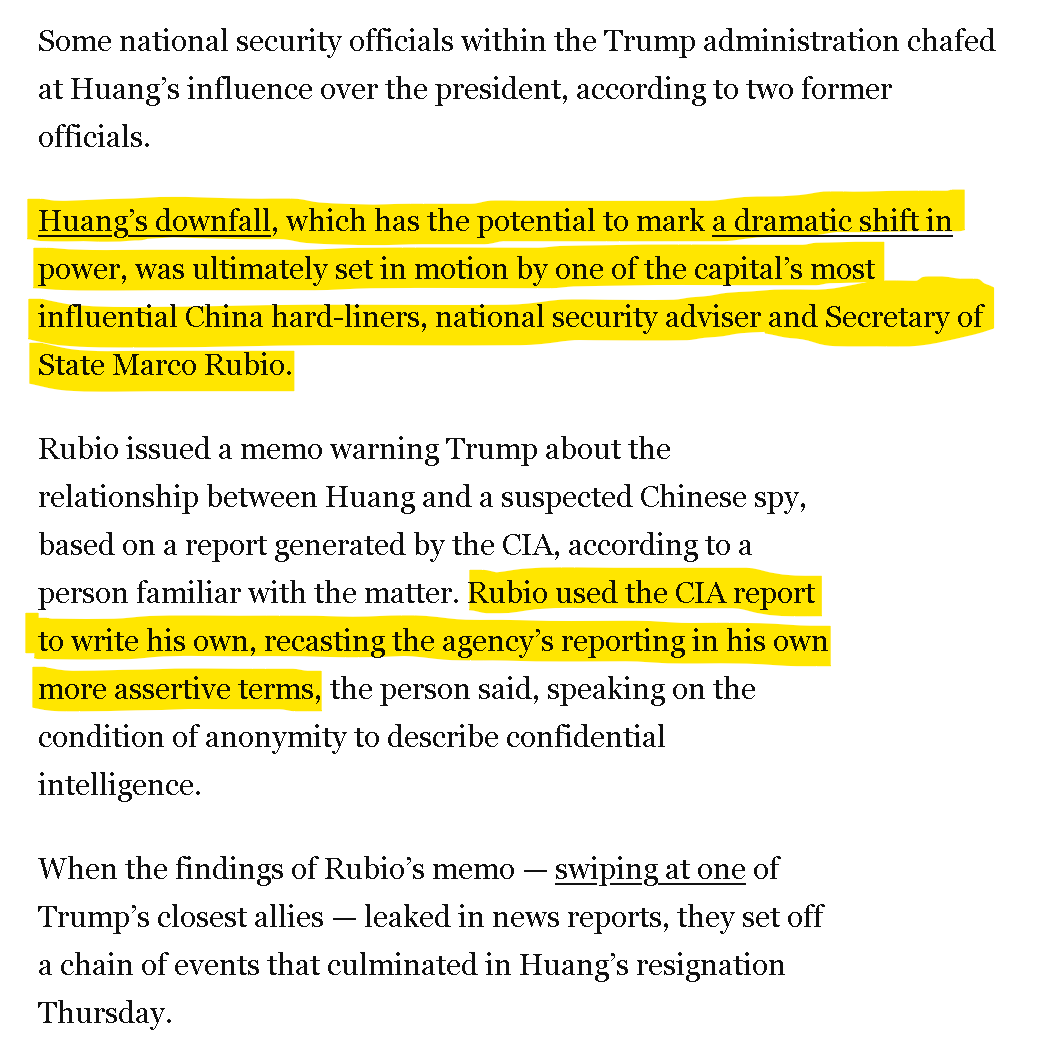
Interesting: the Washington Post says that Jensen Huang's downfall was Marco Rubio's doing (https://t.co/4YahEGer9Q), and it looks like the "spy" framing was directly his and not the CIA's.
As they write, Rubio took a CIA report and rewrote it in a memo "in his own more assertive terms."
Which fits neatly with CNN reporting that the CIA is "not yet convinced" that Alice Huang was a spy (https://t.co/Cd5PTbKqfG): if the CIA is not convinced, yet a memo rewritten from the CIA’s own report presented her as a spy, then there’s only one person who could have turned "not convinced" into "spy": the man who did the "more assertive" rewriting, aka Marco Rubio 🤷
The WaPo article also mentions the motive: China hawks like Rubio had spent years trying to "destroy the influence Jensen had over the president", and WaPo calls his ouster "a huge victory" for them as it allows them to "seize on the moment to redirect the national agenda toward tougher policies on China."
And, as a matter of fact, they’re already pushing three new chip-restriction bills into the defense bill now that Jensen is no longer around to lobby against them.
If true, it means the real "influence operation" targeting Jensen was run out of Washington, not Beijing 🤷
Obviously, not learning the language, the culture and history (academically) of the region is a huge deficiency in writing a book on the history of the Middle East (regarding Simon Sebag Montefiore’s “The Cauldron: the Making of the Modern Middle East, 1900-2026”). What he says below is not true: there was a very early reference to Palestinian “Filastini” as an personal identity in the work of the Arab geographer, Shams Ad-Din Al-Muqaddasi (d. 991 AD), in his book Ahsan At-Taqasim fi Ma`rifat Al-Aqalim, when he self identifies as “Ana Filastini”).