There are a lot of people who struggle to face facts pragmatically.
If I have a set of objectives in a war and achieve none of them, the conclusion is obvious: I lost the war. That is what happened to Trump and Netanyahu.
Right now another strategy of economic asphyxiation is underway and it may prove far more effective, but the military option tried in February was indeed disastrous, not because of the military capabilities of those two countries, but because of disastrous planning based on completely inaccurate premises.
There is no way Iran can defeat the American Navy or Air Force, but if the command structures are politicized and the planning is poor, defeat follows.
Then yesterday someone told me: “The Iranian nuclear program is buried.”
You know what? I agreed. It is indeed buried inside the mountains and enriching uranium.
Because so far there is not a single piece of evidence that it has been compromised beyond the surface structures.
The damage to Iran is $250–450 billion. Roughly the same size as, or smaller than, the costs and losses of the US, Israel, and the GCC.
And in the current scenario, with the Houthi front, the economic losses of the GCC could approach $1 trillion by 2030.
With comparable damage and both Iran and the GCC under blockage, what were the gains of this war?
Some will say: “America needs to destroy its enemies.”
The problem is that there is not infinite ammunition, money, or political support for that.
Wars are won and they are also lost, opening space for other fronts.
Part 2
Although exact figures remain classified, cross-referencing U.S.-approved arms sales over the past decade (2015–2026) against the tempo of airstrikes in Yemen indicates that Saudi Arabia’s current physical inventory of air-to-ground guided munitions sits at a critical floor of just 4,000 to 8,000 ready-to-use units.
That number is dangerously low and forces Riyadh to virtually halt bombing runs, as it must preserve reserves for a far more existential threat: direct confrontation inside its own territory and potential hostilities with Iran.
The Kingdom has placed an order for 30,004 new munitions, alongside the release of 3,000 GBU-39 bombs that had been frozen since 2021. Because these deals were only finalized in recent months, deliveries from U.S will not begin arriving until 2027. And offensive strike munitions are not the only bottleneck.
Recent reports indicate that Saudi Arabia has burned through roughly 86% of its Patriot PAC-3 missile inventory, about 2,400 out of 2,800 units, during recent regional clashes, leaving roughly 400 interceptors ready.
Since those batteries have been actively defending facilities on Saudi soil over the past three months, that stockpile has likely dropped closer to 300 Patriots today.
Without Saudi air cover, the Houthis will very likely recapture all of Yemeni territory in the coming months, unless the Emirates decide to enter the war directly, or Trump steps in to expedite guided-bomb deliveries to Riyadh.
Yet that is no easy call, given that production lines for these munitions move slowly and U.S. stockpiles are themselves strained following the conflict with Iran.
Surprisingly enough, Iran may be on the verge of securing another major strategic victory simply by attriting its adversaries’ ammunition.
* Over the past decade (2015–2026), Saudi Arabia purchased roughly 69,300 guided munitions and physically received between 49,000 and 53,000 (including pre-2015 reserves). With an estimated expenditure of 45,800 to 63,900 units across its bombing campaigns in Yemen, the Kingdom has consumed virtually everything it received and is operating today at its safety floor, with just 4,000 to 8,000 units ready in its depots.
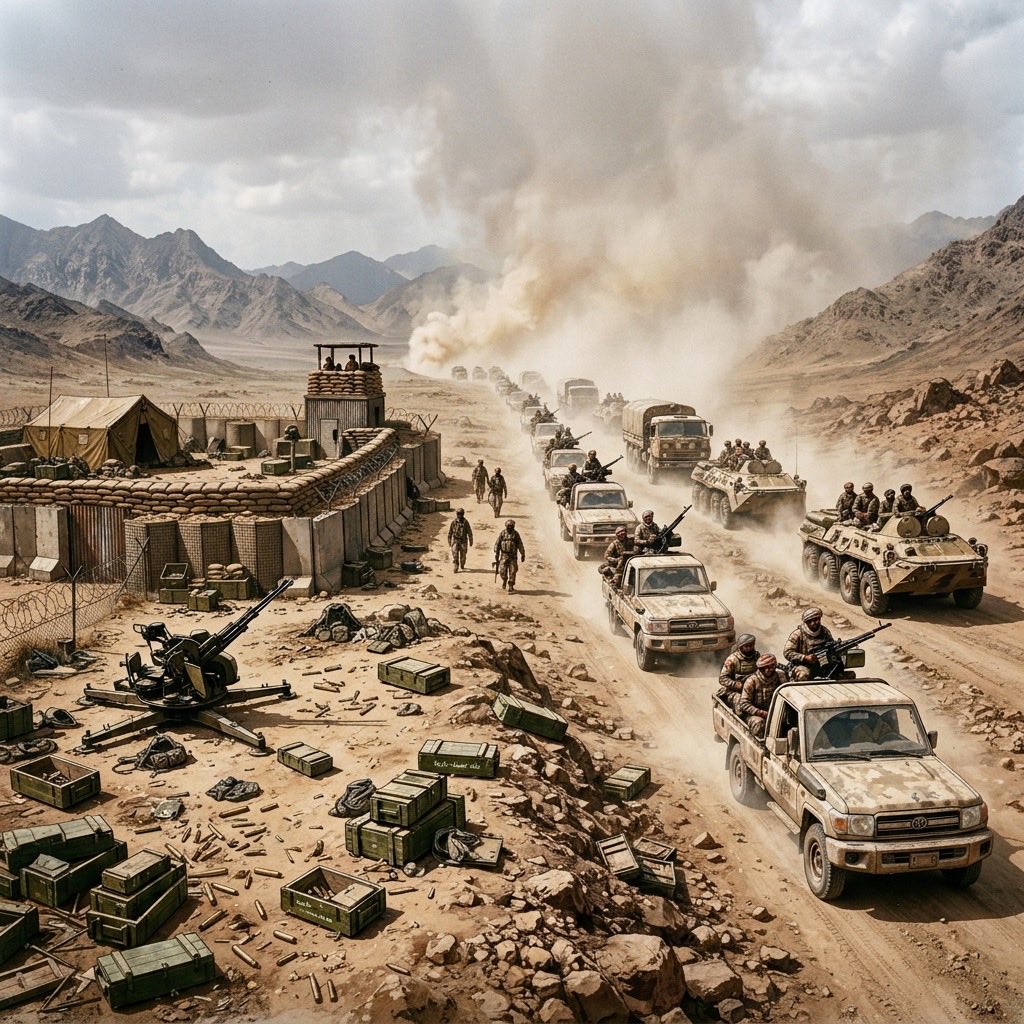
Saudis Run Out of Munitions as Houthis Advance in Large Convoys
The Houthis are advancing toward Aden, the interim capital of Yemen's internationally recognized government, following a resumption of hostilities that shattered a nearly four-year truce.
The Yemeni group has consolidated control over strategic areas surrounding the Bab el-Mandeb Strait, a vital chokepoint for global trade in the Red Sea, after government and Saudi-allied forces pulled back to concentrate troops on the defense of Aden.
To the south, the siege of Taiz is severely compromising critical supply routes for local forces, with no signs of letting up.
Meanwhile, the major Saudi-backed offensive of 100,000 Yemeni troops received only minimal support from the Emirates, ultimately forcing Riyadh into negotiations to limit strikes against its petrochemical complex, agreements that included the participation of Iran, the primary architect behind the renewed conflict in Yemen.
Much of the Houthis' momentum stems from their massive drone strategy. While this includes mini-drones carried by infantry units, it relies primarily on Iranian backing with reconnaissance and combat UAVs, such as the Qasef-1 and Qasef-2K, derived from the Iranian Ababil line, and the Samad-1 and Samad-2, both Iranian designs tailored for Yemen.
The Qasef-1 and Qasef-2K are the drones making the greatest impact on ground combat in southern Yemen. With a range of up to 150 km and a 30 kg warhead, the Qasef-2K variant was modified to detonate mid-air roughly 20 meters above its target, showering shrapnel down onto trenches, artillery, and concentrations of government troops.
While drones and missiles contribute heavily to Houthi superiority, the decisive factor behind their rapid advance is that the war's primary game-changer, the Royal Saudi Air Force, now has its munitions on a strict countdown.
That explains why the Houthis have begun moving far more aggressively in larger convoys across the open desert.
Since the war resumed in July 2026, the Saudi-led coalition has carried out more than 5,300 airstrikes in Yemen.
By the operational standards of modern air campaigns, 5,300 airstrikes translate to an estimated expenditure of 8,000 to 13,200 guided munitions, based on a typical burn rate of 1.5 to 2.5 bombs or missiles per strike. In practice, fighters like the F-15SA and the Eurofighter Typhoon routinely drop pairs of bombs to guarantee target destruction, especially against trenches, ammo depots, and fortified positions.
Under a higher-intensity scenario of up to 4 munitions per strike, that expenditure climbs to 21,200 ordnance units, a realistic figure when missions require salvo strikes against sprawling convoys, port infrastructure like Hodeida, or dispersed launch batteries.
So, what proves the Saudis are scraping the bottom of their stockpiles?
Read the full article:
https://t.co/3PtltIsM9V